Which Cutting Disc Fits Your Project? A Practical Matching Guide for Metal & Stainless Steel Work
Which Cutting Disc Fits Your Project? A Practical Matching Guide for Metal & Stainless Steel Work
Choosing a cutting disc is not about picking the cheapest or most popular model — it is about matching the disc to the actual job. Four variables decide whether a disc performs well: the workpiece material, the disc diameter and bore, the disc thickness, and the maximum speed of the machine that drives it. Change any one of these, and the same disc can go from fast and clean to slow, overheated, and unsafe.
This guide maps CNDOME's cutting disc and grinding wheel range — from 1.5-inch mini discs for hobby grinders to 16-inch industrial cut-off discs — to the project conditions they serve. It is written for workshop supervisors, purchasing staff, and distributors who need a practical reference for selecting discs across metal fabrication, steel structure work, shipyard processing, and stainless steel applications.
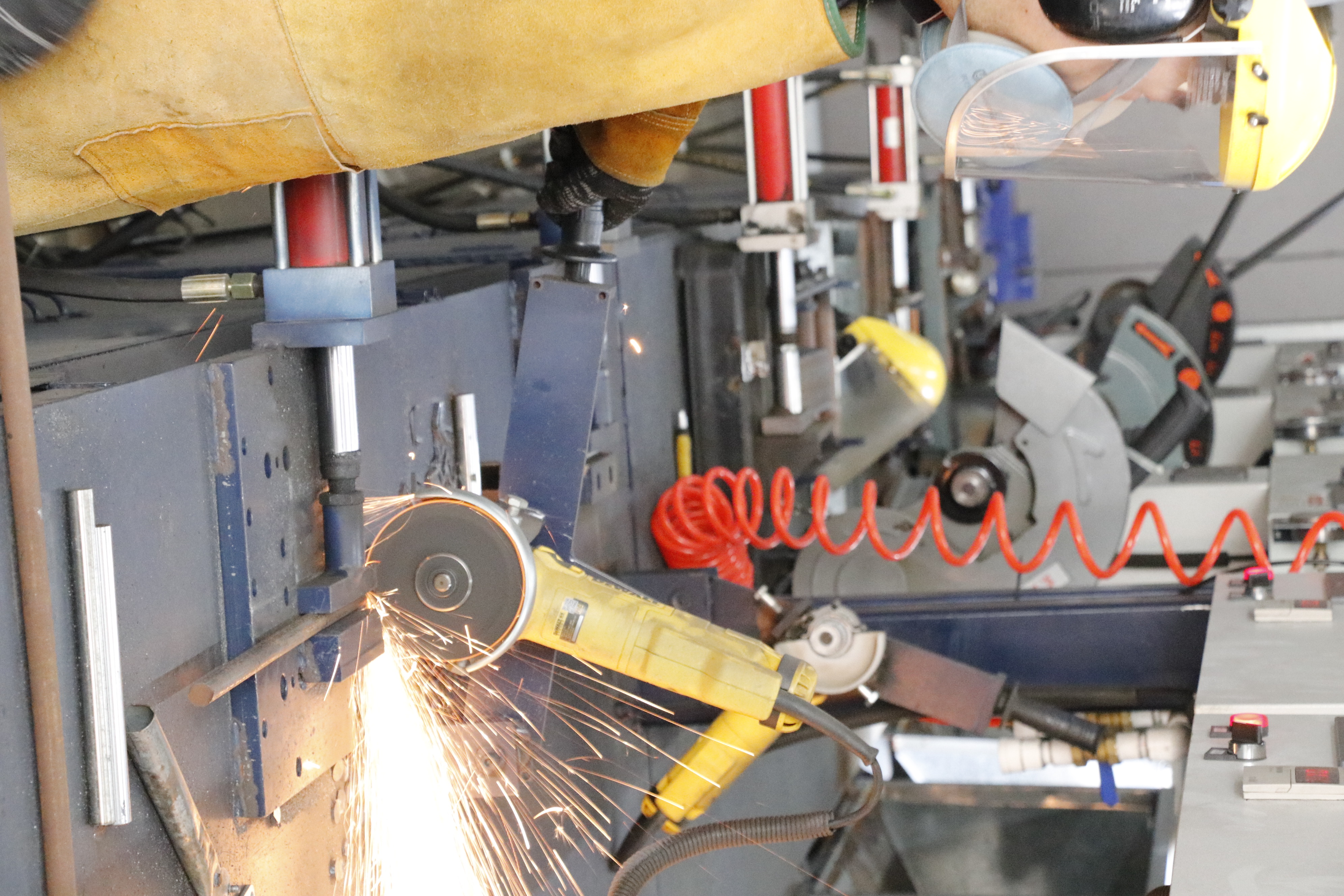
Matching the disc to the job starts with the workpiece: cutting steel bars on site.
Why a Wrongly Matched Cutting Disc Fails
When a cutting disc does not match the job, the symptoms are consistent: low efficiency, poor precision, edge chipping, heat generation, blueing during cutting, high dust, and low yield. These are usually matching failures, not tool defects. The disc may be too thick for a clean cut, too small for the machine, or not designed for the material being processed.
The conditions that cause these problems vary widely. Mechanical processing manufacturers, metal cutting engineering shops, steel structure fabricators, shipyards, and home DIY users place very different demands on the same consumable. A 1.5-inch disc that is ideal for cutting thin wire in a DIY workshop will not survive a shipyard's steel plates. A 16-inch disc that handles foundry castings is useless on a handheld angle grinder.
The practical conclusion is that there is no universal cutting disc. There are only discs whose speed rating, shape, and reinforcement match a specific machine, combined with grains and bonds that suit a specific workpiece. Once this is accepted, selection becomes a repeatable process instead of a guess.
The Cutting Disc Market: What Buyers Should Know Before Choosing
Market context helps explain why selection errors are costly. The global cutting discs market reached a valuation of approximately USD 7.32 billion in 2024, according to Market Research Future. Some estimates range from USD 2.5 billion to USD 5.1 billion depending on whether the research covers only disc consumables or the broader cutting equipment sector. Asia-Pacific accounted for 48.28% of global revenue in the cutting equipment and tools sector in 2025, making it the largest regional market, according to Mordor Intelligence. Within the product mix, stainless steel cutting discs are identified as the dominating category, driven by demand from construction and automotive manufacturing (Cognitive Market Research).
The supply side is equally significant. The China abrasives market was valued at USD 2.29 billion in 2024, with synthetic raw materials contributing USD 1.35 billion (Intel Market Research). This is the environment in which manufacturers such as Changzhou Dome Abrasives Manufacture Co., Ltd. (CNDOME) operate. CNDOME has developed and manufactured resin-bonded cutting and grinding wheels for more than 26 years, providing OEM and ODM services to more than 2,000 global tool and professional abrasive wheel brands. Its temperature- and humidity-controlled workshop covers more than 20,000 m², equipped with 60 automated production lines and a daily output of about 600,000 pieces. Around 80% of output is exported, mainly to Latin America, Europe, Africa, and Asia.
Safety frameworks also shape project selection. The European standard EN 12413:2019 specifies the safety requirements and testing procedures for rotating bonded abrasive products, including cutting and grinding wheels. Independent testing bodies such as MPA Hannover provide safety testing and certification for abrasive tools — a key requirement for exporting industrial cutting discs to the EU market. For a buyer, compliance documentation should be verified before a disc is approved for a project, not after.
CNDOME Cutting Disc Range: Sizes, Shapes, and Materials by Project
Portable cutting discs for angle grinders (1.5–5 inches)
For handheld work, the small-format range is built around T41 flat discs rated at 80 m/s:
- 1.5-inch cutting disc (38x1.1x3): 45,000 RPM — mini grinders, home DIY, light metal and INOX cutting.
- 2-inch cutting disc (50x1.2x10 / 50x2x10): 30,100 RPM — small-part cutting for metal and INOX.
- 3-inch cutting disc (75x1.2x10 / 76x1.0x10): 20,100 RPM — small workshops and DIY.
- 4-inch cutting disc (107x1.2x16 / 100x1.0x16): 15,400 RPM — standard angle grinder cutting for metal and INOX.
- 4.5-inch cutting disc (115x1.2x22.23 / 115x1.6x22.23): 13,300 RPM — the most common portable size for metal and stainless steel.
- 5-inch cutting disc (125x1.2 / 1.6 / 2 / 3 x22.23): 12,200 RPM, available in T41 and T42 shapes.
These portable discs are made from aluminium oxide, white aluminium oxide, and resin. The 5-inch version also offers silicon carbide and zirconium options for higher-strength materials. Reinforced construction keeps the wheel stable at high speed and reduces breakage risk during handheld work.
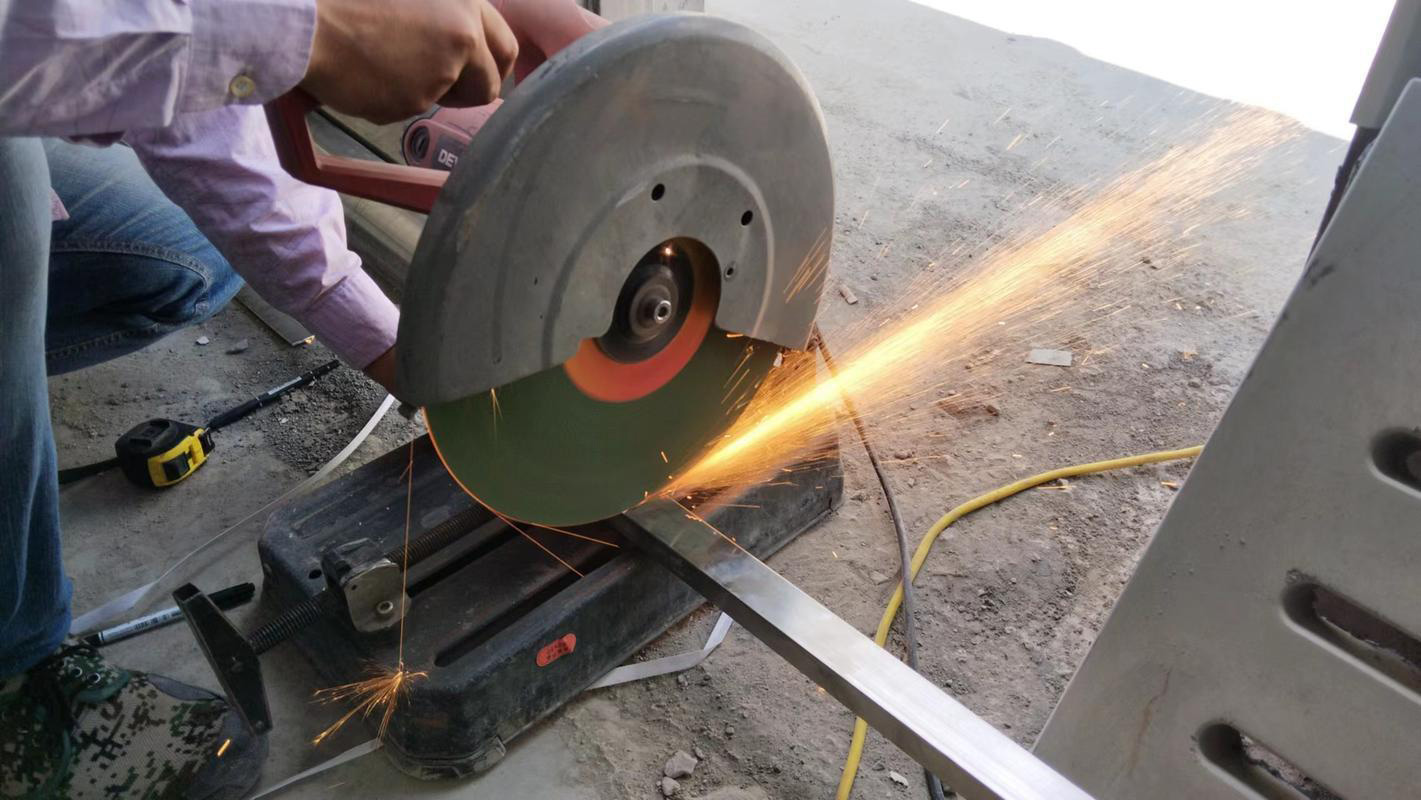
Stainless steel cutting calls for discs matched to the alloy; thin profiles reduce blueing.
Heavy portable and stationary cutting discs (7–16 inches)
Larger projects require larger discs with higher edge strength:
- 7-inch cutting disc (180x1.6 / 2 / 3 x22.23): 8,500 RPM, T41. Materials include aluminium oxide, white aluminium oxide, resin, silicon carbide, and zirconium. The typical project base is steel and metal processing, automobile manufacturing, shipbuilding, casting, steel structures, and construction.
- 9-inch cutting disc (230x2.0 / 2.5 / 3.0 x22.23): 6,600 RPM, T41/T42 — heavy cutting on steel structures and shipyard plates.
- 14-inch cutting disc (355x3.2x25.4): 4,400 RPM, T41. This disc has a diameter of 355 mm, a thickness of 3.2 mm, and a bore of 25.4 mm. It is made of aluminium oxide, white aluminium oxide, and resin, and is typically matched to stationary cutting machines and pipe or bar cutting.
- 16-inch cutting disc (400x3.5x32): 3,800 RPM, T41 — industrial stationary cutting and foundry work.
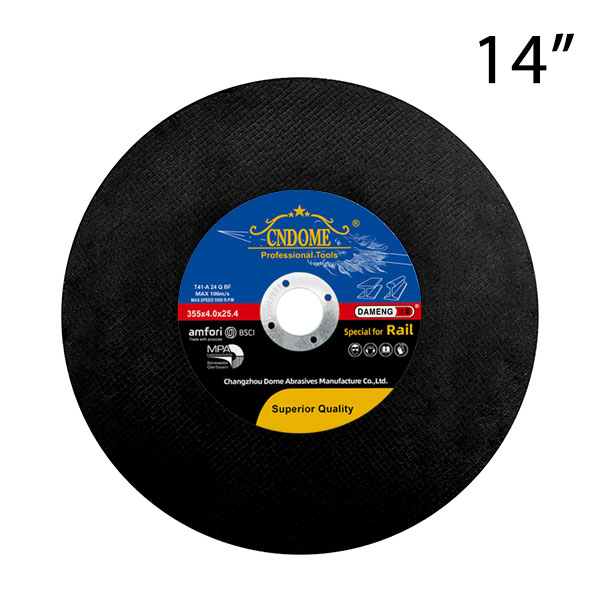
14-inch cutting disc: a stationary-machine format for large-section metal.
Grinding wheels and ceramic grinding discs
Not every job is a cutting job. For surface grinding, weld dressing, and scale removal, CNDOME offers T27 grinding wheels in 4-inch (100x6x16), 4.5/5-inch (115/125x6x22.23), 6/7-inch (150/180x6x22.23), and 9-inch (230x6x22.23) formats, all rated at 80 m/s. They are made from aluminium oxide, white aluminium oxide, and resin, and are used in steel and metal processing, shipbuilding, casting, steel structure, and construction.
For hard-to-process steel and stainless steel, the ceramic grinding disc range covers 115x22.23 and 125x22.23 models in T29 shape, rated at 100 m/s. The ceramic construction — ceramic sandpaper over a reinforced fiber cover plate — suits steel, metal processing, automobile manufacturing, shipbuilding, casting, steel structure, and construction projects that demand faster stock removal.
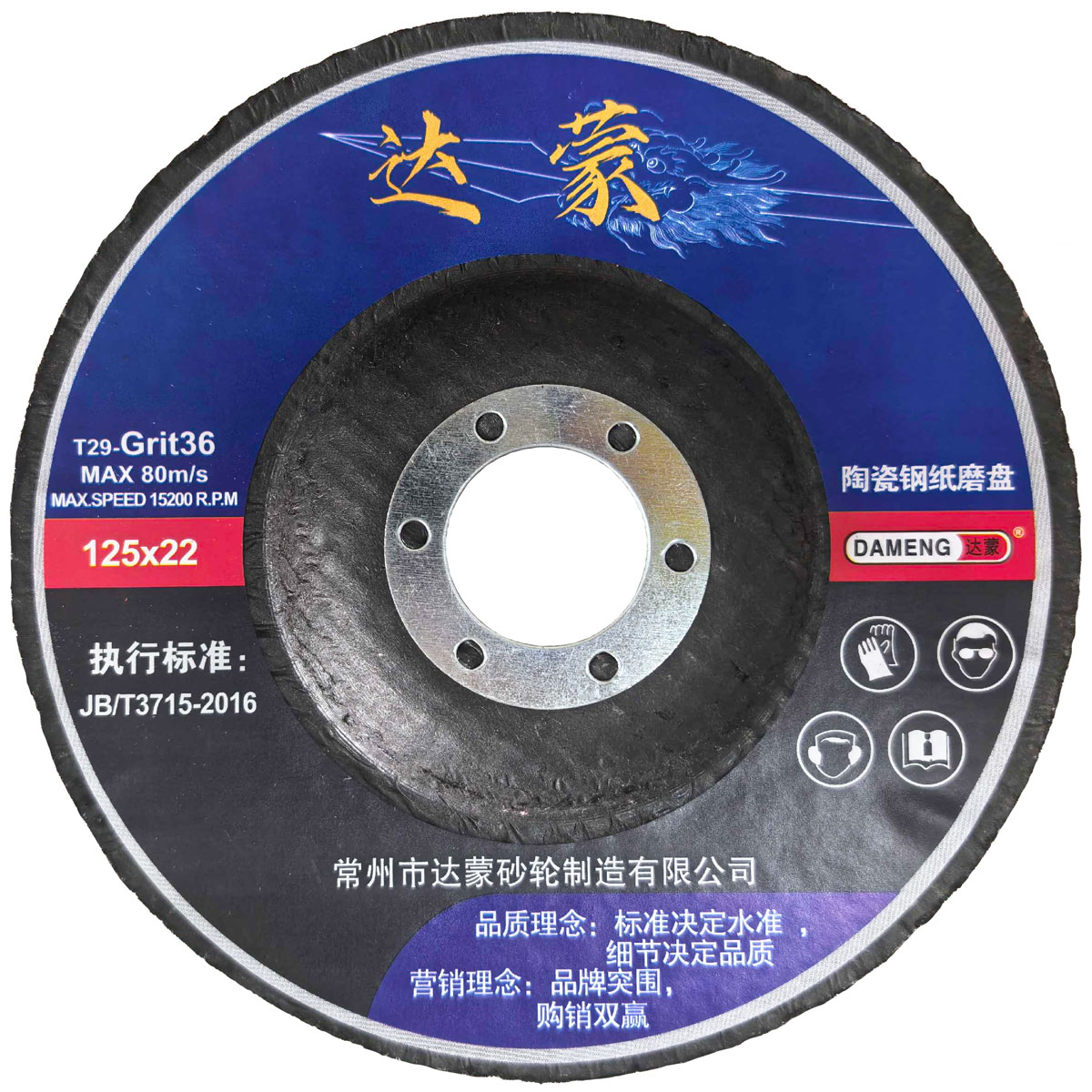
Ceramic grinding disc: T29 shape, 100 m/s, for hard-to-process steel.
How to Match a Cutting Disc to a Project in 5 Steps
Step 1 — Identify the workpiece material. Mild steel, stainless steel, castings, rails, and thin sheet each behave differently. General steel cutting is well served by aluminium oxide and white aluminium oxide discs. For stainless steel and higher-strength alloys, select discs that add silicon carbide or zirconium — available on the 5-inch and 7-inch cutting wheel lines. For scale-covered or hard surfaces, a ceramic grinding disc (T29, 100 m/s) is the better match.
Step 2 — Match disc diameter and bore to the machine. The disc must fit the arbor, guard, and power of the machine. Common bores in the CNDOME range are 10 mm (1.5–3 inch discs), 16 mm (4 inch), 22.23 mm (4.5–9 inch discs and grinding wheels), 25.4 mm (14 inch), and 32 mm (16 inch). If the bore does not match the arbor, use the correct adapter — never force a smaller bore onto a larger arbor.
Step 3 — Choose thickness by cut quality versus disc life. Ultra-thin discs (1.0–1.2 mm) cut faster with less material loss, generate less heat, and produce cleaner edges — a strong match for stainless steel and burr-free requirements. Mid-thickness discs (1.6–2.0 mm) balance speed and durability for general workshop work. Thicker discs (2.5–3.5 mm) provide longer life and higher edge strength for heavy structural work and stationary cut-off machines.
Step 4 — Select the shape for the operation. T41 is a flat cutting disc for straight cuts. T42 adds a raised hub, used on 5-inch and 9-inch cutting discs. T27 is a depressed-center grinding wheel for surface grinding and weld dressing. T29 is the high-performance shape used on ceramic grinding discs. Using a grinding wheel for cutting, or a cutting disc for grinding, is a safety risk — keep the shape matched to the task.
Step 5 — Verify the speed rating against the machine's RPM. All CNDOME cutting and grinding wheels listed in this guide are rated at 80 m/s maximum, except the ceramic grinding discs, which are rated at 100 m/s. Check that the machine's no-load RPM does not exceed the disc rating — for example, 13,300 RPM for 4.5-inch discs, 6,600 RPM for 9-inch discs, and 3,800 RPM for 16-inch discs. Speed matching is a safety requirement, not a performance preference.
Project Match in Practice: Five Sourcing Patterns
Five patterns from CNDOME's case records show how disc selection scales across business types:
1. Stainless steel pipe processor (Latin America): 500,000 pieces per year. This stainless processing manufacturer cuts and polishes the outer and inner walls of stainless steel pipes. The key requirements were long grinding disc life, no slag shedding, and high safety. Over a three-year period, the discs have been used stably in the production workshop, with small-batch customization and timely supply matched to production needs.
2. Machining factory (Asia): 30 orders per year. A machining factory cuts and polishes iron and stainless steel parts across 24-hour shifts. Because the factory needs multiple specifications and models at short notice, inventory depth is the deciding criterion: the supplier keeps ample stock of frequent sizes, ready to ship at any time.
3. Tool supermarket (Mexico, United States, South America): 40 million pieces per year. This pattern covers a full range from 3 to 14 inches sold through tool supermarkets and offline hardware stores, serving both home DIY and professional metalworking. The buying decision is driven by long service life, fast cutting, low noise, burr-free edges, complete model coverage, and packaging quality.
4. Tool brand OEM (Brazil): 10 million pieces per year. A Brazilian tool brand sells CNDOME-produced discs through offline hardware stores. The case record reports high sharpness on both iron and stainless steel, high safety, and stable performance, supporting the brand's position as the largest tool brand in the Brazilian market.
5. Cross-border e-commerce and foreign trade (90+ countries): about 60 orders per year. CNDOME provides product development and private-label services to brand owners, including Fortune 500 companies, whose discs are sold on Amazon, eBay, AliExpress, Walmart, Shopee, Lazada, TEMU, TikTok, and Shopify. Both small and large batches can be customized, and abrasive formulations can be adjusted to meet different cutting and polishing requirements.
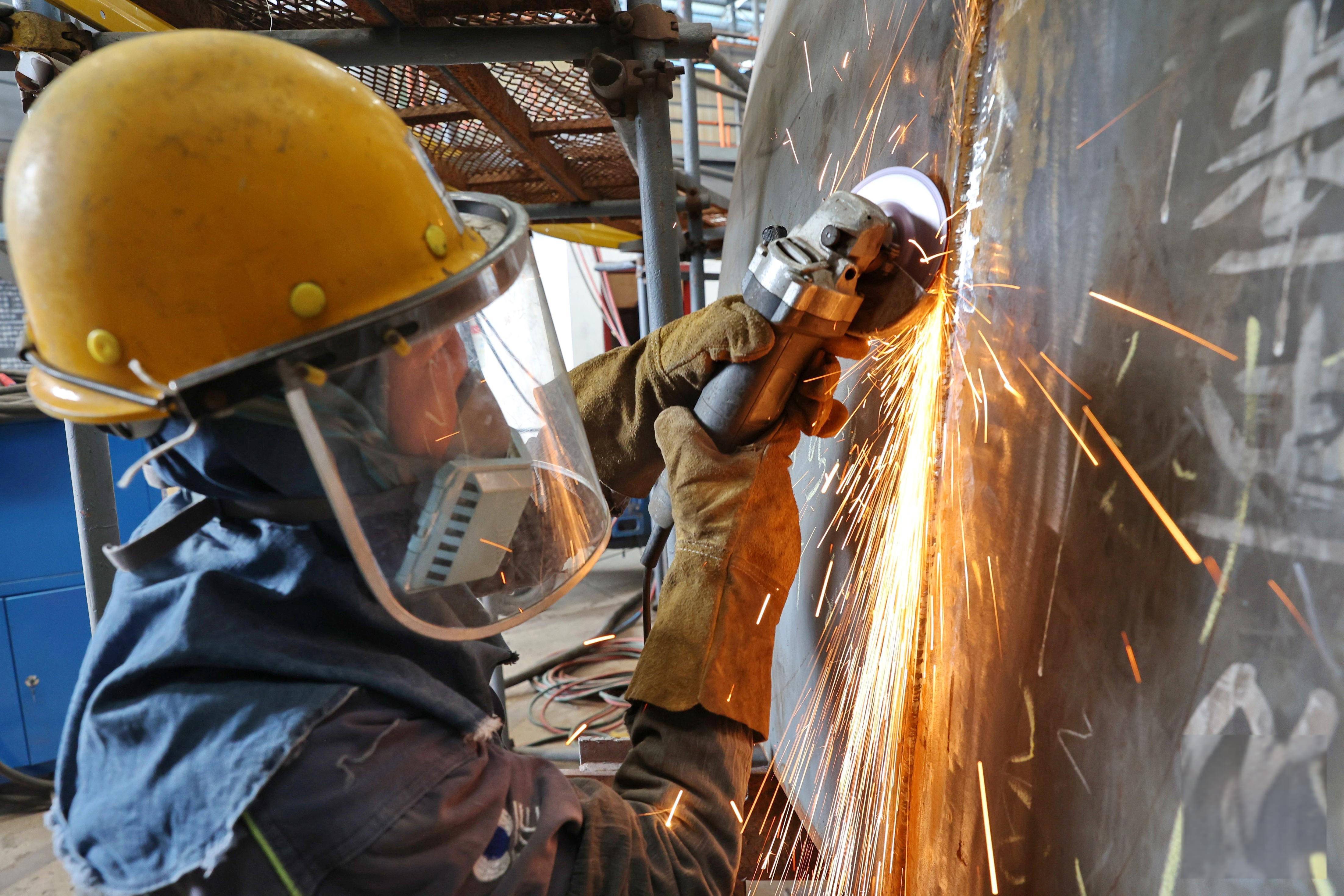
Shipyard processing is a typical project base for 7-inch and 9-inch wheels.
Cutting Disc vs. Project Type: Quick Reference Table
The table below summarizes which CNDOME disc matches common project conditions. All cutting and grinding wheels in the table are resin-bonded products.
| Disc type | Models (mm) | Shape | Max speed | Typical project match |
|---|---|---|---|---|
| 3-inch cutting disc | 75x1.2x10 / 76x1.0x10 | T41 | 80 m/s, 20,100 RPM | Small workshops, home DIY, metal/INOX |
| 4-inch cutting disc | 107x1.2x16 / 100x1.0x16 | T41 | 80 m/s, 15,400 RPM | Angle grinder cutting of metal/INOX |
| 4.5-inch cutting disc | 115x1.2x22.23 / 115x1.6x22.23 | T41 | 80 m/s, 13,300 RPM | General metal and stainless steel cutting |
| 5-inch cutting disc | 125x1.2 / 1.6 / 2 / 3 x22.23 | T41 / T42 | 80 m/s, 12,200 RPM | Steel and stainless steel, higher-strength alloys |
| 7-inch cutting disc | 180x1.6 / 2 / 3 x22.23 | T41 | 80 m/s, 8,500 RPM | Shipyard, casting, steel structure, automotive |
| 9-inch cutting disc | 230x2.0 / 2.5 / 3.0 x22.23 | T41 / T42 | 80 m/s, 6,600 RPM | Heavy structural cutting |
| 14-inch cutting disc | 355x3.2x25.4 | T41 | 80 m/s, 4,400 RPM | Stationary cut-off machines, pipe and bar cutting |
| 16-inch cutting disc | 400x3.5x32 | T41 | 80 m/s, 3,800 RPM | Industrial stationary cutting, foundry |
| Grinding wheel | 100 / 115 / 125 x6 x16 / 22.23 | T27 | 80 m/s | Grinding, weld dressing on steel |
| 6/7-inch grinding wheel | 150 / 180 x6 x22.23 | T27 | 80 m/s | Steel fabrication, shipyard grinding |
| 9-inch grinding wheel | 230x6x22.23 | T27 | 80 m/s | Heavy surface grinding |
| Ceramic grinding disc | 115 / 125 x22.23 | T29 | 100 m/s | Hard-to-process steel, automotive, casting, shipbuilding |
Notes: the 5-inch and 7-inch cutting discs add silicon carbide and zirconium options to the basic aluminium oxide / white aluminium oxide / resin formula. The ceramic grinding disc uses ceramic sandpaper over a reinforced fiber cover plate.
Frequently Asked Questions
Q: Do CNDOME cutting discs comply with EN 12413 and MPA requirements for EU projects?
EN 12413:2019 specifies the safety requirements and testing procedures for rotating bonded abrasive products, including cutting and grinding wheels sold in the EU. MPA Hannover provides independent safety testing and certification for abrasive tools, which is a key requirement for exporting industrial cutting discs to the European market. CNDOME operates a temperature- and humidity-controlled workshop and applies 100% AI Visual Comparison Testing in its quality control. For project-specific compliance documentation, contact the factory directly through its 24/7 online support.
Q: Can CNDOME customize cutting discs for a specific project or branded product line?
Yes. CNDOME specializes in OEM and ODM services, with customization options that cover logo, label, package, abrasive formulation, and specification. The same product base can be adjusted to meet different cutting and polishing requirements, and both small and large batches can be customized. CNDOME has provided long-term support to more than 2,000 global tool and professional abrasive wheel brands.
Q: What is the minimum order quantity for customized cutting discs?
For custom cutting discs — including private-label or formulation-adjusted products — the MOQ is 10,000 pieces or more. The factory's monthly capacity is 8 million pieces, with a daily output of about 600,000 pieces across 60 automated production lines, so larger project programs can be supported without difficulty.
Q: Can I test a cutting disc on my own project before placing a bulk order?
The most reliable way to match a disc to a project is to test it under your own working conditions. Contact CNDOME's 24/7 online support or email chris@czdome.com to discuss sample needs, workpiece material, and the grinder or cut-off machine you use. Remote technical assistance is available to help confirm the right specification before sampling.
Q: What is the lead time for cutting disc production and delivery?
The lead time for custom cutting disc orders is approximately 30 days. This is supported by a monthly capacity of 8 million pieces, 60 automated production lines, and warehouse stock for frequently ordered specifications. These factors help distributors and manufacturers maintain stable replenishment for continuous projects.
Build a Repeatable Disc Selection Process
Project-to-disc matching is a repeatable process: identify the material, match the size and bore to the machine, choose thickness by cut quality, select the correct shape, and verify the speed rating. Applying these five steps consistently reduces waste, speeds up work, and lowers the risk of premature disc failure — on a construction site, in a shipyard, or on a DIY bench.
CNDOME (Changzhou Dome Abrasives Manufacture Co., Ltd.) supports this process with more than 26 years of resin-bonded cutting and grinding wheel manufacturing, 60 automated production lines, and a daily output of about 600,000 pieces. The product range covers cutting discs from 1.5 to 16 inches, grinding wheels up to 9 inches, and ceramic grinding discs — with OEM/ODM customization of logo, label, packaging, abrasive formulation, and specification.
If you are evaluating discs for a specific project or product line, the practical next step is to review the factory brochure and confirm the specification with the manufacturer.
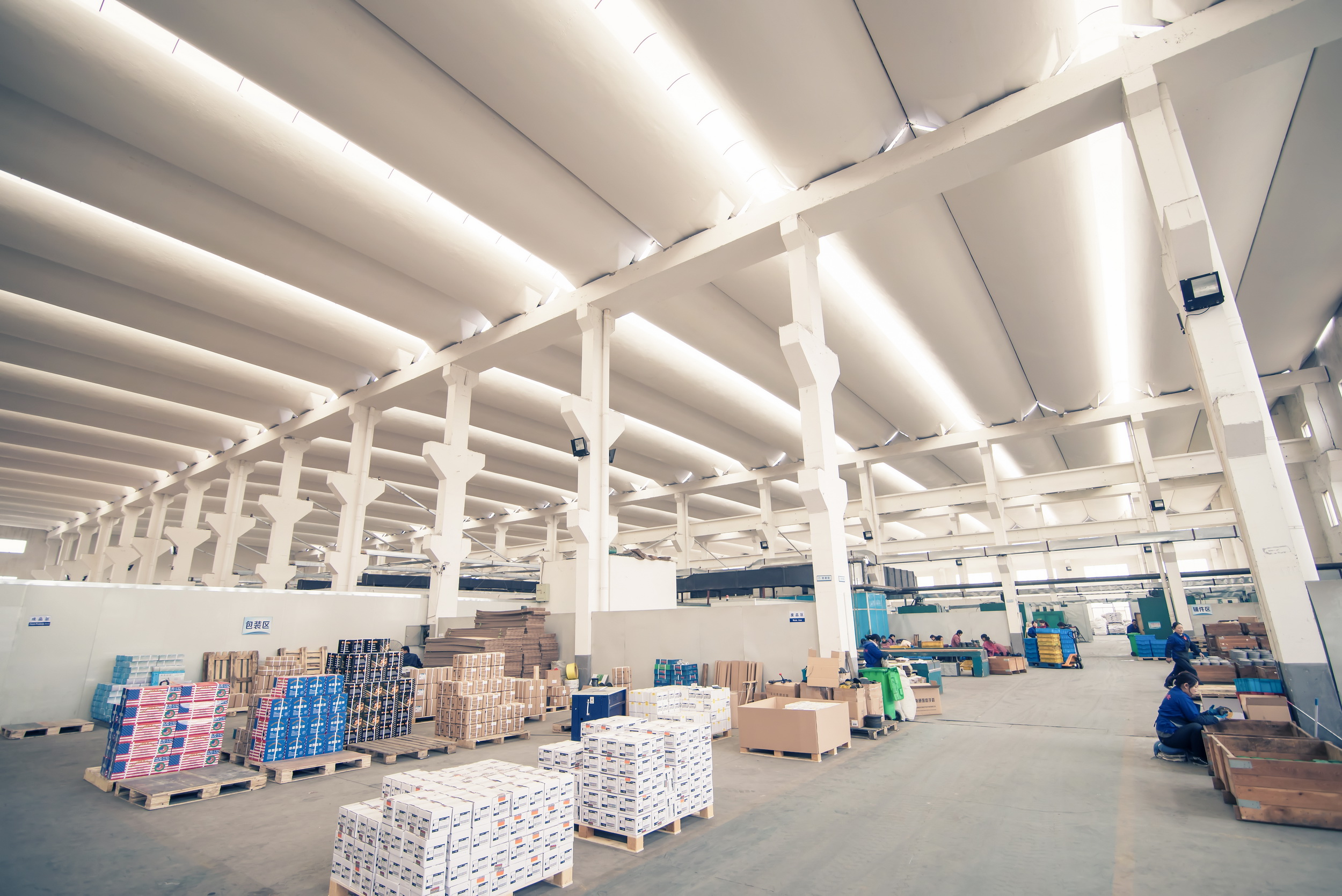
Temperature- and humidity-controlled storage supports consistent supply for distributors and production lines.
Download the CNDOME brochure or discuss your project:
https://cdn.socialarks.com/sbsp/24879/common/2026/0519/6a0c1596e4f3c.pdf
Email: chris@czdome.com | Tel / WhatsApp: +86 18796960868
Changzhou Dome Abrasives Manufacture Co., Ltd.
Garden Industrial Park, Zhenglu Town, Tianning District, Changzhou City, Jiangsu Province, China
Have Questions or Need More Details?
Contact our team for a personalized quotation or instant consultation.
Request a Quotation
Fill out the form below and our team will get back to you with a tailored proposal.
WhatsApp Direct Chat
Prefer to chat in real-time? Message us on WhatsApp for instant assistance & quick answers.
- Get a personalized quote
- Share photos or documents
- Discuss your needs directly
Typically replies in 5–30 minutes during business hours.