What Is a Cutting Disc? Types, Shapes, and Sizes Explained
Abrasive Fundamentals
A cutting disc is a thin, resin-bonded abrasive wheel that is fitted to an angle grinder, cutting machine or straight grinder and spun at high speed to slice through metal, stainless steel and other materials. It removes material with abrasive grain rather than teeth, which is why the same product is sold under several names: cutting disc, cutting wheel, cut-off wheel or abrasive wheel.
Three variables decide whether a disc does the job it was bought for: shape, size and speed rating. Shape codes such as T41, T42, T27 and T29 describe the profile of the wheel and therefore whether it is made for cutting or for grinding. Size runs from 1.5 inch (38 mm) up to 16 inch (400 mm) in diameter, with bore diameters from 3 mm to 32 mm. Maximum operating speed is stated as a surface speed, and 80 m/s is the standard rating for metal cutting across most of that range.
This guide explains each element in plain terms, using specification data from the cutting and grinding wheel range produced by CNDOME (Changzhou Dome Abrasives Manufacture Co., Ltd.), a resin-bonded abrasive wheel manufacturer established in 2001 in Changzhou, Jiangsu, China.
Why the Term Cutting Disc Leads to Wrong Purchases
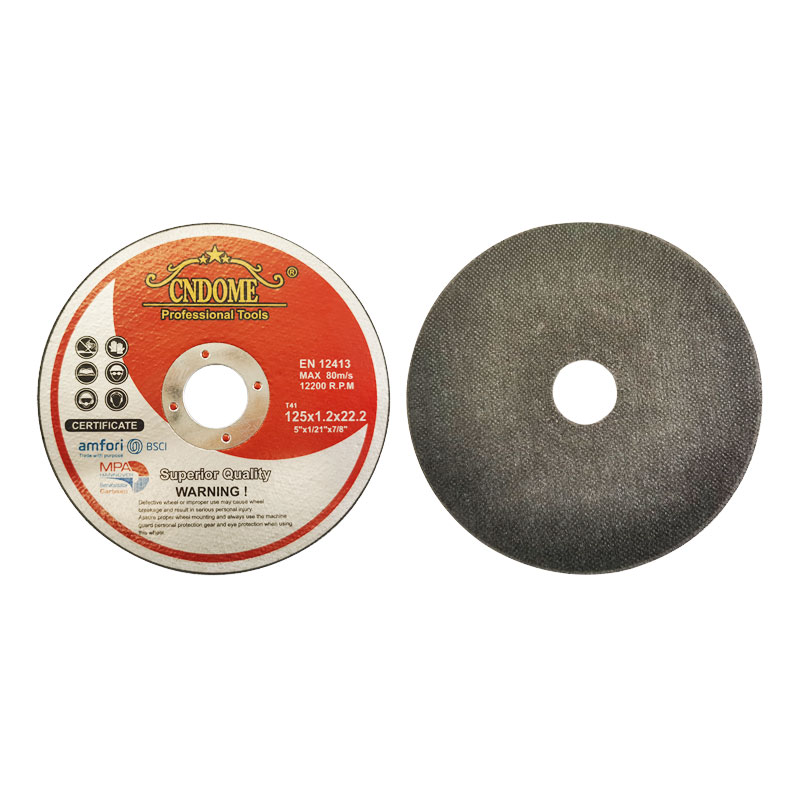
A cutting disc removes material in a narrow kerf, while a grinding wheel removes material across a face. That single difference explains most specification errors, because both products are round abrasive wheels of similar diameter and both mount on the same grinder spindle.
When the wrong wheel is selected, the symptoms show up on the workpiece rather than on the packaging: low cutting efficiency, poor precision on difficult-to-process materials, high dust, low yield, edge chipping, heat generation and blueing along the cut. A matched disc is expected to deliver the opposite conditions, including high flatness, a burr-free edge that does not blacken, high temperature resistance, long service life and no vibration during grinding.
Three assumptions cause most of the mismatches:
- That every abrasive wheel cuts. T27 and T29 profiles are built for grinding, not for severing material.
- That a larger disc is automatically more capable. Diameter has to match the tool guard and the spindle speed, not the ambition of the job.
- That the speed printed on the disc is a target. It is a ceiling, and the machine must not exceed it.
Industry Background: A Global Consumable Category Under Standardised Rules
Cutting discs are consumables, so demand tracks industrial activity rather than equipment replacement cycles. The global cutting discs market was valued at approximately USD 8.5 billion entering 2026, according to market research published by IndexBox. Within the wider abrasives market, Fortune Business Insights reports that Asia-Pacific accounted for a 44.7% revenue share in 2025, driven by industrial expansion in China and India.
The material mix is equally concentrated. Fortune Business Insights data shows aluminium oxide abrasives holding 46.3% of the material market share, which reflects its cost-effectiveness in general metal fabrication. For trade and customs purposes, cutting discs and similar bonded abrasive products are classified under HS code 6804.22.
Compliance is part of the product definition in export markets. EN 12413 is the European safety standard that applies to bonded abrasive products such as cutting and grinding discs, and it covers requirements including maximum operating speed and product marking. CNDOME's 180x1.6x22.23 mm cutting disc carries CE certification to EN 12413 under certificate number M.2022.206.C74459 issued by UDEM, and the certification covers cutting disc and grinding wheel products for global markets.
Manufacturing capacity behind the category is concentrated in industrial clusters. CNDOME operates a temperature- and humidity-controlled workshop covering more than 20,000 square meters with 60 automated production lines, approximately 140 employees and a 10-engineer R&D team. Reported output is about 600,000 pieces per day, with an annual production capacity of 95 million pieces. Around 80% of production is exported to markets in Latin America, Europe, Africa and Asia, and the company provides long-term OEM and ODM support to more than 2,000 global tool and professional abrasive wheel brands.
Cutting Disc Shapes Explained: T41, T42, T27 and T29
The shape code on a disc tells a buyer two things at once: the geometry of the wheel and the operation it was designed for. Four codes cover the majority of everyday metalworking requirements.
T41 — flat cutting disc
T41 is the flat, straight profile used for cutting. In the CNDOME range, T41 discs span the full size ladder from 38 mm to 400 mm in diameter, with thickness options from 1.0 mm to 3.5 mm and a maximum operating speed of 80 m/s across the family. The abrasive is aluminium oxide or white aluminium oxide held in a resin bond, and the intended work is cutting metal and stainless steel (INOX) in steel processing, metal processing, automobile manufacturing, shipbuilding, casting, steel structure and construction.
T42 — raised-hub cutting disc
T42 describes a cutting disc with a raised hub, where the centre of the wheel stands above the plane of the cutting edge. The hub form allows the disc to be mounted directly on the grinder spindle and lets the cutting edge run deeper into the workpiece before the tool body interferes with the material.
In the CNDOME range, T42 is offered as a shape option on the 125 mm (5 inch) cutting discs, which are produced with thickness options from 1.2 mm to 3.0 mm, and on the 230 mm (9 inch) cutting discs, which are produced with thickness options of 2.0 mm, 2.5 mm and 3.0 mm. Both use a 22.23 mm bore and are rated at a maximum operating speed of 80 m/s.
T27 — depressed-centre grinding wheel
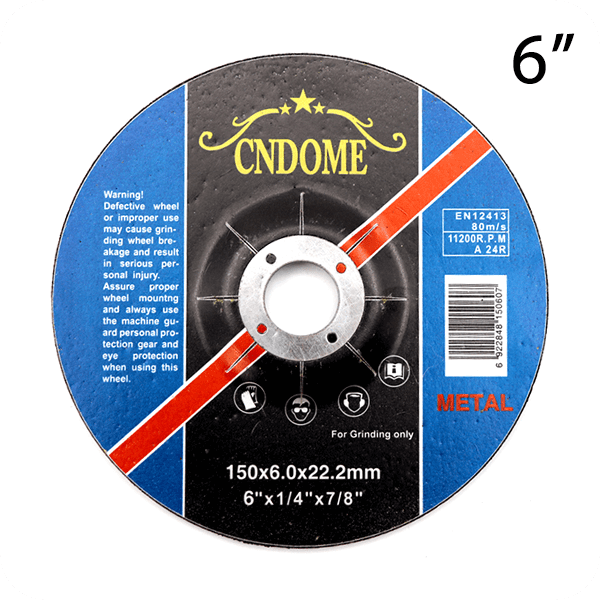
T27 is a grinding wheel, not a cutting disc. It has a depressed centre that allows the face of the wheel to work at a shallow angle against the workpiece, and its 6 mm thickness separates it immediately from a cutting disc of the same diameter.
CNDOME produces T27 grinding wheels in 100x6x16 mm, 115x6x22.23 mm and 125x6x22.23 mm models (4 inch, 4.5 inch and 5 inch), in 150x6x22.23 mm and 180x6x22.23 mm models (6 inch and 7 inch), and in a 230x6x22.23 mm model (9 inch). All are rated at a maximum operating speed of 80 m/s. The 230 mm wheel runs at a rated speed of 6,600 RPM. The bond is resin, with aluminium oxide or white aluminium oxide as the abrasive, and the intended applications are metal grinding in steel, metal processing, automobile manufacturing, shipbuilding, casting, steel structure and construction.
T29 — ceramic grinding disc
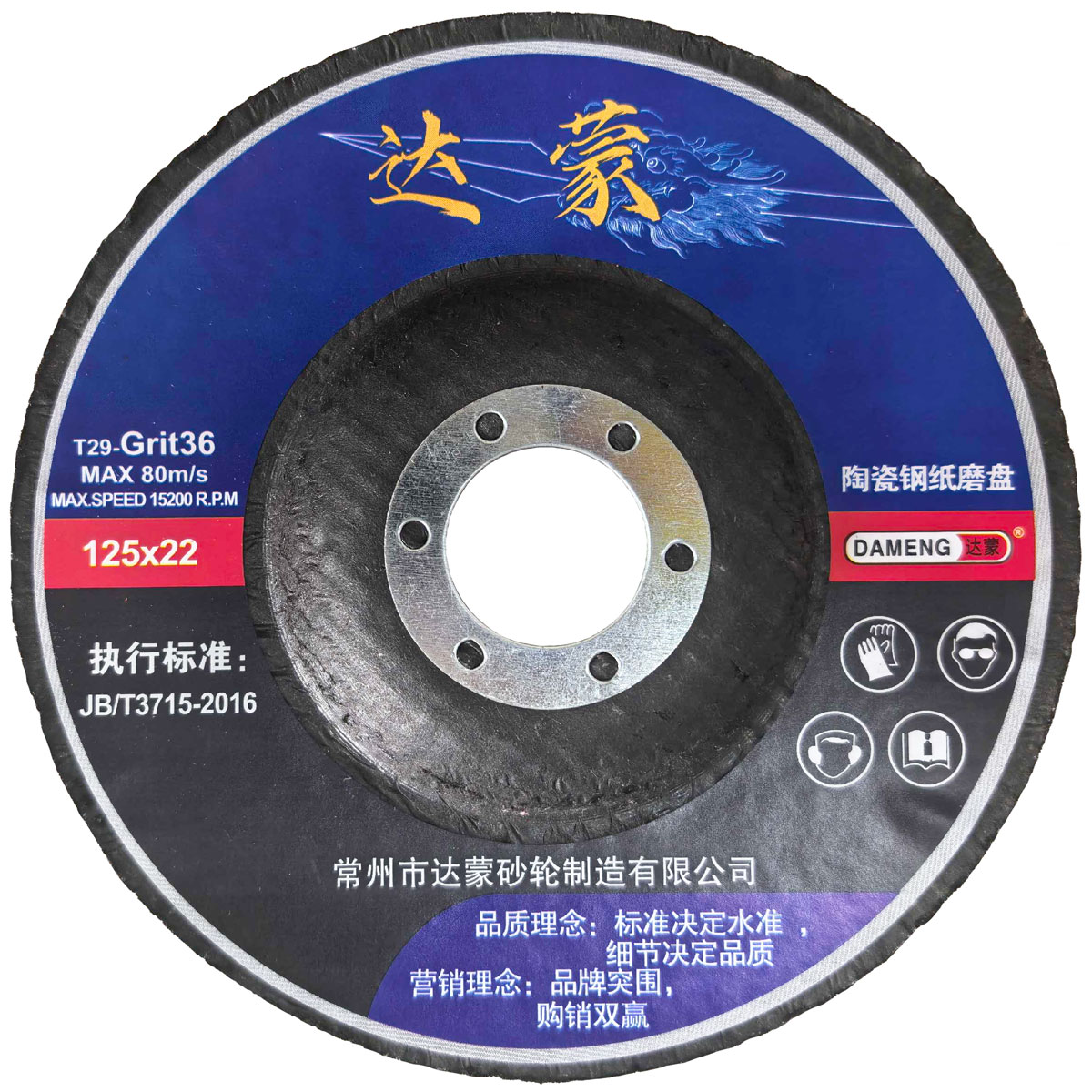
T29 is a grinding disc profile used with ceramic grain. The CNDOME ceramic grinding disc is available in 115 mm and 125 mm diameters with a 22.23 mm bore, uses ceramic sandpaper with a reinforced fiber cover plate, and carries a maximum operating speed of 100 m/s — higher than the 80 m/s rating of the metal cutting discs described above. It is intended for grinding metal and stainless steel (INOX) in steel, metal processing, automobile manufacturing, shipbuilding, casting, steel structure and construction work.
Cutting Disc Sizes: From 1.5 Inch (38 mm) to 16 Inch (400 mm)
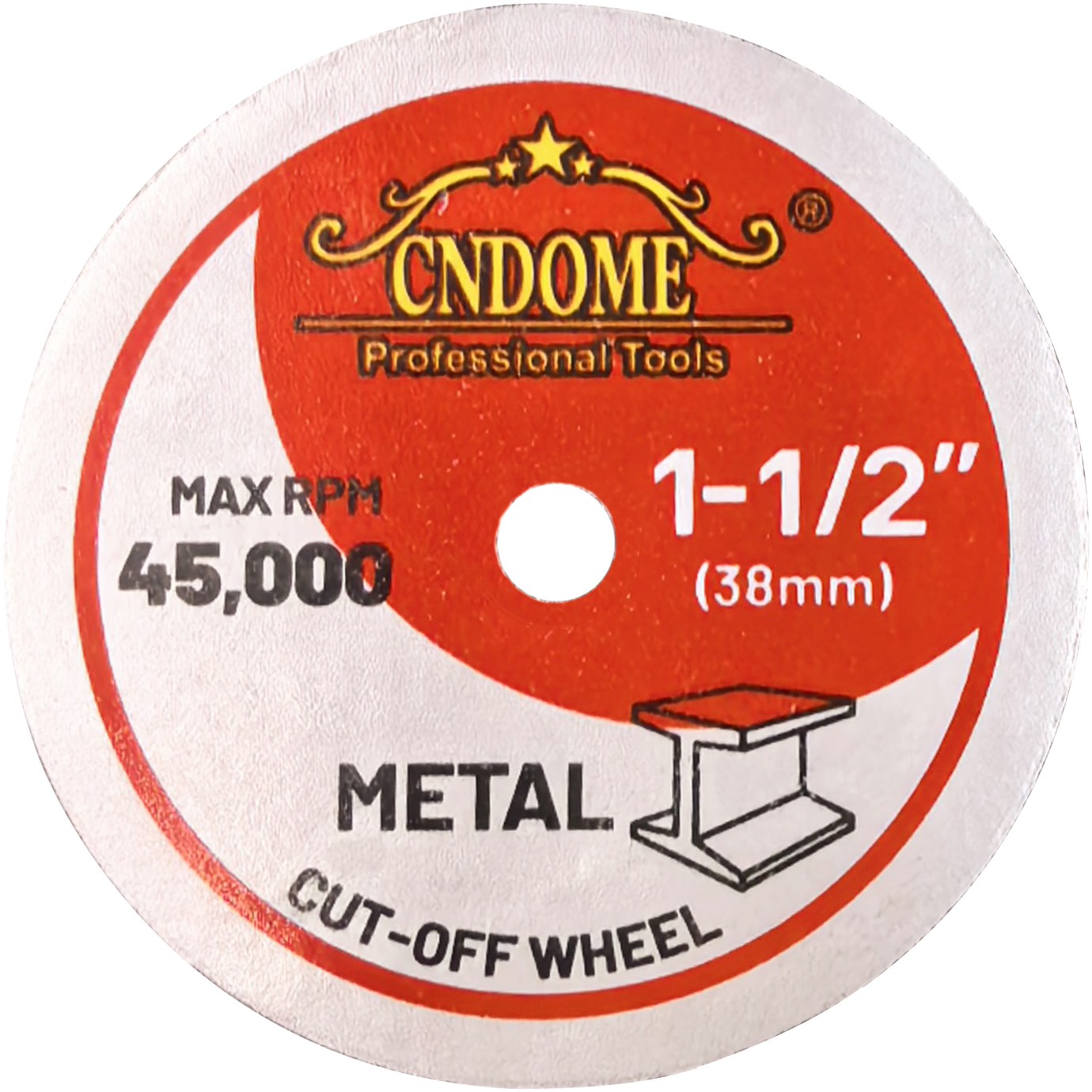
Cutting disc size is expressed as diameter, thickness and bore. In the CNDOME range the smallest cutting disc is a 1.5 inch (38 mm) disc with a 1.1 mm thickness and a 3 mm bore, and the largest is a 16 inch (400 mm) disc with a 3.5 mm thickness and a 32 mm bore. Across that span, bore diameters run from 3 mm to 32 mm, with 10 mm, 16 mm, 22.23 mm, 25.4 mm and 32 mm covering the intermediate sizes.
One detail is worth understanding before comparing discs by RPM. The maximum operating speed stays at 80 m/s across the cutting range, because that figure describes the speed of the abrasive edge, not the speed of the spindle. As diameter increases, the RPM needed to reach 80 m/s falls. A 38 mm disc is rated at 45,000 RPM, while a 400 mm disc is rated at 3,800 RPM. Both are operating at the same surface speed. This is why the RPM on the label must always be checked against the tool: the disc rating and the machine rating have to be compatible in the same units.
Materials and Bonding: Aluminium Oxide, Resin and Where Ceramic Fits
Almost every cutting disc in the standard range uses aluminium oxide or white aluminium oxide as the abrasive grain, held together by a resin bond. Aluminium oxide is the default choice for general metal fabrication, and Fortune Business Insights places aluminium oxide at 46.3% of the abrasive material market share. In the CNDOME range this combination covers the 2 inch, 3 inch, 4 inch, 4.5 inch and 9 inch cutting discs, plus the full T27 grinding wheel family.
Two further abrasive options appear higher in the size range. The 5 inch (125 mm) and 7 inch (180 mm) cutting discs are manufactured with aluminium oxide, white aluminium oxide, silicon carbide and zirconium, with resin as the bonding agent — a wider grain mix that suits heavier metal cutting and stainless steel work.
Ceramic grain sits at the top of the range in the T29 grinding disc, which pairs ceramic sandpaper with a reinforced fiber cover plate and carries a 100 m/s maximum operating speed. The practical decision rule is straightforward: aluminium oxide and resin for general cutting and grinding of steel and metal, silicon carbide and zirconium options for tougher cutting work, and ceramic grain where grinding performance and higher speed ratings are the priority.
How to Read a Cutting Disc Specification: Step by Step
A disc marked 115x1.2x22.23 with a T41 shape and an 80 m/s rating contains seven pieces of information. Read them in this order.
- Diameter first. 115 mm is the first figure in the model code. Diameter must match the tool: a 115 mm disc belongs on a 115 mm grinder, and a 400 mm disc belongs on a stationary cutting machine.
- Thickness second. 1.2 mm is the second figure. Thin cutting discs in the range run from 1.0 mm to 1.2 mm, general cutting discs from 1.6 mm upward, large discs to 3.2 mm and 3.5 mm, and T27 grinding wheels at 6 mm.
- Bore third. 22.23 mm is the arbor hole. Bore sizes in the range run from 3 mm on the smallest disc through 10 mm, 16 mm, 22.23 mm and 25.4 mm to 32 mm on the 400 mm disc.
- Shape code. T41 or T42 means cutting; T27 or T29 means grinding. This determines whether the wheel is used to sever material or to remove it across a face.
- Maximum operating speed. 80 m/s for metal cutting discs and T27 grinding wheels, 100 m/s for the T29 ceramic grinding disc. Confirm the tool can reach the required surface speed without exceeding its own limit.
- Rated speed in RPM. 13,300 RPM for a 115 mm disc, 8,500 RPM for a 180 mm disc, 3,800 RPM for a 400 mm disc. Compare this against the no-load speed of the machine.
- Marking and certification. Confirm the disc marking, the size on the label and the certificate reference all describe the same product before releasing an order.
Use Cases: Where Each Shape and Size Is Used
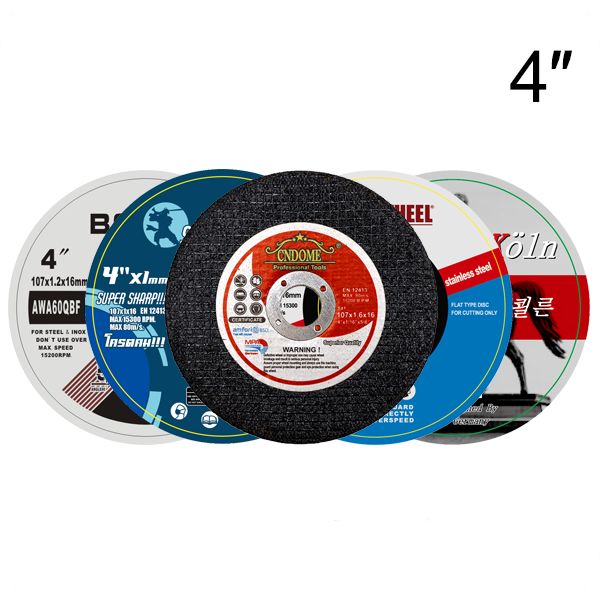
- Steel and metal processing: 4 inch and 4.5 inch T41 cutting discs (107x1.2x16, 100x1.0x16, 115x1.2x22.23) on portable angle grinders for section, tube and bar cutting.
- Stainless steel and INOX: thin T41 cutting discs plus the T29 ceramic grinding disc in 115 mm and 125 mm, where a clean, non-blackened edge and reduced heat damage matter.
- Shipbuilding: 9 inch cutting discs (230x2.0/2.5/3.0x22.23) and 9 inch T27 grinding wheels (230x6x22.23) for plate preparation and weld dressing in shipyard processing.
- Automotive and casting: 7 inch, 14 inch and 16 inch T41 discs (180 mm, 355 mm and 400 mm) for heavier cutting on castings and thicker sections, typically on stationary cutting machines.
- Steel structure and construction: 5 inch cutting discs in T41 or T42 form (125x1.2 to 3.0x22.23) for structural steel work on site.
- Home DIY and light maintenance: 1.5 inch, 2 inch and 3 inch discs (38 mm, 50 mm and 75/76 mm) for small tools and hobby cutting, including the 2 inch disc with a 10 mm arbor hole.
Discs across the range are used with angle grinders, cutting machines, straight angle grinders and chainsaws. The application scenario is common in markets including Brazil, UAE and Australia, and covers industrial manufacturing, construction and routine maintenance.
Cutting Disc Comparison Table: Shape, Size, Bore and Speed
Table 1 — Shape families
| Shape | Wheel form | Primary operation | Diameters in range | Thickness | Bore | Max speed | Bond and abrasive |
|---|---|---|---|---|---|---|---|
| T41 | Flat cutting disc | Cutting metal and INOX | 38–400 mm | 1.0–3.5 mm | 3–32 mm | 80 m/s | Resin bond; aluminium oxide / white aluminium oxide |
| T42 | Raised-hub cutting disc | Cutting with a raised hub | 125 mm and 230 mm models | 1.2–3.0 mm (125 mm); 2.0–3.0 mm (230 mm) | 22.23 mm | 80 m/s | Resin bond; aluminium oxide / white aluminium oxide |
| T27 | Depressed-centre grinding wheel | Grinding | 100–230 mm | 6 mm | 16 mm and 22.23 mm | 80 m/s | Resin bond; aluminium oxide / white aluminium oxide |
| T29 | Ceramic grinding disc | Grinding metal and INOX | 115 mm and 125 mm | Not stated in the reference specification | 22.23 mm | 100 m/s | Ceramic sandpaper with reinforced fiber cover plate |
Table 2 — Cutting disc size ladder
| Nominal size | Diameter and model | Thickness options | Bore | Max speed | Rated speed |
|---|---|---|---|---|---|
| 1.5 inch | 38 mm (38*1.1*3) | 1.1 mm | 3 mm | 80 m/s | 45,000 RPM |
| 2 inch | 50 mm (50*1.2*10 / 50*2*10) | 1.2 mm / 2.0 mm | 10 mm | 80 m/s | 30,100 RPM |
| 3 inch | 75 / 76 mm (75*1.2*10 / 76*1.0*10) | 1.0 mm / 1.2 mm | 10 mm | 80 m/s | 20,100 RPM |
| 4 inch | 100 / 107 mm (107*1.2*16 / 100*1.0*16) | 1.0 mm / 1.2 mm | 16 mm | 80 m/s | 15,400 RPM |
| 4.5 inch | 115 mm (115x1.2x22.23 / 115x1.6x22.23) | 1.2 mm / 1.6 mm | 22.23 mm | 80 m/s | 13,300 RPM |
| 5 inch | 125 mm (125x1.2 / 1.6 / 2 / 3 x22.23) | 1.2–3.0 mm | 22.23 mm | 80 m/s | 12,200 RPM |
| 7 inch | 180 mm (180x1.6 / 2 / 3 x22.23) | 1.6–3.0 mm | 22.23 mm | 80 m/s | 8,500 RPM |
| 9 inch | 230 mm (230x2.0 / 2.5 / 3.0 x22.23) | 2.0–3.0 mm | 22.23 mm | 80 m/s | 6,600 RPM |
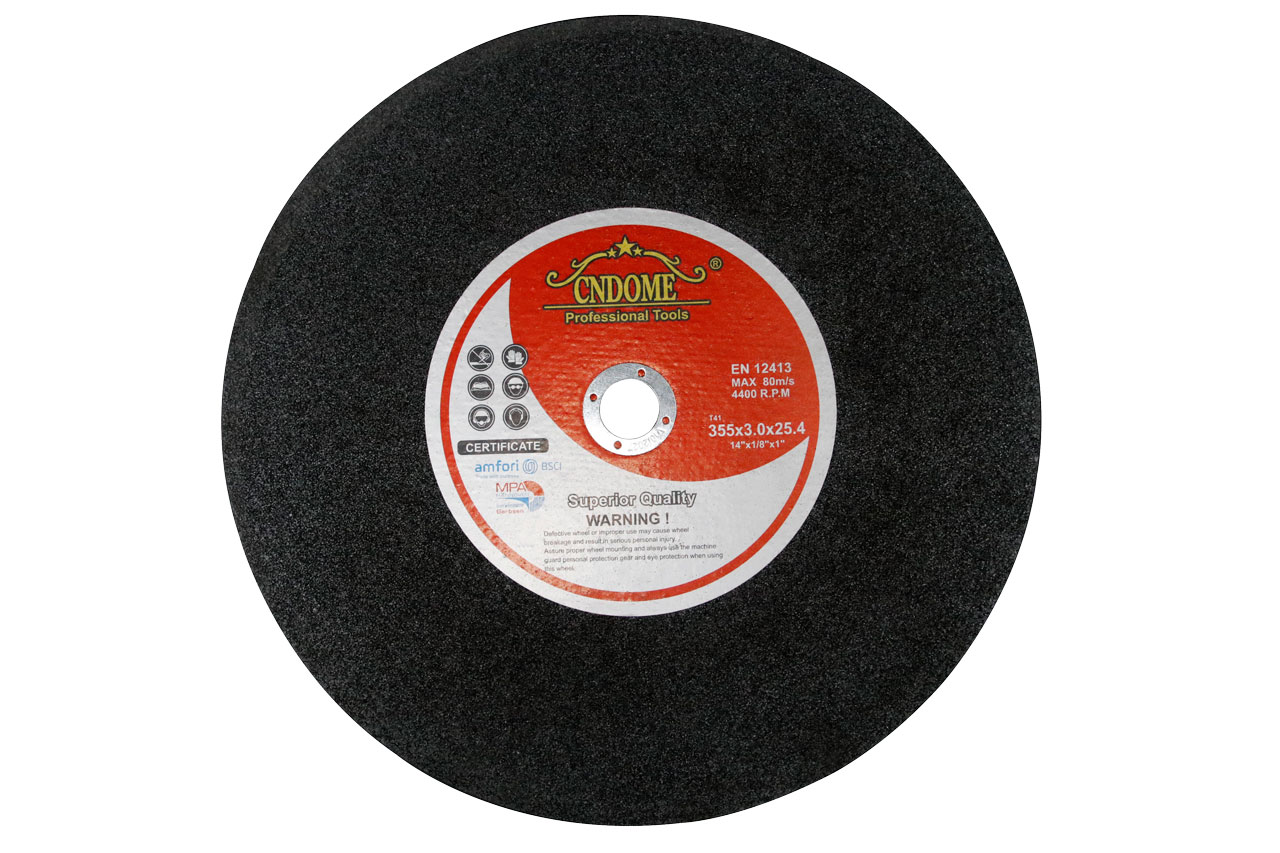
| 14 inch | 355 mm (355x3.2x25.4) | 3.2 mm | 25.4 mm | 80 m/s | 4,400 RPM |
| 16 inch | 400 mm (400x3.5x32) | 3.5 mm | 32 mm | 80 m/s | 3,800 RPM |
Frequently Asked Questions
What certifications should a cutting disc have before it is sold internationally?
Certification is part of the product definition for bonded abrasives, not an optional extra. EN 12413 is the European safety standard that applies to bonded abrasive products such as cutting and grinding discs, and it addresses requirements including maximum operating speed and product marking. CNDOME's 180x1.6x22.23 mm cutting disc is CE certified to EN 12413 under certificate number M.2022.206.C74459 issued by UDEM, and the certificate covers cutting disc and grinding wheel products for global markets. For customs and trade documentation, cutting discs are classified under HS code 6804.22. Before releasing an order, buyers should confirm that the certificate number, the marking on the disc and the size stated on the label all describe the same product.
Can cutting disc shapes, sizes and specifications be customized?
Yes. Customization is part of normal manufacturing rather than a special project. CNDOME produces resin-bonded cutting and grinding wheels in T41, T42, T27 and T29 shapes, with cutting disc diameters from 38 mm to 400 mm and bore sizes from 3 mm to 32 mm, and supports OEM and ODM programmes for distributors, tool brands and professional abrasive wheel brands. The existing range already spans multiple diameters, thicknesses, bores and abrasive blends — aluminium oxide and white aluminium oxide in the standard cutting discs, with silicon carbide and zirconium options in the 125 mm and 180 mm models, and ceramic grain in the T29 grinding disc. That variation is the practical space in which a customized specification is defined. Production support includes 60 automated production lines, a 10-engineer R&D team and long-term support for more than 2,000 global tool and professional abrasive wheel brands.
Which factors drive cost per cut rather than unit price?
Cutting discs are consumables, so procurement comparisons are normally made on cost per cut. The variables that change that number are the diameter and thickness of the disc, since a larger and thicker wheel contains more abrasive material; the abrasive grain and bond combination; the number of cuts a disc delivers before it is worn out; the time lost to disc changes during a shift; and whether the cut edge needs further finishing before it is accepted. Specifying purely on unit price tends to shift cost elsewhere — into rework, downtime or higher consumable consumption. A spec-level comparison of diameter, thickness, shape and speed rating is usually the fastest way to make the trade-off visible.
Can buyers request samples before committing to a bulk order?
Yes, and for cutting discs this is the standard validation step, because performance depends on the material being cut and on the tool being used. A buyer can request samples in the specific shape and size under evaluation — for example a 115x1.2x22.23 mm T41 flat cutting disc for general metal work, or a 125 mm T29 ceramic grinding disc where grinding performance matters — and test them on their own material and equipment before a bulk order is placed.
What determines lead time on a cutting disc order?
Lead time depends on production capacity and on whether the order uses a standard size or a customized build. CNDOME operates a temperature- and humidity-controlled workshop of more than 20,000 square meters with 60 automated production lines, reported daily output of about 600,000 pieces and an annual production capacity of 95 million pieces, with around 80% of output exported to Latin America, Europe, Africa and Asia. Standard sizes that already exist in the range can be scheduled against running production, while customized OEM or ODM items require specification confirmation and approval before mass production begins. Because diameter, thickness, bore, shape and grain all have to be locked before scheduling, confirming the exact specification is the step that determines the delivery date. Send the specification to chris@czdome.com or WhatsApp +86 18796960868 to request samples, a quotation or a delivery schedule.
Conclusion: Shape, Size and Speed Are the First Three Specs to Fix
A cutting disc is defined by its shape code, its dimensions and its speed rating. T41 covers flat cutting discs from 38 mm to 400 mm; T42 adds a raised hub on 125 mm and 230 mm models; T27 and T29 are grinding wheels with a 6 mm face or a ceramic grain, built for removing material rather than severing it. Diameters run from 1.5 inch (38 mm) to 16 inch (400 mm), bores from 3 mm to 32 mm, and the maximum operating speed holds at 80 m/s across the cutting range — with 100 m/s for the T29 ceramic grinding disc — while the rated RPM falls as diameter grows.
Buyers who fix those three specifications first, then confirm material, bond and certification, avoid nearly all of the mismatches described at the start of this guide. The remaining step is verification: samples tested on the actual material, and a certificate reference that matches the disc in the box.

Request the CNDOME Cutting Disc Catalog and Samples
CNDOME (Changzhou Dome Abrasives Manufacture Co., Ltd.) manufactures resin-bonded cutting discs and grinding wheels in T41, T42, T27 and T29 shapes from 38 mm to 400 mm, and supports OEM and ODM programmes for distributors, importers and brand owners. Download the product catalog here, review the range at czdome.com, or send your specification to chris@czdome.com / WhatsApp +86 18796960868 to request samples or a quotation.
Have Questions or Need More Details?
Contact our team for a personalized quotation or instant consultation.
Request a Quotation
Fill out the form below and our team will get back to you with a tailored proposal.
WhatsApp Direct Chat
Prefer to chat in real-time? Message us on WhatsApp for instant assistance & quick answers.
- Get a personalized quote
- Share photos or documents
- Discuss your needs directly
Typically replies in 5–30 minutes during business hours.