Evaluating Cutting Disc Material Quality: Aluminium Oxide and Resin Bonding
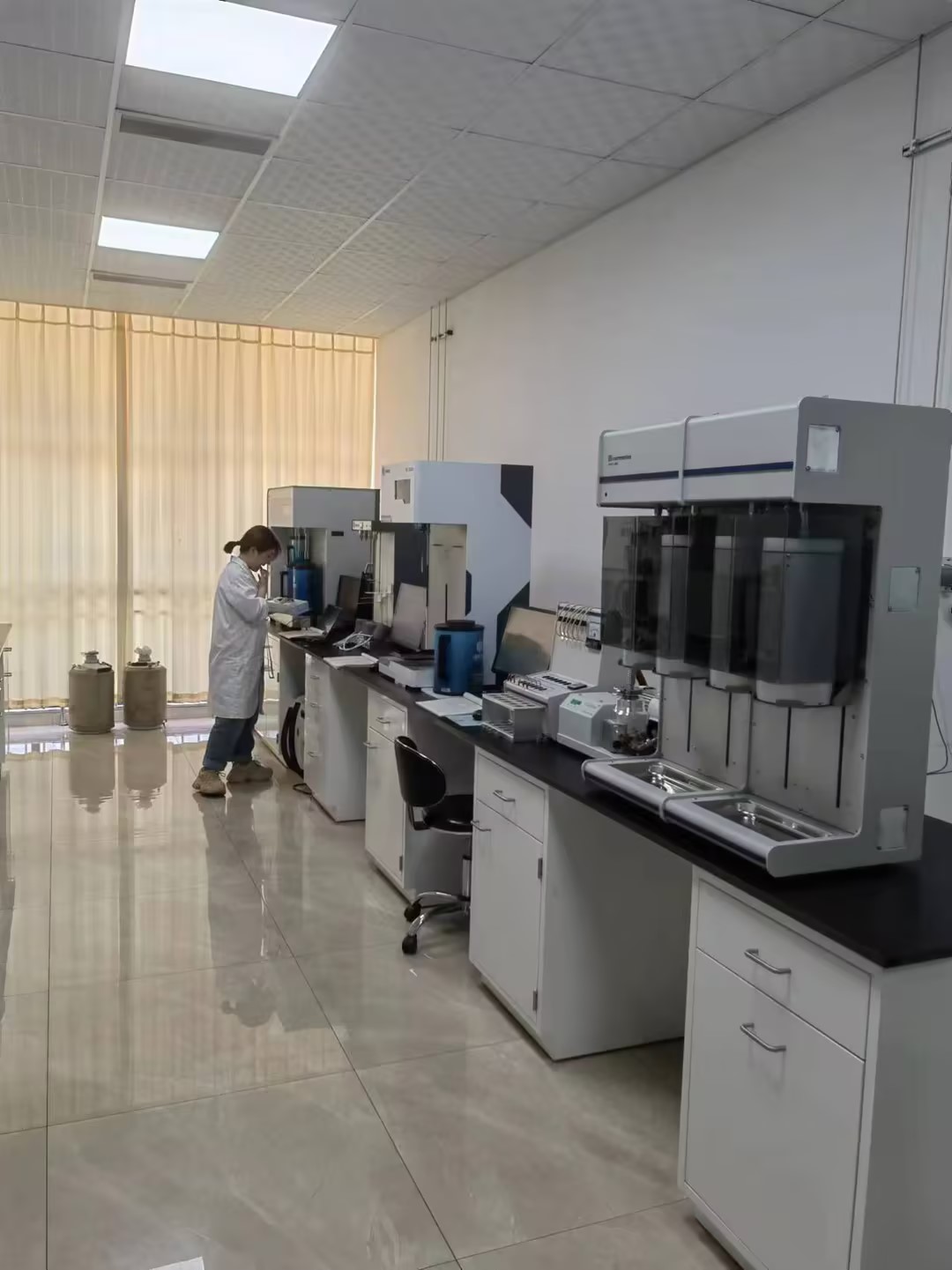
Material quality in a resin-bonded cutting disc is verified in the laboratory and on the shop floor — not by looking at the disc face.
Material quality in a resin-bonded cutting disc is decided by three things a buyer can actually verify: the abrasive grain, the bond and reinforcement that hold that grain together, and the manufacturer's ability to repeat the same thickness and density batch after batch. Aluminium oxide is the primary abrasive in general-purpose cutting discs, white aluminium oxide is the secondary grain used where cut quality and stainless steel performance matter most, and resin is the bonding system that cures both into a reinforced wheel.
CNDOME — the brand of Changzhou Dome Abrasives Manufacture Co., Ltd., a resin-bonded abrasive manufacturer founded in 2001 in Changzhou, Jiangsu, China — produces cutting discs made of Aluminium Oxide, White Aluminium Oxide and resin across models including 230x2.0x22.23 mm and 400x3.5x32 mm. This guide is written for buyers in the evaluation stage: what these materials do, how to test them without a laboratory, and what documentary evidence a supplier should be able to produce before purchase orders are issued.
Why Two Identical-Looking Cutting Discs Perform Differently
Two resin-bonded cutting discs of the same nominal size can sit side by side on a warehouse shelf and behave completely differently at 6,600 RPM. The dark face of the disc tells the buyer almost nothing about the variables that determine performance: grain type and purity, the grain-to-bond ratio, the filler system, the fiberglass reinforcement, and the thickness and density tolerance the factory held during pressing and curing.
That gap is the central problem in supplier evaluation. Price and appearance are visible; material composition is not. The variables that actually decide whether a disc cuts cleanly for its whole life are these:
- Grain type and purity — standard (brown) aluminium oxide, white aluminium oxide, silicon carbide, zirconium, or premium ceramic grain.
- Grain-to-bond ratio — how much abrasive is packed into the resin matrix, which controls cut speed versus disc life.
- Bond formulation — the resin system and fillers that cure the grain into a working wheel.
- Reinforcement construction — the fiberglass reinforcement that provides burst resistance at rated speed.
- Pressing density and thickness tolerance — variation in thickness around the rim, which shows up later as vibration and uneven wear.
- Bore size and flatness — a 22.23 mm bore on 230 mm discs, and a disc that sits flat rather than wobbling on the spindle.
- Curing environment — temperature and humidity control during curing, which is invisible in a finished disc but decisive for batch consistency.
- Marking and traceability — legible maximum speed, expiry and batch identification on the disc itself.
When any of these variables drift, the symptoms only appear in use: a disc that glazes on stainless steel instead of cutting, heat discoloration along the cut line, burrs that require a second operation, vibration that wears the grinder spindle, or a batch where the first fifty discs cut well and the next fifty do not. For a distributor or a private-label brand owner, the commercial risk is larger than the technical one — a rejected container, a warranty claim, or a retailer quietly delisting the line.
There is also a specific documentary trap in this category. Safety certificates for bonded abrasives are issued for defined dimensions, not for a brand in general. A certification document issued for a 230 mm disc does not automatically cover a 115 mm disc, and buyers who file a single PDF as "supplier approval" frequently discover that gap during a customer audit or a customs query.
Industry Background: Where Resin-Bonded Cutting Discs Stand Today
The global cutting discs market reached a valuation of approximately USD 7.32 billion in 2024, according to Market Research Future. Scope matters when reading that figure: Strategic Market Research publishes USD 5.1 billion and Reports and Insights USD 2.5 billion for narrower definitions of the same category, so the number should be treated as an indication of scale rather than an exact measurement.
Regionally, Mordor Intelligence reports that Asia-Pacific accounted for 48.28% of global revenue in the cutting equipment and tools sector in 2025, which is why so much abrasive manufacturing capacity — and so much supplier evaluation — concentrates in that region. Within China specifically, Intel Market Research values the abrasives market at USD 2.29 billion in 2024, of which USD 1.35 billion came from synthetic raw materials such as the fused aluminium oxide grains used in resin-bonded discs.
On the demand side, Cognitive Market Research identifies stainless steel cutting discs as the dominating product category within the cutting discs market, driven by demand from construction and automotive manufacturing. That matters for material selection: stainless steel work is where grain purity and bond formulation are most easily exposed.
On the compliance side, European safety standard EN 12413:2019 specifies the safety requirements and testing procedures for rotating bonded abrasive products, including cutting and grinding wheels. MPA Hannover provides independent safety testing and certification for abrasive tools, and this certification is a key requirement for exporting industrial cutting discs into the EU market. For suppliers, the benchmark set is well documented: Market Research Future lists Saint-Gobain (Norton), 3M, Robert Bosch GmbH, Tyrolit and PFERD among the major industry players in the abrasives and cutting tool sector — the reference group that OEM manufacturers are measured against in tenders and distributor negotiations.
The Three Material Layers That Determine Cutting Disc Quality
A resin-bonded cutting disc is a composite: abrasive grain, a resin bond, fillers and fiberglass reinforcement, pressed into shape and cured. Each layer can be evaluated separately.
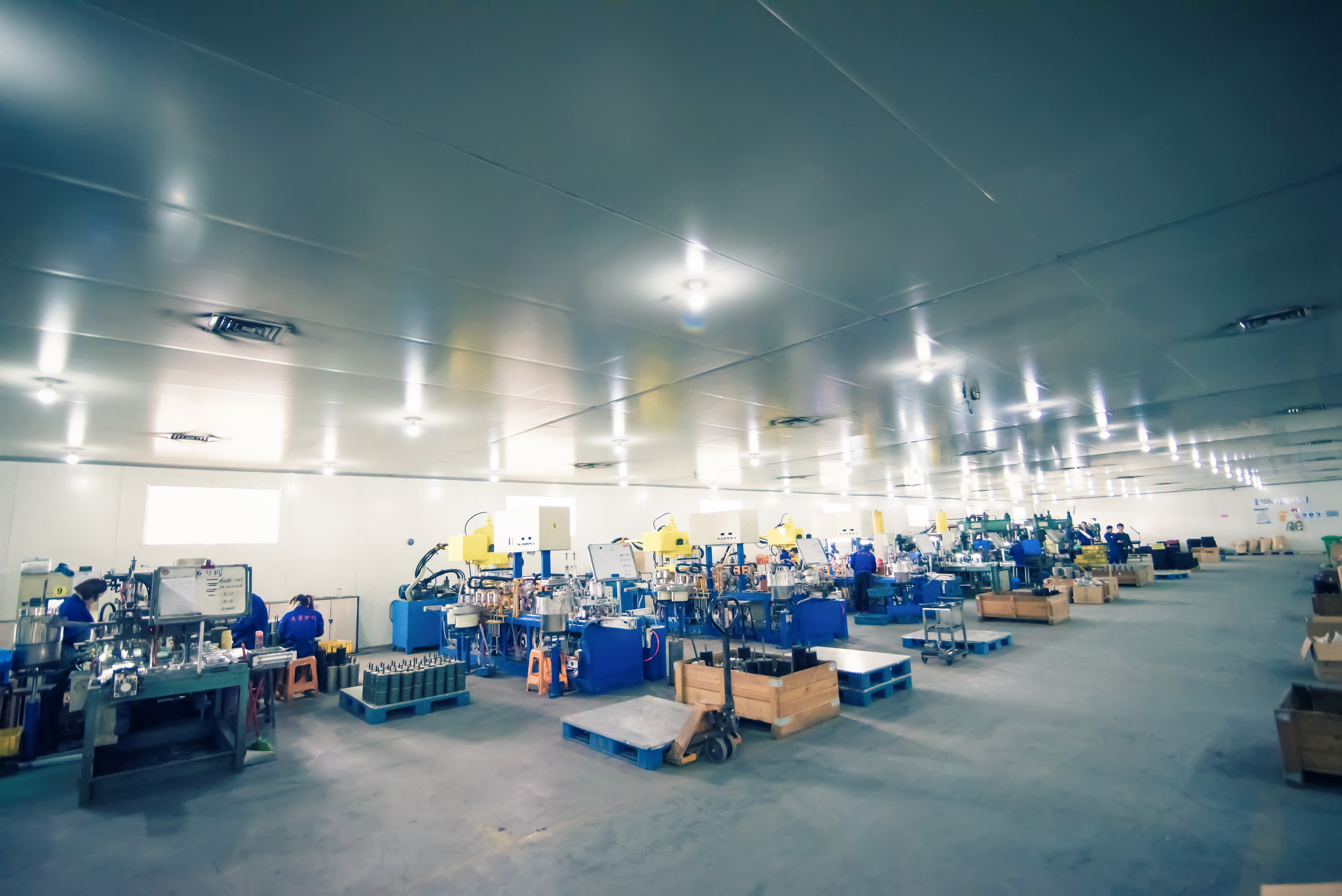
Pressing and curing control is what turns a good formulation into a repeatable batch.
Layer 1 — Aluminium Oxide as the Primary Abrasive
Aluminium oxide is the primary abrasive grain in general-purpose cutting discs and the workhorse of steel cutting. In CNDOME's range, aluminium oxide is the primary material for the 9-inch cutting disc family — 230x2.0x22.23, 230x3.0x22.23 and 230x2.5x22.23 mm, with a 230 mm diameter, a 22.23 mm bore and thickness options of 2.0 mm, 3.0 mm and 2.5 mm — and for the 16-inch disc at 400x3.5x32 mm. Both configurations are described as made of Aluminium Oxide, White Aluminium Oxide and resin, with a maximum speed of 80 m/s.
For the buyer, the practical question is not "is it aluminium oxide?" but "which aluminium oxide, at what grain-to-bond ratio, for which material?" CNDOME's cutting disc specifications also list Silicon carbide and Zirconium within the material set, which indicates a manufacturer that formulates for different cutting tasks rather than offering one universal mix.
Layer 2 — White Aluminium Oxide as the Secondary Abrasive
White aluminium oxide is a higher-purity grain than standard brown aluminium oxide and is commonly selected for stainless steel and INOX work. Its role in the disc is to cut cooler and cleaner, reducing the risk of the iron and sulfur contamination that leads to rust blooming on a cut edge, and reducing heat discoloration on visible stainless surfaces. It is typically blended with standard aluminium oxide rather than used alone, which is exactly how it appears in CNDOME's specification: Aluminium Oxide and White Aluminium Oxide in the same disc.
In evaluation terms, a supplier that can state which grain is primary and which is secondary, and hold that blend stable across shipments, is a different proposition from a supplier that quotes a single generic "alumina" specification.
Layer 3 — Resin Bond and Fiberglass Reinforcement
Resin is the bonding system that converts loose grain into a cutting tool. The bond is pressed with the grain, the fillers and the fiberglass reinforcement, then cured under controlled temperature and humidity. Fiberglass reinforcement is what allows the disc to run at high peripheral speed with a defined burst margin, and it is the reason a reinforced disc can be used safely on a portable angle grinder rather than only on a fixed machine.
Bond quality is the hardest layer for a buyer to judge, because a poorly cured bond looks the same as a well-cured one. It reveals itself through disc life, through glazing, and through whether the last third of a batch behaves like the first third.
The Advanced Tier — Ceramic Grinding Discs and Ceramic Grain
One useful technology indicator in supplier evaluation is whether the manufacturer's product range extends beyond commodity brown alumina. CNDOME lists Ceramic Grinding Disc among its main products, alongside cutting discs, grinding wheels, abrasive discs and flap discs. Ceramic abrasive products — ceramic grain combined with a fiberglass-reinforced construction — sit in a higher abrasive class than standard aluminium oxide: the grain is engineered for longer life and higher performance under load, and producing it consistently requires tighter control of grain blending, pressing and curing than a commodity mix.
The lesson for buyers is that a manufacturer able to hold a ceramic grinding disc specification is also, in general, able to hold a tighter specification on a standard aluminium oxide cutting disc of the same size.
Reading the Specification Correctly
Material evaluation starts with reading the marking properly. A 230x2.0x22.23 disc is 230 mm in diameter, 2.0 mm thick, with a 22.23 mm bore; the structural configuration is T41/T42, the operating speed is 6,600 RPM and the maximum speed is 80 m/s. The 400x3.5x32 disc is 400 mm in diameter, 3.5 mm thick, with a 32 mm bore, T41 shape, 80 m/s maximum speed and 3,800 RPM operating speed. Both are intended for steel and metal processing, automobile manufacturing, shipbuilding, casting, steel structure and construction applications.
Discs should be compared at the same rated speed and the same intended material — not merely at the same diameter.
Step-by-Step: How to Verify Material Quality Before You Order
The following sequence can be run by a sourcing team with a caliper, a scale, and a grinder. It separates material quality claims from material quality evidence.
- Match certification to the exact dimension. Ask for the certificate that names the specific disc size in the purchase order, not a general company certificate. MPA Hannover certificates under EN 12413 are issued per dimension; CNDOME's set covers sizes including 76x1.2, 115 mm thickness variants, 125 mm, 180x1.6, 230 mm and 300 mm discs.
- Measure thickness around the rim. Take readings at several points on the circumference of the same disc. A disc whose thickness varies noticeably around the rim will cut unevenly and generate vibration.
- Weigh the discs in a batch. Discs of the same nominal size should have consistent mass. Large spread within one carton indicates inconsistent grain-to-bond ratio or uneven pressing density.
- Check the bore and flatness. Confirm the bore (22.23 mm on the 230 mm disc) and lay the disc on a flat reference surface. A disc that rocks rather than sits flat will not run true.
- Inspect the reinforcement and face. Look at the fiberglass reinforcement visible at the arbor area and across the face; check for cracks, chips, or uneven colour, and confirm the marking with maximum speed and expiry is legible.
- Run a controlled cut test. Use the same grinder and the same material you actually cut. Compare cut time, burr formation, heat discoloration on stainless, and how much disc diameter is consumed per cut.
- Compare batches, then compare the factory. Repeat the checks on a second production batch. Then ask how the factory controls variation: CNDOME operates a temperature- and humidity-controlled workshop of more than 20,000 m² with 60 automated production lines, applies 100% AI visual comparison testing, and runs a monthly capacity of 8 million pieces.
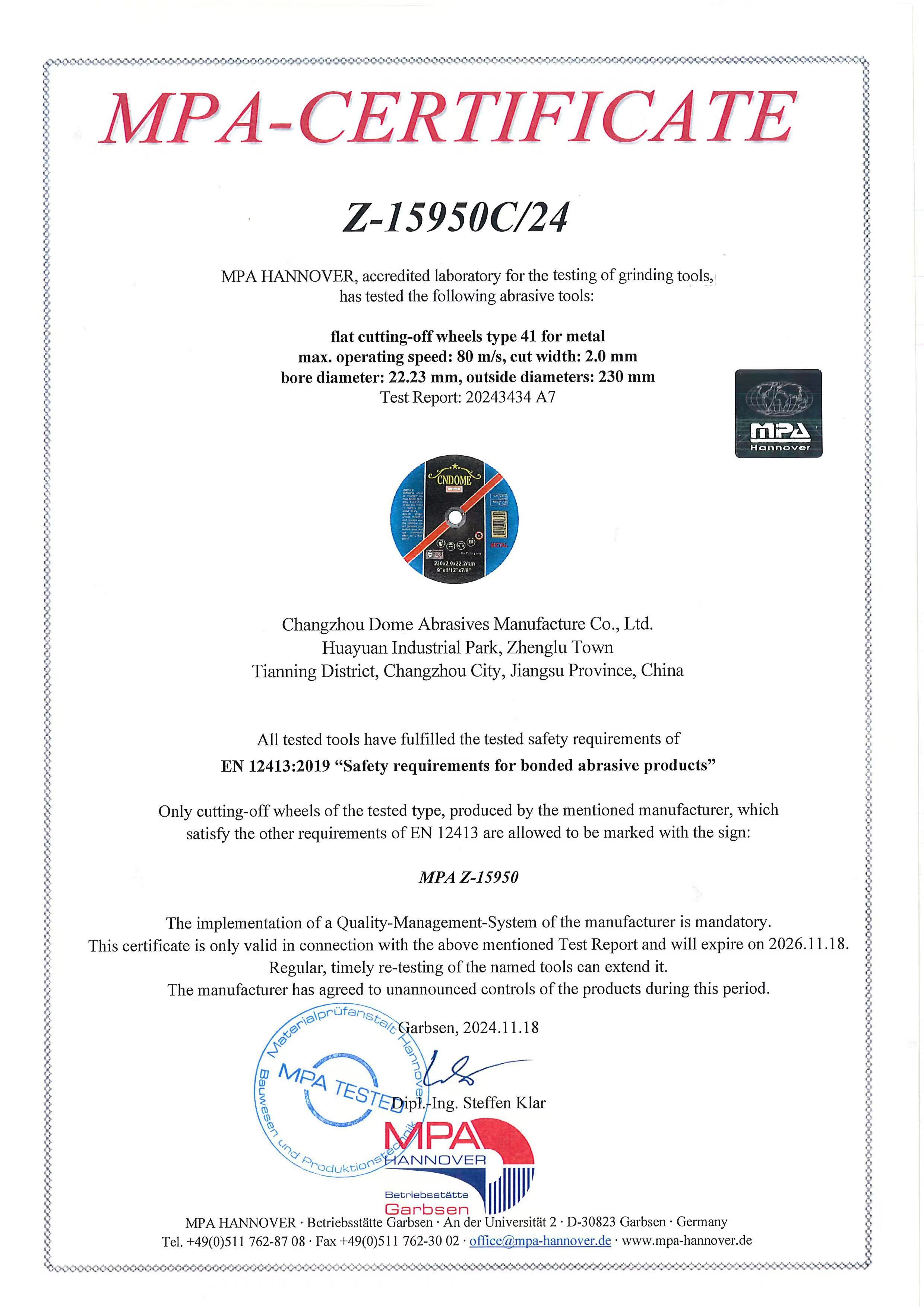
Abrasive certification is dimension-specific — this document covers a 230x2 mm disc, not the whole product range.
Where Material Quality Shows Up in Real Projects
Material choices only matter in context. The cases below are supplier-side records from abrasive cutting and grinding programmes in the Americas, Europe and Asia.
Steel and Structural Fabrication
On steel structure, construction, casting and shipbuilding work, the 230 mm cutting disc family (230x2.0x22.23, 230x2.5x22.23, 230x3.0x22.23) runs at 6,600 RPM with a maximum speed of 80 m/s in T41/T42 configuration. The material question here is grain-to-bond balance: a bond that is too hard glazes on structural steel, while a bond that is too soft wears out before the cut is finished.
Stainless Steel Pipe Cutting and Polishing
A stainless processing manufacturer in South America — Argentina, Brazil, Chile, Colombia, Peru, Venezuela, Ecuador, Paraguay and Uruguay — uses these discs for polishing the outer and inner walls of stainless steel pipes, at a project scale of 500,000 pieces per year over three years of service. Reported outcomes include stable long-term use, long disc life without frequent replacement, no slag shedding, and high safety. Small-batch customization support, timely supply and environmental compliance were listed as key highlights. This is the application where white aluminium oxide in the blend earns its place.
Tool Supermarkets and Retail DIY Programmes
A tool supermarket programme across Mexico, the United States and South American countries reached 40,000,000 pieces per year over three years, with home DIY and professional metalworking as the end uses. The reported results were stable high sales and benchmark brand status in tool supermarkets, supported by long service life, fast cutting speed, low noise, burr-free cutting, a complete model range from 3 to 14 inches, and retail-grade packaging.
Private-Label Tool Brands
A tool brand OEM in Brazil reached 10,000,000 pieces per year over three years, selling through offline hardware stores and becoming the largest tool brand in the Brazilian market. The operating profile is sharpness on both iron and stainless steel, high safety and stable performance, with long disc life, burr-free cutting, fast material feeding and low dust.
Cross-Border E-Commerce and Brand Owners
For foreign trade companies and e-commerce sellers across China, Singapore, the United States, Germany, Nigeria and South Africa, CNDOME provides product development services for brand owners and tool brands — including Fortune 500 companies — selling in over 90 countries, at a pace of 60 orders per year over three years. The delivered service is OEM and private-label customization sold globally through Amazon, eBay, AliExpress, Walmart, Shopee, Lazada, TEMU, TikTok and Shopify, with both small and large batch customization, short customization lead times and fast delivery.

Multi-size stocking is what allows a distributor to serve both DIY and professional metalworking demand from one supplier.
Comparison Tables: Materials and Verification Evidence
The first table compares the abrasive and bonding materials used in resin-bonded cutting discs. The second converts material claims into the evidence a buyer should request.
| Material | Function in the disc | Typical application focus | In CNDOME cutting discs |
|---|---|---|---|
| Aluminium Oxide | Primary abrasive grain | General steel cutting and fabrication | Yes — stated primary material |
| White Aluminium Oxide | Secondary, higher-purity grain | Stainless steel and INOX where contamination and heat discoloration matter | Yes — stated secondary material |
| Silicon carbide | Hard, sharp grain for non-ferrous and stone-type work | Cast iron, stone, non-ferrous materials | Listed within the cutting disc material set |
| Zirconium | Tough grain for aggressive stock removal | Heavy grinding and blending | Listed within the cutting disc material set |
| Ceramic grain | Premium abrasive class for longer life under load | Demanding cutting and grinding | CNDOME range includes Ceramic Grinding Disc |
| Resin bond | Cures grain, filler and reinforcement into a working wheel | All resin-bonded cutting and grinding discs | Yes — core bonding system |
| What to verify | Evidence available from CNDOME | Why it matters to the buyer |
|---|---|---|
| Safety certification per dimension | MPA Hannover certificates under EN 12413, for example Z-15953C/26 and Z-15953B/26, both valid until 26 January 2028 | Abrasive certificates are size-specific; a certificate for one disc size does not cover another |
| Product conformity marking | CE certificate M.2022.206.C74459, valid until 9 June 2027, scope: cutting and grinding wheels | Confirms the product family is covered against the EN 12413 safety standard |
| Factory quality system | ISO9001:2015 certificate 18524Q10838R0M, valid until 4 June 2027, scope: production of resin grinding wheels | Confirms resin wheel production runs under a documented quality system |
| Environmental and social compliance | ISO14001:2015 certificate 25024E11441R0M, valid until 19 December 2027; amfori BSCI report 156-025464-001, valid until 16 October 2027 | Increasingly required by European and global retail and brand-owner buyers |
| Thickness consistency | Caliper check at multiple points around the rim against the nominal thickness | Uneven thickness causes vibration and uneven wear in the cut |
| Density consistency | Mass comparison of discs within one batch of the same nominal size | Indicates a stable grain-to-bond ratio and controlled pressing |
| Reproducibility at scale | 100% AI visual comparison testing, 8 million pieces monthly capacity, 30-day lead time | Shows the factory can repeat the approved specification in volume |
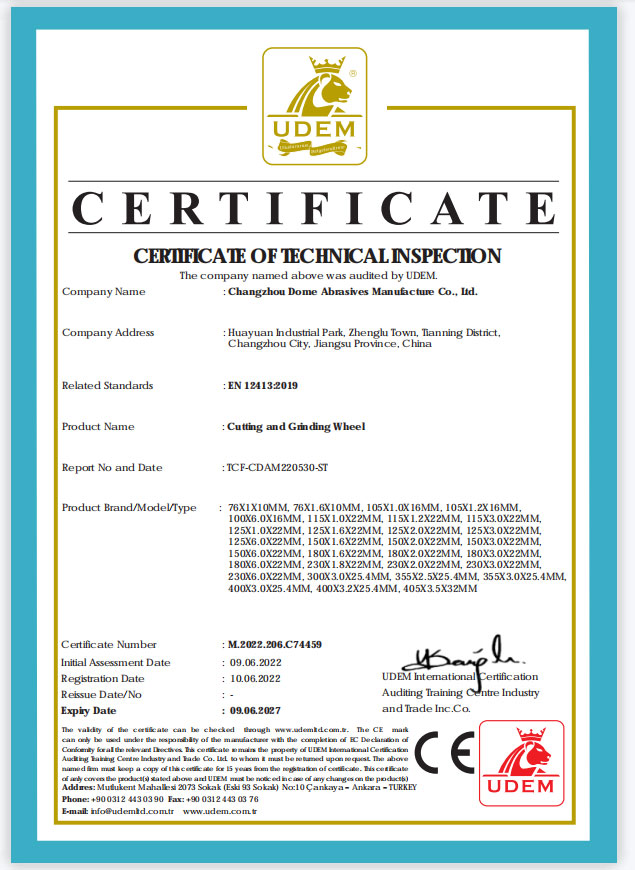
Certificate scope, validity date and covered product family should all be checked against the purchase order.
FAQ: Evaluating Cutting Disc Material Quality
Which certifications should a buyer verify before approving a resin-bonded cutting disc supplier?
European safety standard EN 12413:2019 specifies the safety requirements and testing procedures for bonded abrasive products, and MPA Hannover provides independent safety testing and certification for abrasive tools, which is a key requirement for exporting industrial cutting discs into the EU market. For CNDOME, verifiable documents include MPA Hannover certificates under EN 12413 — for example Z-15953C/26 and Z-15953B/26, both valid until 26 January 2028 — a CE certificate in the scope of cutting and grinding wheels (M.2022.206.C74459, valid until 9 June 2027), an ISO9001:2015 certificate for the production of resin grinding wheels (18524Q10838R0M, valid until 4 June 2027), an ISO14001:2015 certificate (25024E11441R0M, valid until 19 December 2027), and an amfori BSCI report (156-025464-001, valid until 16 October 2027). Because MPA certificates are issued for defined dimensions, each certificate number should be matched to the exact disc size being purchased.
How can a buyer check aluminium oxide grain quality and resin bond consistency without a laboratory?
Grain and bond quality can be screened with three measurements and one cut test. Measure thickness with a caliper at several points around the rim and compare against the nominal value; weigh discs of the same nominal size within one batch and compare mass, since large variation points to unstable grain-to-bond ratio or uneven pressing density; check the bore and whether the disc sits flat. Then run a controlled cut on the material you actually use and compare cut time, burrs and heat discoloration. Factory-side control matters as much as the sample: CNDOME operates a temperature- and humidity-controlled workshop of more than 20,000 m² with 60 automated production lines, applies 100% AI visual comparison testing, and produces ceramic abrasive products such as the Ceramic Grinding Disc — a sign of capability beyond commodity brown alumina.
What drives the cost of an aluminium oxide cutting disc?
The main cost drivers are the grain type and blend (standard aluminium oxide, white aluminium oxide or ceramic grain), the grain-to-bond ratio and filler system, the fiberglass reinforcement construction, the disc thickness and diameter, the packaging format, and the order volume. CNDOME's customized cutting discs are available in quantities of 10,000 pieces or more, with a monthly capacity of 8 million pieces and a 30-day lead time. Buyers comparing quotations should normalize for grain type and exact dimensions first, because discs with the same diameter but different grain composition or bond formulation are not equivalent products, and the cheaper quotation is frequently the more expensive one per finished cut.
Can buyers test samples before committing to a production order?
Sample validation is the standard way to check material quality before volume commitment, and it can be done in the buyer's own workshop. Request samples of the exact specification on the purchase order, then measure thickness and mass, check the bore and flatness, and cut the material you normally work with. CNDOME supports both small and large batch customization with short customization lead times and fast delivery, and its OEM and private-label service covers logo, label, packaging, abrasive formulation and specification. Samples can be requested directly from the manufacturer: e-mail chris@czdome.com or WhatsApp +86 18796960868, and the full product catalogue can be downloaded from the brochure link at the end of this article.
What are the lead time, MOQ and after-sales terms for custom cutting discs?
Custom cutting discs are available in quantities of 10,000 pieces or more, with a 30-day lead time and a monthly production capacity of 8 million pieces. CNDOME was founded in 2001 and operates a 20,000 m² facility with 140 employees, a 10-person R&D team and an annual output of 95 million pieces; 80% of production is exported to Latin America, Europe, Africa and Asia, supporting more than 2,000 global tool and professional abrasive wheel brands. After-sales support is provided 24/7 online with remote technical assistance. Buyers can send their target specification — size, thickness, bore, grain type and packaging — to receive a quotation and a lead-time confirmation for the exact configuration.
Conclusion: Material Evidence Beats Material Claims
Evaluating a resin-bonded cutting disc comes down to reading the material system correctly. Aluminium oxide is the primary abrasive that does the cutting; white aluminium oxide is the secondary grain that makes stainless steel work cleaner and safer; resin is the bond that holds the grain, the fillers and the fiberglass reinforcement together. What separates suppliers is not the vocabulary of these materials but the evidence behind them: dimension-specific MPA Hannover certification under EN 12413, product conformity, a documented quality system, and the physical consistency of thickness and density from one batch to the next.
Changzhou Dome Abrasives Manufacture Co., Ltd. — trading as CNDOME — is a resin-bonded abrasive manufacturer founded in 2001 in Changzhou, Jiangsu, China, producing cutting discs, grinding wheels, abrasive discs, Ceramic Grinding Disc and flap discs for markets in Latin America, Europe, Africa and Asia, with OEM and ODM services supporting more than 2,000 global tool and abrasive wheel brands.
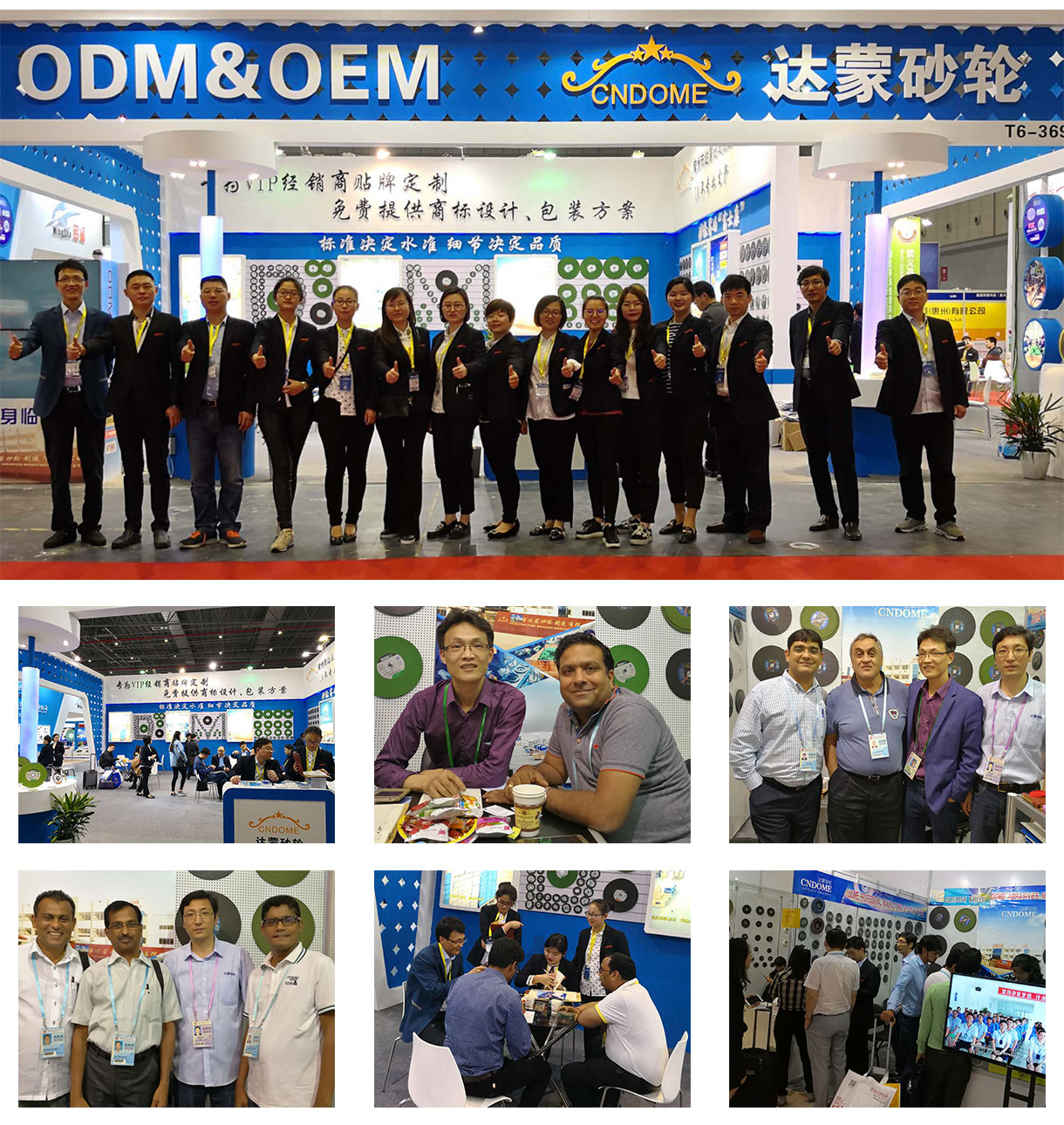
Sample requests and specification reviews can be handled directly with the manufacturer before a production order is placed.
Next Step: Test the Specification, Not the Brochure
Send CNDOME your cutting disc specification — diameter, thickness, bore, grain preference and packaging — and request a sample set for in-house thickness, density and cut testing. Custom cutting discs are available from 10,000 pieces with a 30-day lead time.
Contact: Chris — chris@czdome.com | Tel / WhatsApp: +86 18796960868
Website: czdome.com | Blog: blog.czdome.com
Address: Garden Industrial Park, Zhenglu Town, Tianning District, Changzhou City, Jiangsu Province, China
Catalogue download: CNDOME product brochure (PDF)
Have Questions or Need More Details?
Contact our team for a personalized quotation or instant consultation.
Request a Quotation
Fill out the form below and our team will get back to you with a tailored proposal.
WhatsApp Direct Chat
Prefer to chat in real-time? Message us on WhatsApp for instant assistance & quick answers.
- Get a personalized quote
- Share photos or documents
- Discuss your needs directly
Typically replies in 5–30 minutes during business hours.