Cutting Disc vs. Grinding Disc: A Buyer's Comparison Guide
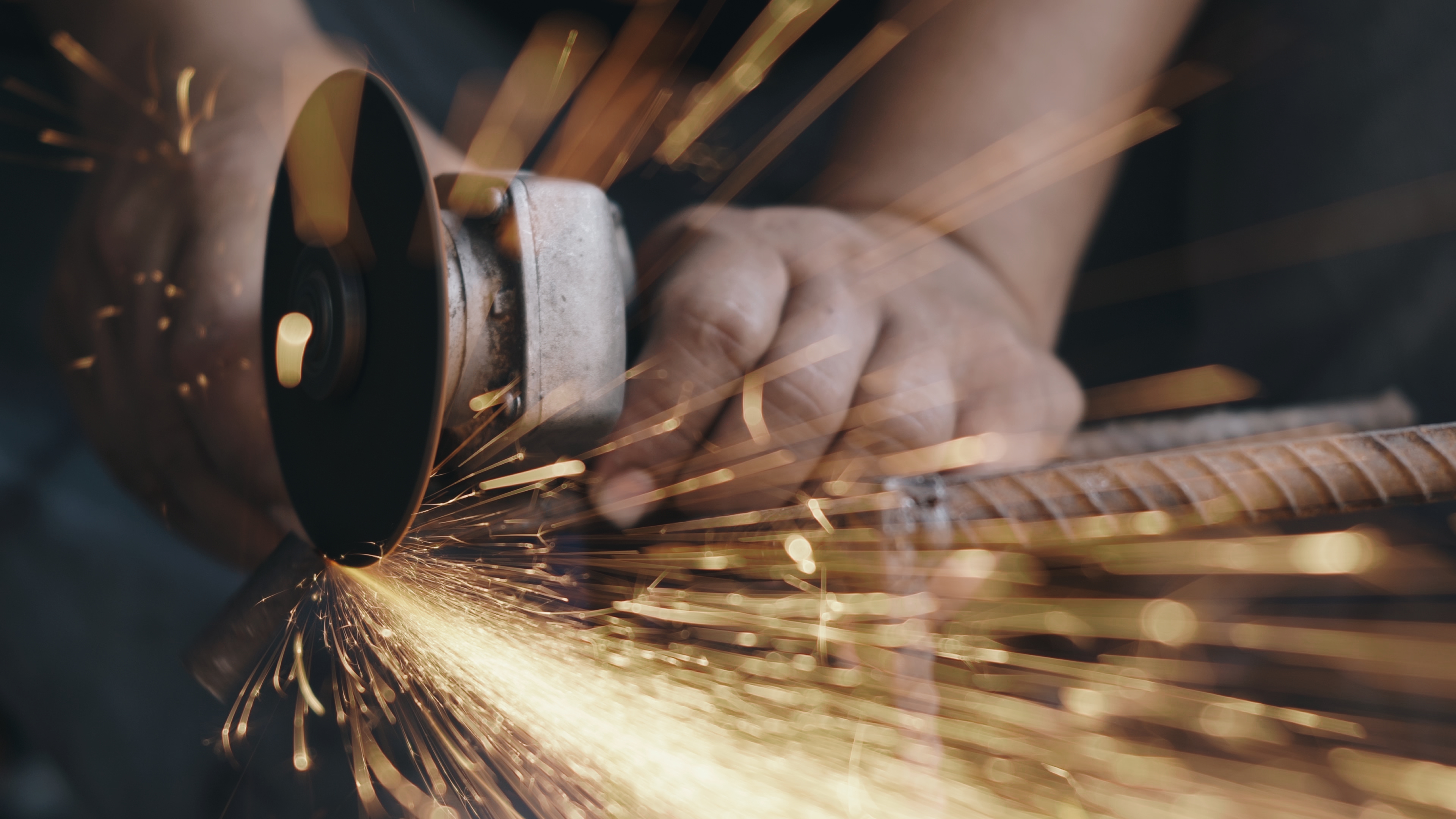
Cutting discs and grinding discs are both resin-bonded abrasive wheels, but they are not interchangeable. A cutting disc is the tool chosen when the job is to part metal or create a narrow slot. A grinding disc is the tool chosen when the job is to remove weld metal, scale, rust, or other surface material. This guide compares the two wheel families on shape, size, operating speed, material compatibility, and certification constraints.
To make the comparison concrete, the guide uses specification examples from Changzhou Dome Abrasives Manufacture Co., Ltd. (CNDOME), a manufacturer that has developed and produced resin-bonded cutting and grinding wheels for more than 26 years.
Why the Distinction Matters for Buyers
Both products sit in similar product categories, both look circular, and both can be mounted on angle grinders. If a buying team compares only outer diameter, it is easy to order a cutting disc when the workshop needs a grinding disc, or to use a grinding disc when the operation requires a clean cut.
The functional difference is working direction. A cutting disc is designed to work on its edge to make a cut. A grinding disc is designed to work on its face to remove material across a surface. The abrasive industry communicates this distinction through shape codes and through dimensions. Buyers should therefore read the shape code and the specification before evaluating price, brand, or packaging.
Resin-Bonded Abrasives in Metal and Construction Markets
Cutting discs and grinding wheels are widely used in industries such as steel, metal processing, automobile manufacturing, shipbuilding, casting, steel structure, and construction. Those sectors need both precision cutting and surface grinding, often on the same production floor.
Third-party research gives context to this buying decision. One published estimate values the global cutting discs market at about USD 7.32 billion in 2024, and Mordor Intelligence reports that Asia-Pacific accounted for 48.28% of global revenue in the cutting equipment and tools sector in 2025. Widespread demand explains why buyers see many sizes of cutting discs, from compact 1.5-inch wheels to large 16-inch wheels. It also makes specification and compliance discipline more important.
Cutting Disc vs. Grinding Disc: Shape and Specification Explained
Cutting Discs: T41/T42 Shapes
In CNDOME's product range, cutting discs are supplied in T41/T42 configurations for cut-off work. A 2-inch cutting disc, for example, is described as a T41 disc for metal/INOX. Other cutting disc sizes also use T41 or T42 profiles, depending on model and diameter. These shapes are part of the cutting-disc family, not the grinding-wheel family.
The 4.5-inch cutting disc illustrates how a cut-off wheel is specified. Model 115x1.2x22.23 has a 115 mm outside diameter, a 1.2 mm thickness, and a 22.23 mm bore. A 1.6 mm thickness option is also available for the same diameter. The disc is T41, the maximum operating speed is 80 m/s, and the rated speed is 13300 R.P.M. The grain system is aluminium oxide / white aluminium oxide with resin as the bond.
Grinding Discs: T27/T29 Shapes
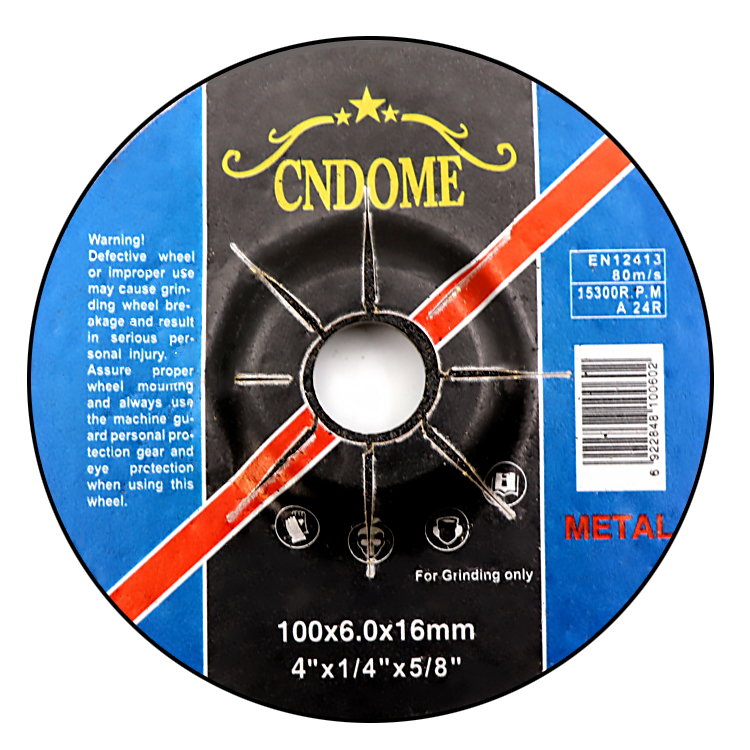
CNDOME grinding discs are produced in T27/T29 shapes for surface work. A common 4-inch grinding disc is model 100x6x16, which means 100 mm outside diameter, 6 mm thickness, and 16 mm bore. Its shape is T27, its maximum operating speed is 80 m/s, and it uses aluminium oxide / white aluminium oxide with a resin bond. This geometry is made for face grinding on metal workpieces.
The T29 profile also belongs to the grinding family. CNDOME makes a ceramic grinding disc in 115 mm and 125 mm nominal sizes with a maximum operating speed of 100 m/s. The ceramic version is labelled as a ceramic grinding disc for metal/INOX and uses a ceramic abrasive layer over a reinforced fibre cover plate.
The key difference between the two examples is geometry. The 4.5-inch cutting disc is only 1.2 mm or 1.6 mm thick, while the 4-inch grinding disc is 6 mm thick. The thinner cutting disc is intended for a narrow cut with lower material loss. The thicker grinding disc is intended to withstand face pressure during surface material removal.
Compliance and Certification Constraints
For European-bound abrasive orders, EN 12413 is the key safety standard for rotating bonded abrasive products. CNDOME holds a CE certificate for cutting and grinding wheels, certificate number M.2022.206.C74459 issued by UDEM, valid under EN 12413 until June 2027. Selected cutting disc models also carry MPA Hannover certification under EN 12413, with certificate numbers in the Z-15950 and Z-15953 series, such as Z-15950A/24 and Z-15953A/26.
Social compliance is also relevant for importers and distributors. CNDOME's cutting disc and grinding wheel production is covered by BSCI audits from ALGI, certificate numbers 156-025464-000 and 156-025464-001. The factory also holds ISO9001 and ISO14001 management system certificates, covering abrasive disc production and related hardware tool accessories.
Buyers should note that certification coverage may be model-specific. Before placing a container order, confirm that the exact diameter, thickness, and arbor size are listed on the certificate or technical file.
Step-by-Step Selection Guide
- Define the operation first. If you need to cut a bar, pipe, or sheet, choose a cutting disc. If you need to remove weld reinforcement, scale, or coating from a surface, choose a grinding disc.
- Check the arbor hole and grinder spindle. The disc bore must match the grinder spindle. A 22.23 mm bore is common for many angle grinder discs, while a 100 mm grinding disc may use a 16 mm bore.
- Match the outside diameter to the machine. A 115 mm disc is commonly referred to as 4.5 inch, while a 100 mm disc is commonly referred to as 4 inch. Larger 180 mm and 230 mm wheels are used for heavier machines.
- Select the correct thickness. For cutting, a 1.2 mm disc is thin and fast, while a 1.6 mm version offers more edge strength for tougher cuts. For a 4-inch grinding disc, 6 mm thickness is normal.
- Confirm material compatibility. If you cut or grind stainless steel, look for products labelled for metal/INOX. CNDOME lists models such as the 2-inch T41 cutting disc and the ceramic T29 grinding disc for metal/INOX applications.
- Check operating speed. The abrasive wheel's maximum speed must not be lower than the tool's no-load speed. Many CNDOME cutting and grinding discs are rated at a maximum operating speed of 80 m/s.
- Verify compliance documents. Check for EN 12413, CE, MPA, BSCI, or ISO9001 documentation according to your destination market and buyer requirements.
- Test with a sample before scaling. Cutting speed, edge quality, wheel life, and noise are best evaluated in a real workshop before mass procurement.
Use Cases: When to Choose Cutting Discs vs. Grinding Discs
- Precision cutting on steel plate and bar: A 4.5-inch T41 cutting disc, 115x1.2x22.23, is suitable when the operator needs a narrow, controlled cut with minimal material loss.
- Stainless steel or INOX fabrication: Choose cutting discs explicitly marked for metal/INOX. Small-diameter T41 metal/INOX cutting discs and T29 ceramic grinding discs are examples of CNDOME products with that designation.
- Surface grinding on steel parts: A 4-inch T27 grinding disc, 100x6x16, is a practical configuration for weld grinding, surface smoothing, and material removal across the face of the workpiece.
- Heavy fabrication and shipyard work: Operators often need both cutting and grinding wheels in multiple sizes to handle steel plate, pipes, castings, and structural profiles within the same facility.
- High-speed stock removal on stainless steel: CNDOME's T29 ceramic grinding disc, available in 115 mm and 125 mm sizes, is rated at 100 m/s and belongs to the grinding side of the comparison.
Cutting Disc vs. Grinding Disc: Comparison Table
| Attribute | Cutting Disc | Grinding Disc |
|---|---|---|
| Main purpose | Cut-off, slitting, parting metal | Surface material removal, weld grinding, smoothing |
| Shape families in CNDOME range | T41 / T42 | T27 / T29 |
| Example specification | 4.5-inch cutting disc: 115x1.2x22.23 | 4-inch grinding disc: 100x6x16 |
| Outer diameter in example | 115 mm | 100 mm |
| Thickness in example | 1.2 mm, with 1.6 mm option available | 6 mm |
| Bore in example | 22.23 mm | 16 mm |
| Maximum speed in examples | 80 m/s; rated 13300 R.P.M | 80 m/s |
| Primary work direction | Edge or periphery | Face or flat surface |
| Typical materials in CNDOME examples | Aluminium oxide / white aluminium oxide with resin bond; some metal/INOX models available | Aluminium oxide / white aluminium oxide with resin bond; ceramic T29 version for metal/INOX |
| Relevant industries listed in product data | Steel, metal processing, automobile manufacturing, shipbuilding, casting, steel structure, construction | Steel, metal processing, automobile manufacturing, shipbuilding, casting, steel structure, construction |
FAQ
Which safety standard should cutting discs and grinding discs meet when I import them into Europe?
The key standard is EN 12413. CNDOME has CE certificate M.2022.206.C74459 covering cutting and grinding wheels under EN 12413, valid until June 2027. Several cutting disc models also have independent MPA certificates issued by MPA Hannover, with numbers such as Z-15950A/24. BSCI audits from ALGI cover social compliance with certificate numbers 156-025464-000 and 156-025464-001. Check the exact model before ordering because certification coverage can be model-specific.
Can I use a T27 grinding disc for cutting metal?
No. A T27 grinding disc is designed for surface grinding, not for narrow through-cuts. Cutting metal requires a T41 or T42 cutting profile. A T27 wheel has a thick face made for pressure against the work surface; using it for cutting can damage the workpiece and overload the wheel.
What do the specification numbers on a cutting disc mean?
Cutting disc dimensions are normally written in millimetres as diameter x thickness x bore. Example 115x1.2x22.23 means 115 mm outer diameter, 1.2 mm thickness, and 22.23 mm arbor hole. A grinding disc specification such as 100x6x16 means 100 mm outer diameter, 6 mm thickness, and 16 mm bore.
Do stainless steel jobs require a different type of cutting disc?
Stainless steel work should use a product identified for INOX or metal/INOX where available. In CNDOME's product range, several cutting and grinding products carry the metal/INOX description, such as the 2-inch T41 cutting disc and the ceramic T29 grinding disc. Standard metal cutting discs are made with aluminium oxide or white aluminium oxide and resin; INOX-specific models should be selected when stainless steel is the workpiece.
Can I request samples or custom branding for cutting and grinding discs?
CNDOME supports OEM and ODM customization for logo, label, package, abrasive formulation, and specification. Custom cutting discs are available in quantities of 10,000 pieces or more. Production capacity is strong enough to support monthly volumes of up to 8 million pieces, and lead time is about 30 days depending on specification. Contact Chris at chris@czdome.com or WhatsApp +86 18796960868 to start a sample or quotation conversation.
Conclusion
A cutting disc and a grinding disc belong to the same abrasive family, but they serve different stages of metalwork. Cutting discs such as the 4.5-inch T41 model 115x1.2x22.23 are built for precision cut-off. Grinding discs such as the 4-inch T27 model 100x6x16 are built for surface material removal. Shape codes T41/T42 versus T27/T29 make the product architecture clear, while dimensions define tool compatibility.
For buyers in the research and evaluation stage, the reliable path is simple: confirm the operation, confirm the shape code, confirm the exact diameter/thickness/bore, and then confirm the certification file. A properly matched abrasive wheel reduces downtime, improves cutting quality, and lowers the risk of purchasing the wrong consumable at container volume.
Need a specification review, sample, or private label quotation? Contact CNDOME for cutting disc and grinding disc options.
Name: Chris
Email: chris@czdome.com
Tel / WhatsApp: +86 18796960868
Have Questions or Need More Details?
Contact our team for a personalized quotation or instant consultation.
Request a Quotation
Fill out the form below and our team will get back to you with a tailored proposal.
WhatsApp Direct Chat
Prefer to chat in real-time? Message us on WhatsApp for instant assistance & quick answers.
- Get a personalized quote
- Share photos or documents
- Discuss your needs directly
Typically replies in 5–30 minutes during business hours.