
Matching Cutting Discs to Industries: Steel, Automotive, and Construction Applications
Cutting discs are matched to industries through four variables: diameter, thickness, profile and abrasive grain. In the CNDOME resin-bonded range, three sizes cover most of the industrial cutting work described in the product data: the 4.5-inch cutting disc (115 × 1.2 × 22.23 mm) for steel and automotive fabrication, the 9-inch cutting disc (230 × 2.0 × 22.23 mm) for shipbuilding and construction, and the 14-inch cutting disc (355 × 3.2 × 25.4 mm) for heavy steel processing. Profile choice — the flat T41 used across the range, or the T42 option listed for the 125 mm and 230 mm discs — decides how the wheel meets the workpiece, while grain and bond decide how it behaves inside the cut.
This guide is written for the people who have to make that match correctly: distributors building a cutting disc assortment, procurement managers specifying consumables for a fabrication shop, workshop engineers replacing a disc under time pressure, and brand owners sourcing under their own label. It maps the CNDOME cutting disc range to the industries listed in the product data — steel and metal processing, automobile manufacturing, shipbuilding, casting, steel structure and construction — and explains which size, thickness and profile belongs in each one.
Why One Disc Specification Cannot Serve Every Industry
A single cutting disc specification cannot serve every industry because the physical limits change with the job. A 115 mm disc is designed to run at 13,300 RPM on a hand-held angle grinder; a 355 mm disc is designed for 4,400 RPM on a larger machine. Those two discs are not interchangeable, and neither is correct for the other's task.
The mismatch appears in four places:
- Machine compatibility. Every CNDOME cutting disc in the range is rated at a maximum operating speed of 80 m/s, but the matching RPM figure falls as diameter rises. Fitting a disc to a machine whose no-load speed exceeds the disc rating is a safety issue, not a performance preference.
- Section thickness. Thin sheet and light tube in automotive work are cut with a thin 115 × 1.2 mm disc. Heavy plate, rail, castings and structural sections demand a larger diameter and a thicker disc so the wheel does not deflect or load up in the cut.
- Finish requirements. Industry specifications commonly call for high flatness, no blackening after cutting, burr-free cutting and no vibration during grinding. Heat generation and blueing during cutting are the visible failure modes when a disc is wrong for the material.
- Working conditions. Applications in this range frequently start from low efficiency, poor precision, difficult-to-process materials, high dust, low yield and edge chipping. Disc selection is one of the few variables a buyer controls that directly affects all of them.
Industry Background: Where Cutting Disc Demand Is Concentrated
The global cutting discs market reached a valuation of approximately USD 7.32 billion in 2024, according to Market Research Future. Published estimates differ by scope: Strategic Market Research values the market at USD 5.1 billion and Reports and Insights at USD 2.5 billion, because some studies count only disc consumables while others include broader cutting equipment. Buyers reading market figures should check which definition is being used before quoting a number.
Regional demand is concentrated in Asia. Asia-Pacific accounted for 48.28% of global revenue in the cutting equipment and tools sector in 2025, maintaining its position as the largest regional market (Mordor Intelligence). The China abrasives market alone was valued at USD 2.29 billion in 2024, of which synthetic raw materials accounted for USD 1.35 billion (Intel Market Research). Within the cutting disc category, stainless steel cutting discs are identified as the dominating product segment, driven by heavy demand in construction and automotive manufacturing (Cognitive Market Research). Named participants in the abrasives and cutting tool sector include Saint-Gobain (Norton), 3M, Robert Bosch GmbH, Tyrolit and PFERD (Market Research Future).
Supply-side capacity matters to the same buyers who read those figures. Changzhou Dome Abrasives Manufacture Co., Ltd. (CNDOME) was founded in 2001 and manufactures resin-bonded cutting and grinding wheels, with main products covering cutting discs, grinding wheels, abrasive discs, ceramic grinding discs and flap discs. The facility covers 20,000 m² with 60 automated production lines, approximately 140 employees and a 10-engineer R&D team; daily output is about 600,000 pieces and annual production capacity is 95 million pieces, supporting customized OEM and ODM programmes for global tool and professional abrasive wheel brands.
The Size-to-Industry Match: Which Disc Belongs Where
Three sizes carry the heaviest industrial load in this range, and each one corresponds to a different set of industries, machines and materials.
4.5-Inch Cutting Disc (115 × 1.2 × 22.23 mm) — Steel and Automotive
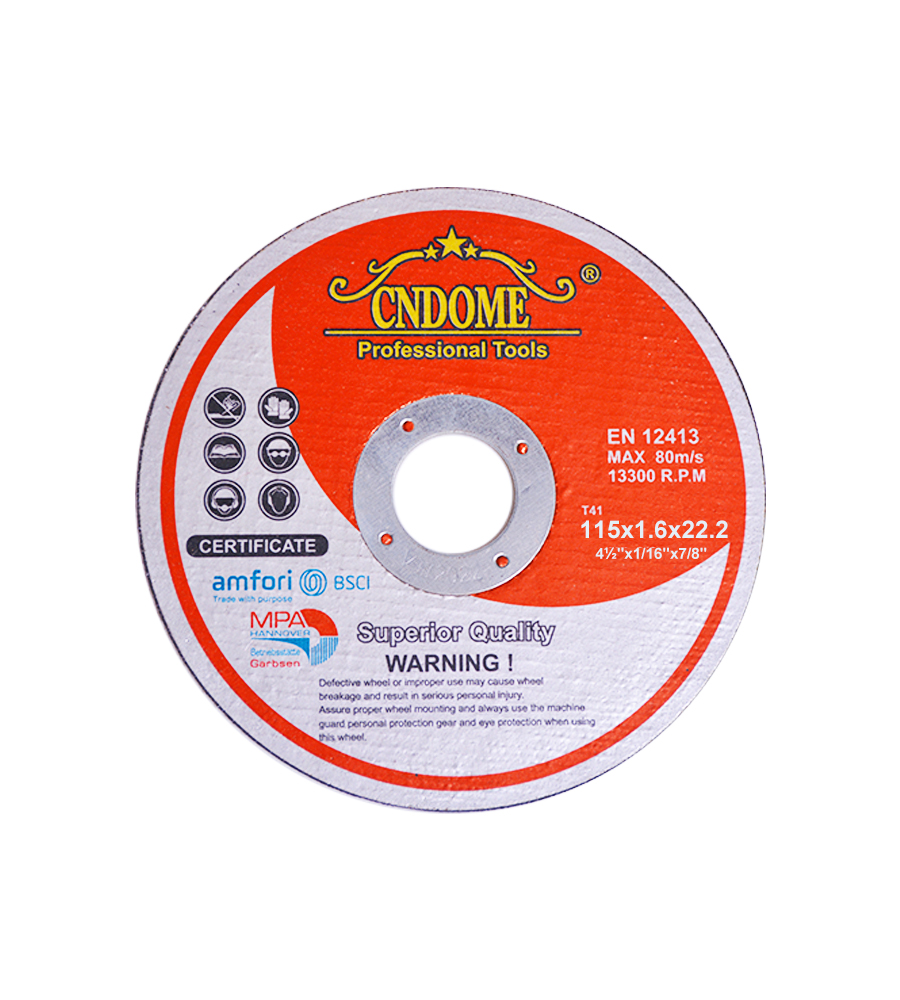
The 4.5-inch cutting disc is the general-purpose industrial size in the range. The model designation is 115 × 1.2 × 22.23, with a second thickness option at 115 × 1.6 × 22.23 mm, a 22.23 mm bore and a T41 flat profile. The disc operates at a maximum speed of 80 m/s and a rated speed of 13,300 RPM, and is manufactured from aluminium oxide, white aluminium oxide and resin. It is intended for use in the steel, metal processing, automobile manufacturing, shipbuilding, casting, steel structure and construction industries.
In automotive manufacturing the 4.5-inch disc suits body and chassis fabrication, exhaust work and general assembly-line cutting where access is limited and a hand-held angle grinder is the tool in use. In steel processing it handles sheet, tube, bar and profile work. Where a slightly thicker disc is preferred for a more rigid cut on the same machine, the 115 × 1.6 × 22.23 mm version uses the same 22.23 mm bore and T41 geometry.
9-Inch Cutting Disc (230 × 2.0 × 22.23 mm) — Shipbuilding and Construction
The 9-inch cutting disc is the mid-range workhorse for heavier sections. It is available in three thicknesses — 230 × 2.0 × 22.23, 230 × 2.5 × 22.23 and 230 × 3.0 × 22.23 mm — with a 22.23 mm bore and either T41 or T42 structural configuration. Rated speed is 6,600 RPM with a maximum operating speed of 80 m/s, and the disc is made of aluminium oxide, white aluminium oxide and resin. It is suitable for steel structure, construction, casting, shipbuilding, automobile manufacturing and steel and metal processing industries.

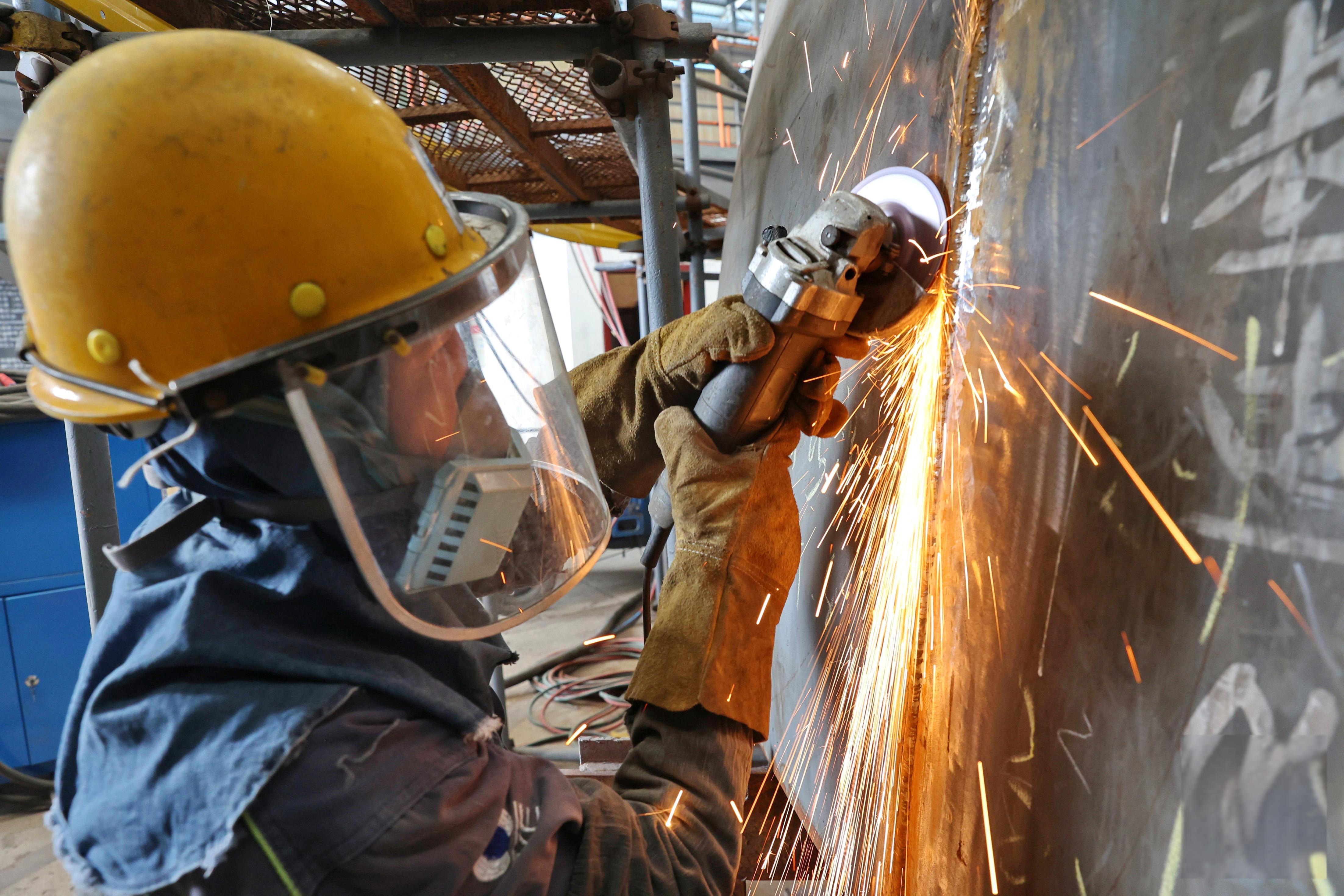
Shipyards and construction sites share the same practical constraints: thick plate, awkward positions, and cuts that must be clean enough for the next operation without extra dressing. The thicker 3.0 mm version of the 9-inch disc is the appropriate choice where the wheel must hold its line through plate and structural steel; the 2.0 mm version suits faster, lower-loss cutting where the machine and the operator can control a thinner wheel. In shipbuilding applications the cutting range is usually paired with a 9-inch grinding disc — model 230 × 6 × 22.23 mm, T27 profile, 80 m/s and 6,600 RPM, made of aluminium oxide or white aluminium oxide bonded with resin — for weld preparation and clean-up on the same machine.
14-Inch Cutting Disc (355 × 3.2 × 25.4 mm) — Heavy Steel Processing
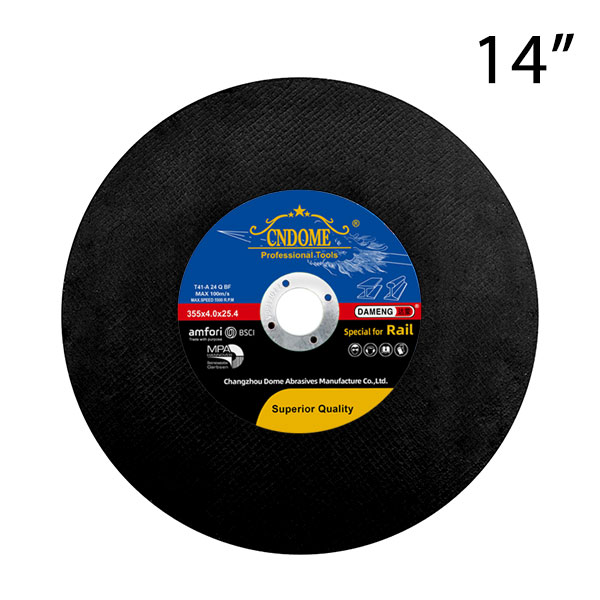
The 14-inch cutting disc is the heavy-duty option. Model 355 × 3.2 × 25.4 has a 355 mm diameter, 3.2 mm thickness and 25.4 mm bore, a T41 profile, and an operating speed of 80 m/s at 4,400 RPM. It is made of aluminium oxide, white aluminium oxide and resin, and is intended for steel and metal processing, automobile manufacturing, shipbuilding, casting, steel structure and construction industries.

Where the workpiece is very heavy — large castings, thick plate and rail sections — the range extends further with the 16-inch cutting disc, model 400 × 3.5 × 32 mm, T41, running at 80 m/s and 3,800 RPM, also intended for casting, steel structure and shipbuilding environments. The rule is consistent across all three sizes: larger diameter for deeper cuts and heavier stock, thinner thickness for lower material loss on the same machine, and a rated speed that must be checked against the machine before the disc is mounted.
T41 and T42: What the Profile Changes
Profile is the second half of the matching decision. T41 is the flat cutting wheel profile — the product data describes it as T41 (flat) — and it is the configuration used by the 1.5-inch, 2-inch, 3-inch, 4-inch, 4.5-inch, 7-inch, 14-inch and 16-inch cutting discs in the range. T42 is the variant listed for the 125 mm (5-inch) and 230 mm (9-inch) cutting discs, where the model designations are marked T41/T42.
In practice the profile decision follows the cut, not the industry. A flat T41 disc gives the straightest line and the greatest usable depth of cut when the machine can approach the workpiece squarely. The T42 option on the 125 mm and 230 mm discs gives buyers an alternative geometry on the two sizes most often used in mixed fabrication and site work, where the operator's approach angle and the machine flange clearance matter as much as the abrasive specification. On the grinding side of the same range, profile designations follow the same logic: T27 for the 4-inch, 4.5-inch, 5-inch, 6-inch, 7-inch and 9-inch grinding discs, and T29 for the ceramic grinding disc.
Step-by-Step: Matching a Disc to an Industry Job
The sequence below uses only the specification fields that appear in the CNDOME product data, so it can be repeated for any incoming enquiry.
- Confirm the machine and its speed. Establish whether the tool is an angle grinder, cutting machine, straight angle grinder or chainsaw, and what its no-load speed is. Every cutting disc listed here is rated at 80 m/s maximum, so the machine must not exceed the matching RPM: 13,300 RPM for 115 mm, 12,200 RPM for 125 mm, 8,500 RPM for 180 mm, 6,600 RPM for 230 mm, 4,400 RPM for 355 mm and 3,800 RPM for 400 mm.
- Measure the section and the cut depth. Diameter is selected by the depth of cut required, not by preference. Automotive sheet and tube work is normally a 115 mm disc job; structural plate and shipyard work is a 230 mm disc job; heavy plate, rail and castings move to 355 mm or 400 mm.
- Set the thickness from the finish target. The range offers 1.2 mm and 1.6 mm at 115 mm; 1.2 mm, 1.6 mm, 2.0 mm and 3.0 mm at 125 mm; 1.6 mm, 2.0 mm and 3.0 mm at 180 mm; and 2.0 mm, 2.5 mm and 3.0 mm at 230 mm. Thinner discs follow the requirement for low loss and high precision; thicker discs support the requirement for high flatness, no vibration and long service life.
- Choose the profile. T41 for the straightest cut where access allows; T42 where the 125 mm or 230 mm disc is used in mixed positions and the depressed-centre option is preferred.
- Match the grain and bond to the material. Cutting discs in the range are built on aluminium oxide, white aluminium oxide and resin; the 125 mm and 180 mm cutting discs also list silicon carbide and zirconium, and the ceramic grinding disc uses ceramic sandpaper with a reinforced fiber cover plate at 100 m/s.
- Check the compliance documentation. Confirm the certification covering the model and the market it will be sold into before the order is placed.
- Confirm the finish requirement against the working conditions. High temperature resistance, burr-free cutting, no blackening after cutting, high flatness and no vibration during grinding are the stated requirements for this application set, and they should be written into the purchase specification rather than assumed.
- Verify supply capability for repeat orders. For industrial accounts the disc specification only holds if the same specification can be supplied again at volume.
Industry Use Cases in the CNDOME Range
Steel and Metal Processing
General steel processing is the broadest application: cutting sheet, plate, bar, tube and profile across mechanical processing manufacturers and metal cutting engineering projects. The 4.5-inch disc (115 × 1.2 × 22.23 mm) covers most hand-held work, the 7-inch disc (180 mm, T41, 8,500 RPM, 80 m/s) covers mid-section work where a larger cut is needed, and the 14-inch and 16-inch discs cover production cutting of heavy stock.
Automobile Manufacturing
Automotive applications favour the smaller end of the range: the 4.5-inch cutting disc is listed for automobile manufacturing at 13,300 RPM, and the 4-inch disc (107 × 1.2 × 16 mm and 100 × 1.0 × 16 mm, T41, 15,400 RPM) and 3-inch disc (75 × 1.2 × 10 mm and 76 × 1.0 × 10 mm, T41, 20,100 RPM) support tighter, smaller-diameter work. The 1.5-inch (38 × 1.1 × 3 mm) and 2-inch (50 × 1.2 × 10 mm and 50 × 2 × 10 mm) discs extend the same material specification into small-diameter and detail work.
Shipbuilding
Shipyard processing combines cutting and grinding on the same plate. The 9-inch cutting disc (230 × 2.0 / 2.5 / 3.0 × 22.23 mm, T41/T42, 6,600 RPM) handles section and plate cutting, while the 9-inch grinding disc (230 × 6 × 22.23 mm, T27, 6,600 RPM) and the 6-inch/7-inch grinding discs (150 × 6 × 22.23 mm and 180 × 6 × 22.23 mm, T27, 80 m/s) cover weld preparation and clean-up.
Construction and Steel Structure
Construction and steel structure work is typically specified around the 9-inch cutting disc for structural sections and the 4.5-inch cutting disc for site fabrication and fixing work. The 4.5-inch cutting disc with T41 configuration is also documented specifically for construction industry use, which makes it the practical size for mixed site work where the same grinder has to cut several materials in a shift.
Casting
Casting work involves gates, risers and heavy irregular sections. The range covers it at both ends: the 9-inch cutting disc for mid-size castings and the 16-inch disc (400 × 3.5 × 32 mm, T41, 3,800 RPM) for very heavy stock, both rated at 80 m/s maximum operating speed.
Routine Maintenance and Repair
Industrial manufacturing, construction and routine maintenance applications are documented for this range across markets including Brazil, UAE and Australia. The 4.5-inch and 5-inch discs are the practical sizes for maintenance work, with the 5-inch disc (125 mm, 1.2 mm to 3.0 mm thickness, T41/T42, 12,200 RPM) offering four thickness options on one diameter.
Cutting Disc Selection Table by Industry
| Industry / application | Recommended disc | Model | Profile | Max operating speed | Rated speed |
|---|---|---|---|---|---|
| Steel and general metal processing | 4.5-inch cutting disc | 115 × 1.2 × 22.23 mm (also 115 × 1.6 × 22.23 mm) | T41 | 80 m/s | 13,300 RPM |
| Automobile manufacturing | 4.5-inch cutting disc | 115 × 1.2 × 22.23 mm | T41 | 80 m/s | 13,300 RPM |
| Shipbuilding | 9-inch cutting disc | 230 × 2.0 × 22.23 mm (2.5 mm and 3.0 mm options) | T41 / T42 | 80 m/s | 6,600 RPM |
| Construction and steel structure | 9-inch cutting disc | 230 × 2.0 × 22.23 mm | T41 / T42 | 80 m/s | 6,600 RPM |
| Heavy steel processing | 14-inch cutting disc | 355 × 3.2 × 25.4 mm | T41 | 80 m/s | 4,400 RPM |
| Casting and very heavy stock | 16-inch cutting disc | 400 × 3.5 × 32 mm | T41 | 80 m/s | 3,800 RPM |
The same logic applies across the full cutting range, which is listed below with its profile and rated-speed data so that a buyer can match a disc to a machine without further reference.
| Disc size | Model designation | Profile | Rated speed | Max operating speed |
|---|---|---|---|---|
| 1.5 inch | 38 × 1.1 × 3 mm | T41 | 45,000 RPM | 80 m/s |
| 2 inch | 50 × 1.2 × 10 mm / 50 × 2 × 10 mm | T41 | 30,100 RPM | 80 m/s |
| 3 inch | 75 × 1.2 × 10 mm / 76 × 1.0 × 10 mm | T41 | 20,100 RPM | 80 m/s |
| 4 inch | 107 × 1.2 × 16 mm / 100 × 1.0 × 16 mm | T41 | 15,400 RPM | 80 m/s |
| 4.5 inch | 115 × 1.2 × 22.23 mm / 115 × 1.6 × 22.23 mm | T41 | 13,300 RPM | 80 m/s |
| 5 inch | 125 × 1.2 / 1.6 / 2.0 / 3.0 × 22.23 mm | T41 / T42 | 12,200 RPM | 80 m/s |
| 7 inch | 180 × 1.6 / 2.0 / 3.0 × 22.23 mm | T41 | 8,500 RPM | 80 m/s |
| 9 inch | 230 × 2.0 / 2.5 / 3.0 × 22.23 mm | T41 / T42 | 6,600 RPM | 80 m/s |
| 14 inch | 355 × 3.2 × 25.4 mm | T41 | 4,400 RPM | 80 m/s |
| 16 inch | 400 × 3.5 × 32 mm | T41 | 3,800 RPM | 80 m/s |
Compliance: What Buyers Should Check Across Industries
Certification is the one part of the matching exercise that is identical for every industry. The cutting disc model 180 × 1.6 × 22.23 mm is CE certified to EN 12413 under certificate number M.2022.206.C74459 issued by UDEM; the certification covers cutting disc and grinding wheel products for the global market. EN 12413:2019 specifies the safety requirements and testing procedures for rotating bonded abrasive products, including cutting and grinding wheels. MPA Hannover provides independent safety testing and certification for abrasive tools, which is a key requirement for exporting industrial cutting discs to the EU market.
Two practical consequences follow for buyers specifying discs by industry. First, the declared maximum operating speed — 80 m/s across the cutting discs listed here and 100 m/s for the T29 ceramic grinding disc — is the number that must be reconciled with the machine before use. Second, documentation should be requested for the specific model being purchased, because certification references are model-specific in the product data.
Frequently Asked Questions
Are CNDOME cutting discs certified for EU and international markets?
The CE certification covering CNDOME cutting discs and grinding wheels is issued by UDEM under certificate number M.2022.206.C74459, and the applicable standard listed is EN 12413; the certified model reference in the product documentation is 180 × 1.6 × 22.23 mm, and the certification covers cutting disc and grinding wheel products for the global market. EN 12413:2019 specifies the safety requirements and testing procedures for rotating bonded abrasive products, including cutting and grinding wheels, and MPA Hannover provides independent safety testing and certification for abrasive tools, which is a key requirement for exporting industrial cutting discs to the EU market.
Can disc specifications be adapted to a specific industry or machine?
The range already covers multiple specification combinations: 4.5-inch discs in 1.2 mm and 1.6 mm thickness, 9-inch discs in 2.0 mm, 2.5 mm and 3.0 mm thickness, 5-inch discs from 1.2 mm to 3.0 mm, and grain options including aluminium oxide, white aluminium oxide, silicon carbide and zirconium with a resin bond, plus a ceramic grinding disc at 115 mm and 125 mm (T29, 100 m/s) made of ceramic sandpaper and a reinforced fiber cover plate. Changzhou Dome Abrasives Manufacture Co., Ltd. has operated customized OEM and ODM services since 2001 and supports more than 2,000 global tool and professional abrasive wheel brands from a 20,000 m² temperature- and humidity-controlled workshop with 60 automated production lines.
What drives the cost of an industrial cutting disc?
The specification itself is the main cost driver. A 355 × 3.2 × 25.4 mm disc contains substantially more abrasive material and reinforcement than a 115 × 1.2 × 22.23 mm disc, the grain type changes raw-material cost, and certified documentation adds testing and administrative work. When comparing quotations for the same industry application, compare the specification line by line — diameter, thickness, bore, profile, grain, and maximum operating speed — before comparing price, because two discs with the same diameter can differ in thickness, profile and grain.
How should a buyer validate a disc before a bulk order?
Validation starts with the two ends of the application. On the input side, check the working conditions the disc is expected to handle: low efficiency, poor precision, difficult-to-process materials, high dust, low yield, edge chipping, heat generation and blueing during cutting. On the output side, check the finishing requirements: high flatness, no blackening after cutting, high temperature resistance, burr-free cutting, long service life and no vibration during grinding. Then confirm that the declared speed matches the machine — 115 mm at 13,300 RPM, 230 mm at 6,600 RPM and 355 mm at 4,400 RPM, all at a maximum operating speed of 80 m/s. Samples and the full product catalogue are available on request from Chris at chris@czdome.com or +86 18796960868.
What production capacity supports repeat industrial orders?
Changzhou Dome Abrasives Manufacture Co., Ltd. operates a 20,000 m² facility with 60 automated production lines, approximately 140 employees and a 10-engineer R&D team. Daily output is about 600,000 pieces and annual production capacity is 95 million pieces, with around 80% of output exported to main markets in Latin America, Europe, Africa and Asia. Production scheduling is confirmed against the final specification and the order volume.
Conclusion: Match the Industry, Then Match the Disc
Industry matching is simply a filter applied before specification matching. Steel and automotive work resolves to the 4.5-inch cutting disc at 115 × 1.2 × 22.23 mm; shipbuilding and construction resolve to the 9-inch cutting disc at 230 × 2.0 × 22.23 mm in T41 or T42; heavy steel processing resolves to the 14-inch cutting disc at 355 × 3.2 × 25.4 mm. Where the stock is heavier again, the 16-inch disc at 400 × 3.5 × 32 mm covers castings and large sections, and the smaller 1.5-inch to 7-inch sizes cover automotive detail work, maintenance and site fabrication. All cutting discs in the range share the same maximum operating speed of 80 m/s, which makes the machine's RPM — not the industry label — the final check before mounting.
Request a Sample or the CNDOME Catalogue
Tell us the industry, the material and the machine, and we will confirm the matching disc size, thickness and profile from the CNDOME range. Contact Chris at chris@czdome.com, call or message +86 18796960868, or download the full CNDOME product brochure (PDF). More information on the manufacturer is available at czdome.com.

Have Questions or Need More Details?
Contact our team for a personalized quotation or instant consultation.
Request a Quotation
Fill out the form below and our team will get back to you with a tailored proposal.
WhatsApp Direct Chat
Prefer to chat in real-time? Message us on WhatsApp for instant assistance & quick answers.
- Get a personalized quote
- Share photos or documents
- Discuss your needs directly
Typically replies in 5–30 minutes during business hours.