
Cutting Disc 101: Types, Sizes and Materials for Steel and Stainless Steel Work
A cutting disc is a resin-bonded abrasive wheel mounted on an angle grinder or cutting machine to separate or slot metal. It is also commonly called a cutting wheel, a steel cutting disc, or simply an abrasive wheel. Cutting discs belong to the bonded abrasive family, and they differ from grinding wheels mainly by job: a cutting disc makes a narrow cut, while a grinding wheel removes surface material. Changzhou Dome Abrasives Manufacture Co., Ltd., the company behind CNDOME abrasive products, has developed and manufactured resin-bonded cutting and grinding wheels since 2001. Its product family includes cutting discs, grinding wheels, abrasive discs, ceramic grinding discs, and flap discs.
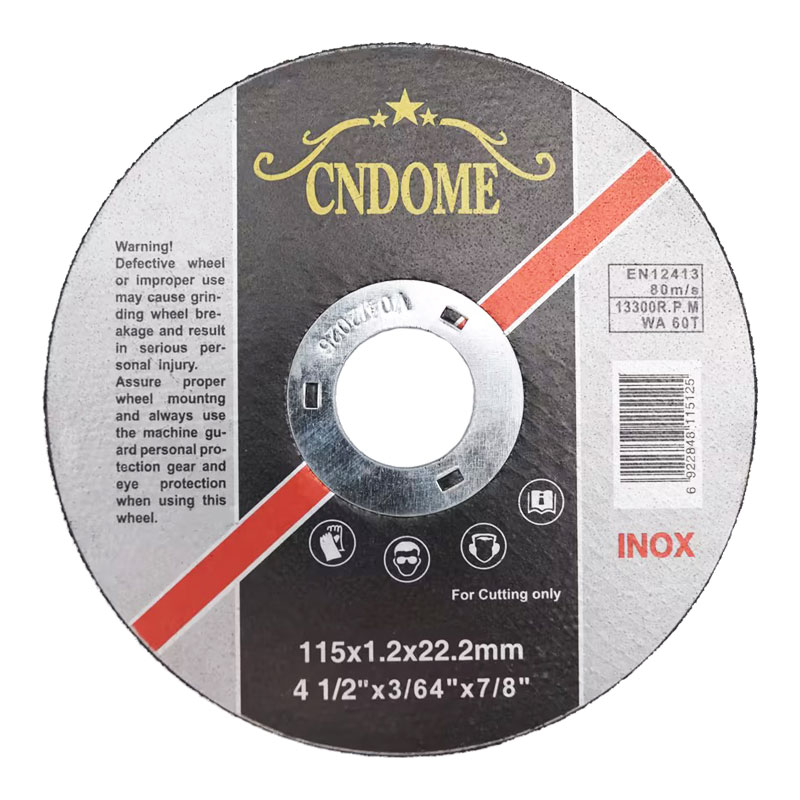
What Is a Cutting Disc?
A cutting disc removes material through fast rotation of abrasive grains. The disc is pressed against steel, stainless steel, castings, or other metal sections, and the exposed grains wear a narrow slot through the workpiece. This is why the disc must be matched to the machine speed: for example, CNDOME cutting discs are generally rated with a maximum operating speed of 80 m/s, while rated speeds vary by diameter from roughly 3,800 RPM on a 16 inch disc to 45,000 RPM on a small 1.5 inch disc.
Cutting discs are not saw blades. They have no continuous cutting teeth. Instead, their working surface is a dense layer of abrasive grain and resin bond. The product designation often used by CNDOME, such as 115x1.2x22.23, simply describes diameter x thickness x bore in millimetres. A 115 mm disc with a 1.2 mm thickness and a 22.23 mm bore is a widely used 4.5 inch cutting disc for angle grinders.
Why Cutting Discs Matter in Metalworking and Construction
Cutting discs are small consumables, but they directly affect speed, surface quality, safety, and operating cost. Operators expect a disc to cut cleanly without excessive heat, dust, vibration, or edge breakage. In CNDOME's application notes, the common challenges in real workshops include low efficiency, poor precision, difficult-to-process material, high dust, low yield, edge chipping, heat generation, and blueing during cutting. Good cutting disc selection addresses those conditions by delivering high precision and low loss while reducing dust and avoiding heat damage.
Market research also shows why cutting discs are a mainstream industrial category. Market Research Future estimated the global cutting discs market at approximately USD 7.32 billion in 2024. According to Mordor Intelligence, Asia-Pacific accounted for 48.28% of global revenue in the cutting equipment and tools sector in 2025. In China, the abrasives market was valued at USD 2.29 billion in 2024. These figures give context to buyers who are evaluating abrasive wheel suppliers in different regions.
How Cutting Discs Are Built: Grain, Bond and Model Numbers
Bonded abrasive wheels are made from abrasive grains held in a bond system. For resin-bonded cutting discs, the most common CNDOME material list is aluminium oxide, white aluminium oxide, and resin. Some discs also include silicon carbide and zirconium in the composition. The term resin-bonded simply means that a resin matrix holds the abrasive grains together, which allows the disc to break down gradually during cutting and expose fresh sharp particles.
Model numbers make it easier for a buyer to identify the correct wheel. The format diameter x thickness x bore is used across the CNDOME range. For example, 180x1.6x22.23 describes a 7 inch cutting disc with a 180 mm diameter, a 1.6 mm thickness, and a 22.23 mm bore. A 50x2x10 model describes a 2 inch cutting disc with a 10 mm bore and a 2 mm thickness. Understanding this simple code helps match a disc to the spindle and guard of the tool.
Cutting Disc Shapes: T41, T42 and T27
Cutting and grinding discs use shape codes to describe their profile. T41 normally identifies a flat cutting disc. T42 normally identifies a depressed-centre cutting disc, which has a raised centre area that can be useful with angle grinders. T27 normally identifies a depressed-centre grinding disc used for surface grinding rather than cutting. These shape codes appear on labels and product sheets so that users can confirm the geometry before mounting the disc.
CNDOME's cutting disc range is mainly supplied in T41 and T42 profiles. The 4 inch, 4.5 inch, 7 inch, and many smaller discs are listed with a T41 shape. Some 5 inch and 9 inch cutting discs are listed as T41/T42, giving buyers a choice of profile. Grinding products such as the 4 inch, 4.5 inch, 5 inch, 6 inch, 7 inch, and 9 inch grinding wheels are supplied in T27 profile. The T29 profile is used for the company's ceramic grinding disc.
Abrasive Materials: Aluminium Oxide, White Aluminium Oxide, and Ceramic
Abrasive grain choice affects how the disc behaves on different work materials. CNDOME cutting discs for metal and INOX are commonly made from aluminium oxide, white aluminium oxide, and resin. Aluminium oxide is a conventional abrasive for steel cutting applications. White aluminium oxide is also used across the metal/INOX cutting line, and selected disc products add silicon carbide or zirconium for more demanding jobs. For example, the 7 inch cutting disc material list includes aluminium oxide, white aluminium oxide, resin, silicon carbide, and zirconium.
For grinding work, CNDOME offers a separate ceramic abrasive category: the ceramic grinding disc for metal/INOX. This ceramic grinding disc is available in 115 mm and 125 mm diameters with a 22.23 mm bore. It has a T29 shape, uses ceramic sandpaper and a reinforced fibre cover plate, and allows a maximum operating speed of 100 m/s. It is intended for grinding metal and stainless steel in steel processing, shipbuilding, casting, automobile manufacturing, and construction-related fabrication.
Cutting Disc Sizes: From 1.5 Inch to 16 Inch
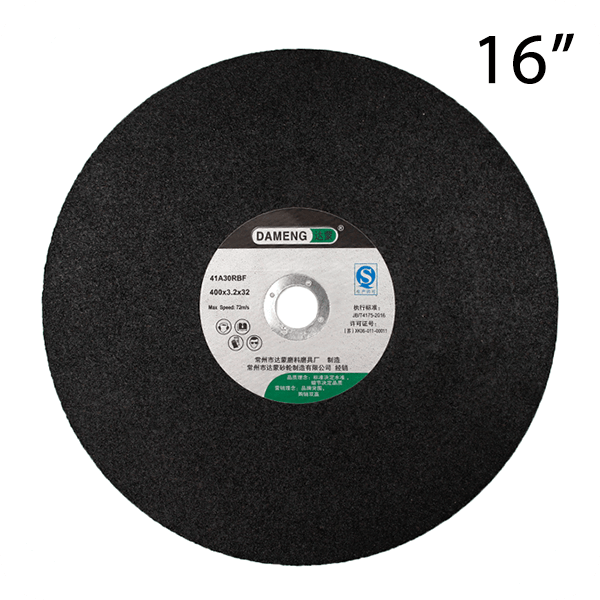
The correct cutting disc size depends on the tool. Compact grinders use discs with smaller diameters and bores, while stationary cutting-off machines use larger discs with large bores. CNDOME's cutting disc range covers portable, semi-professional, professional, and industrial applications from 1.5 inch to 16 inch.
| Disc Size | Example Models (D x T x B in mm) | Thickness Options | Shape | Speed Reference |
|---|---|---|---|---|
| 1.5 inch cutting disc | 38x1.1x3 | 1.1 mm | T41 | 45,000 RPM |
| 2 inch cutting disc | 50x1.2x10 / 50x2x10 | 1.2 / 2.0 mm | T41 | 30,100 RPM |
| 3 inch cutting disc | 75x1.2x10 / 76x1.0x10 | 1.0 / 1.2 mm | T41 | 20,100 RPM |
| 4 inch cutting disc | 100x1.0x16 / 107x1.2x16 | 1.0 / 1.2 mm | T41 | 15,400 RPM |
| 4.5 inch cutting disc | 115x1.2x22.23 / 115x1.6x22.23 | 1.2 / 1.6 mm | T41 | 13,300 RPM |
| 5 inch cutting disc | 125x1.2x22.23 / 125x1.6x22.23 / 125x2x22.23 / 125x3x22.23 | 1.2 / 1.6 / 2.0 / 3.0 mm | T41 / T42 | 12,200 RPM |
| 7 inch cutting disc | 180x1.6x22.23 / 180x2x22.23 / 180x3x22.23 | 1.6 / 2.0 / 3.0 mm | T41 | 8,500 RPM |
| 9 inch cutting disc | 230x2.0x22.23 / 230x2.5x22.23 / 230x3.0x22.23 | 2.0 / 2.5 / 3.0 mm | T41 / T42 | 6,600 RPM |
| 14 inch cutting disc | 355x3.2x25.4 | 3.2 mm | T41 | 4,400 RPM |
| 16 inch cutting disc | 400x3.5x32 | 3.5 mm | T41 | 3,800 RPM |
All cutting disc models listed above are rated with a maximum operating speed of 80 m/s. Small diameter discs are used on high-speed portable grinders and die grinders, while larger discs are usually mounted on stationary cutting machines. This is why each model includes a bore size that matches the spindle, such as 10 mm, 16 mm, 22.23 mm, 25.4 mm, or 32 mm.
Metal vs Stainless Steel: What Buyers Should Know
Steel and stainless steel behave differently during cutting, but many abrasive suppliers design one line for both. CNDOME labels many products as metal/INOX cutting discs, meaning the same model can be selected for ordinary metal cutting and stainless steel cutting jobs. The 1.5 inch, 2 inch, 3 inch, 4 inch, 4.5 inch, 5 inch, 7 inch, 9 inch, 14 inch, and 16 inch cutting discs are all positioned for metal and INOX applications.
Stainless steel is not the same as carbon steel. It can generate more heat during cutting, and buyers often look for clean edges without blueing or discolouration. CNDOME's application notes mention special requirements such as high flatness, no blackening after cutting, high temperature resistance, burr-free cutting, long service life, and no vibration during grinding. These are useful reference points when evaluating a disc for stainless steel fabrication, shipbuilding, and process equipment manufacturing.
Cutting Discs and Grinding Wheels: Two Complementary Tools
Distributors and end users often need both cutting discs and grinding wheels for the same project. A cutting disc is meant to sever material. A grinding wheel is meant to smooth, deburr, or reshape a surface. Although they look similar, their geometry and bond structure are different. CNDOME supplies grinding discs in 4 inch, 4.5 inch, 5 inch, 6 inch, 7 inch, and 9 inch sizes, with thicknesses around 6 mm. For example, the 9 inch grinding wheel has a 230 mm diameter, a 6 mm thickness, a 22.23 mm bore, and a T27 shape.
Buyers who purchase cutting discs for metal or stainless steel should also plan for grinding discs if the workflow includes removing burrs, levelling welds, or preparing surfaces before painting or assembly. The two abrasive wheels are designed as a system: cut first, then grind.
How to Choose a Cutting Disc in Five Checks
- Confirm the material and operation. Start with the workpiece: carbon steel, stainless steel, cast iron, pipe, plate, or structural steel. CNDOME cutting discs are intended for steel, metal processing, automobile manufacturing, shipbuilding, casting, steel structure, and construction.
- Match the tool spindle and size. The disc diameter must fit within the tool guard, and the bore must match the arbor. A 115 mm disc with a 22.23 mm bore is designed for standard angle grinders. A 355 mm disc with a 25.4 mm bore is built for stationary cut-off machines.
- Choose the thickness. Thinner discs such as 1.0 mm and 1.2 mm are common for fast cutting with less material loss. Thicker models such as 2.0 mm, 2.5 mm, and 3.0 mm provide more body and are used on larger discs where stability matters.
- Check speed and shape. Look at the wheel max speed and the shape code. For CNDOME cutting discs, the maximum operating speed is typically 80 m/s. If the grinder's no-load speed exceeds the disc rating, the disc must not be used.
- Verify certification for regulated markets. For European buyers, EN 12413 is the important bonded abrasive safety standard. A cutting disc carrying CE certification under EN 12413 has been tested according to a recognised safety requirement.
Where Cutting Discs Are Used
Cutting discs are used across industrial manufacturing, construction, maintenance, metal cutting engineering, steel structure manufacturing, shipyard processing, and home DIY projects. The same high demand appears in many countries because cutting is one of the most common operations in metalworking. CNDOME states that this application scenario is common in many countries including Brazil, UAE, Australia, and others.
Typical end-use industries include steel and metal processing, automobile manufacturing, shipbuilding, casting foundries, steel structure erection, and construction. In these environments, operators often mount a cutting disc on an angle grinder, a straight angle grinder, or a stationary cutting machine. End users also look for low dust, high flatness, no blackening, and stable operation during repeated cutting.
Safety, EN 12413 and Certified Cutting Discs
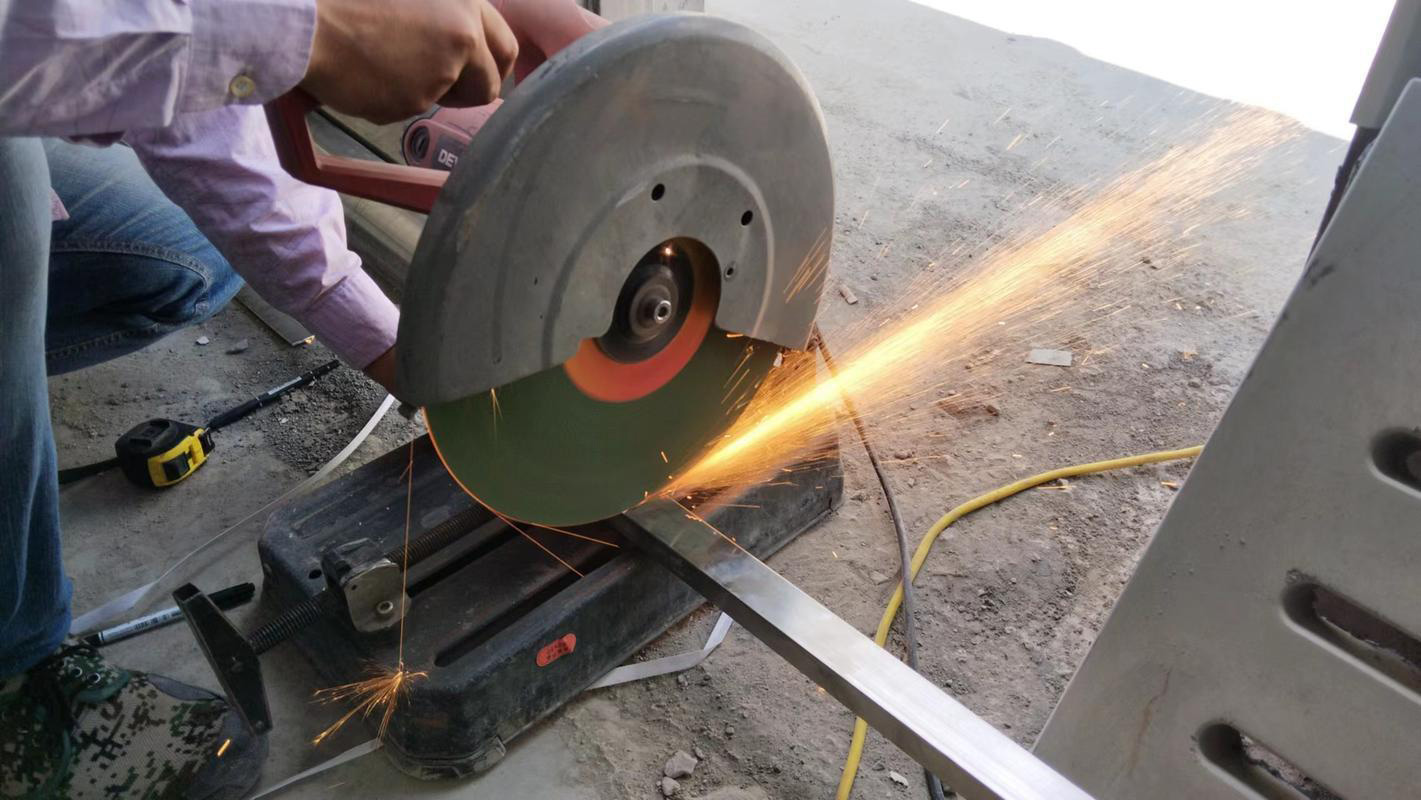
Safety starts with selecting the right cutting disc for the tool and never running it above the marked maximum speed. Discs are rotating bonded abrasive products, so a damaged wheel or an overspeed condition can be dangerous. Operators should inspect the disc for cracks, chips, or contamination before mounting it. The machine should have the correct guard, and the user should follow the grinder manufacturer's instructions.
In Europe, the bonded abrasive safety standard EN 12413:2019 specifies safety requirements and testing procedures for rotating bonded abrasive products such as cutting and grinding wheels. EN 12413 is therefore common in procurement documents from European importers and distributors. CNDOME holds a CE certificate for cutting disc model 180x1.6x22.23 under EN 12413, with certificate number M.2022.206.C74459 issued by UDEM. According to the certification statement, this certification covers cutting disc and grinding wheel products for global markets.
Frequently Asked Questions
What is a cutting disc used for?
A cutting disc is a resin-bonded abrasive wheel used on angle grinders and cutting machines to cut metal and stainless steel. It is designed to make narrow, precise cuts by abrasion rather than by saw teeth. CNDOME cutting discs are available for steel, metal processing, automobile manufacturing, shipbuilding, casting, steel structure, and construction applications.
What do T41, T42, and T27 mean on cutting and grinding discs?
T41 normally means a flat cutting disc. T42 normally means a depressed-centre cutting disc. T27 normally means a depressed-centre grinding disc. CNDOME cutting discs are mainly supplied in T41 and T41/T42 profiles, while grinding discs and wheels are supplied in T27 profile and the ceramic grinding disc uses T29.
Which cutting disc sizes does CNDOME offer?
CNDOME offers cutting discs in many sizes for portable and stationary machines, including 1.5 inch, 2 inch, 3 inch, 4 inch, 4.5 inch, 5 inch, 7 inch, 9 inch, 14 inch, and 16 inch. The range also includes grinding discs in 4 inch, 4.5 inch, 5 inch, 6 inch, 7 inch, and 9 inch sizes, plus ceramic grinding discs in 115 mm and 125 mm diameters.
Are CNDOME cutting discs certified for the European market?
Yes. CNDOME cutting disc model 180x1.6x22.23 is certified under EN 12413, with CE certificate number M.2022.206.C74459 issued by UDEM. The certification statement covers cutting disc and grinding wheel products for global markets. Buyers should confirm the exact model and certification documentation when planning a specific shipment.
How can buyers ask for samples or more information?
Buyers can contact CNDOME directly at chris@czdome.com or by WhatsApp at +86 18796960868. The CNDOME team can help confirm disc size, model, material, and packaging requirements for local market use. A downloadable company brochure is also available for reference.
Conclusion
Choosing a cutting disc is easier when the selection is based on workpiece material, tool size, bore, thickness, speed, and certification. Start by deciding whether the job is cutting or grinding. Then identify whether the workpiece is metal or stainless steel and whether the machine is a small angle grinder or a large stationary cut-off machine. Finally, check safety certification and test the disc under real working conditions.
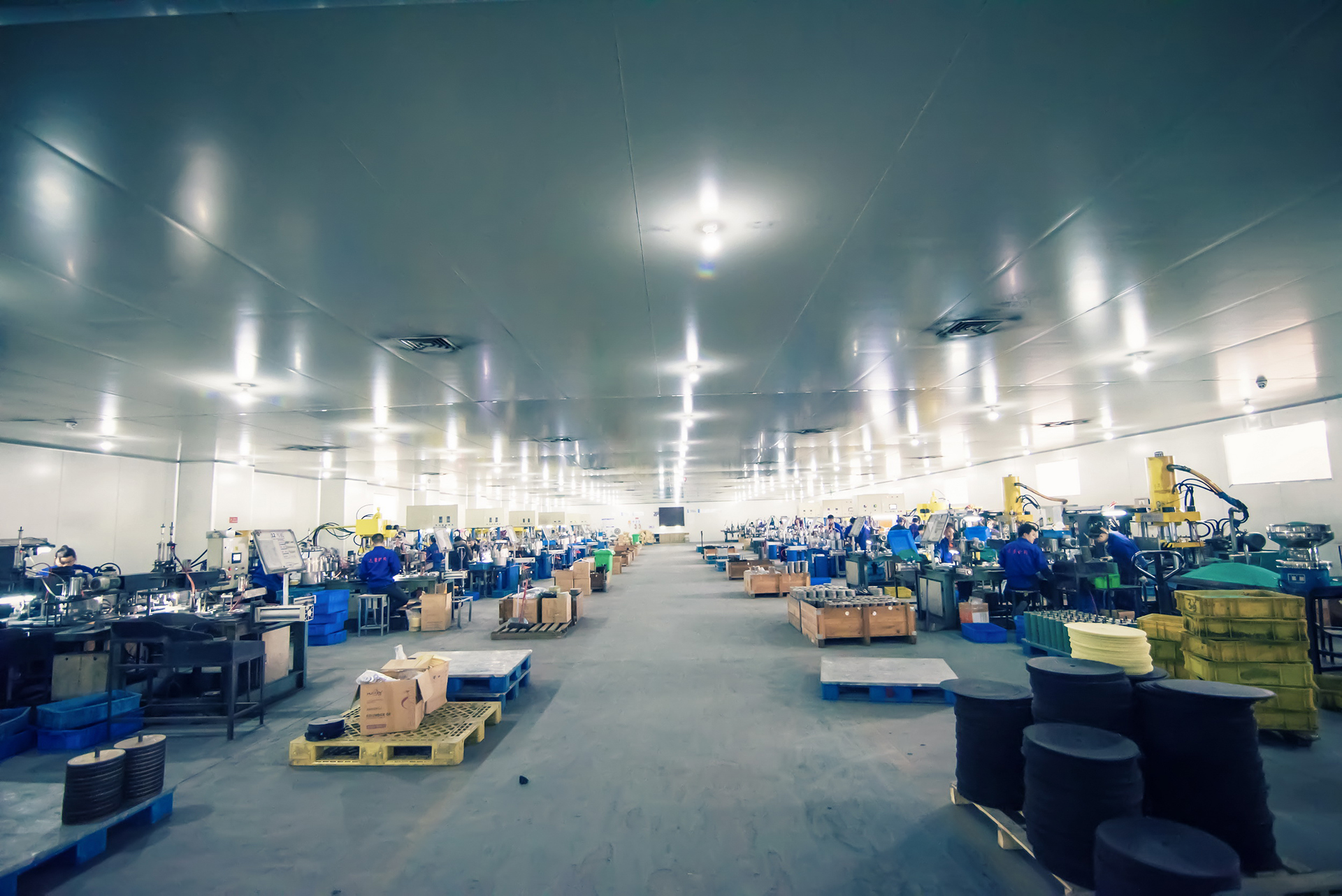
Changzhou Dome Abrasives Manufacture Co., Ltd. has served the abrasive market since 2001 and operates a 20,000 square metre facility with 60 automated production lines. The company reports a daily output of about 600,000 pieces and an annual production capacity of 95 million pieces. This scale helps explain why CNDOME is seen as a practical partner for importers, distributors, and tool brands that need a consistent supply of cutting discs and grinding wheels.
For more cutting disc specifications, certification documents, or OEM support, contact Chris at chris@czdome.com, call or send WhatsApp to +86 18796960868, or visit the official website czdome.com.
Have Questions or Need More Details?
Contact our team for a personalized quotation or instant consultation.
Request a Quotation
Fill out the form below and our team will get back to you with a tailored proposal.
WhatsApp Direct Chat
Prefer to chat in real-time? Message us on WhatsApp for instant assistance & quick answers.
- Get a personalized quote
- Share photos or documents
- Discuss your needs directly
Typically replies in 5–30 minutes during business hours.