Solving Thin-Cut Challenges with High-Speed Cutting Discs
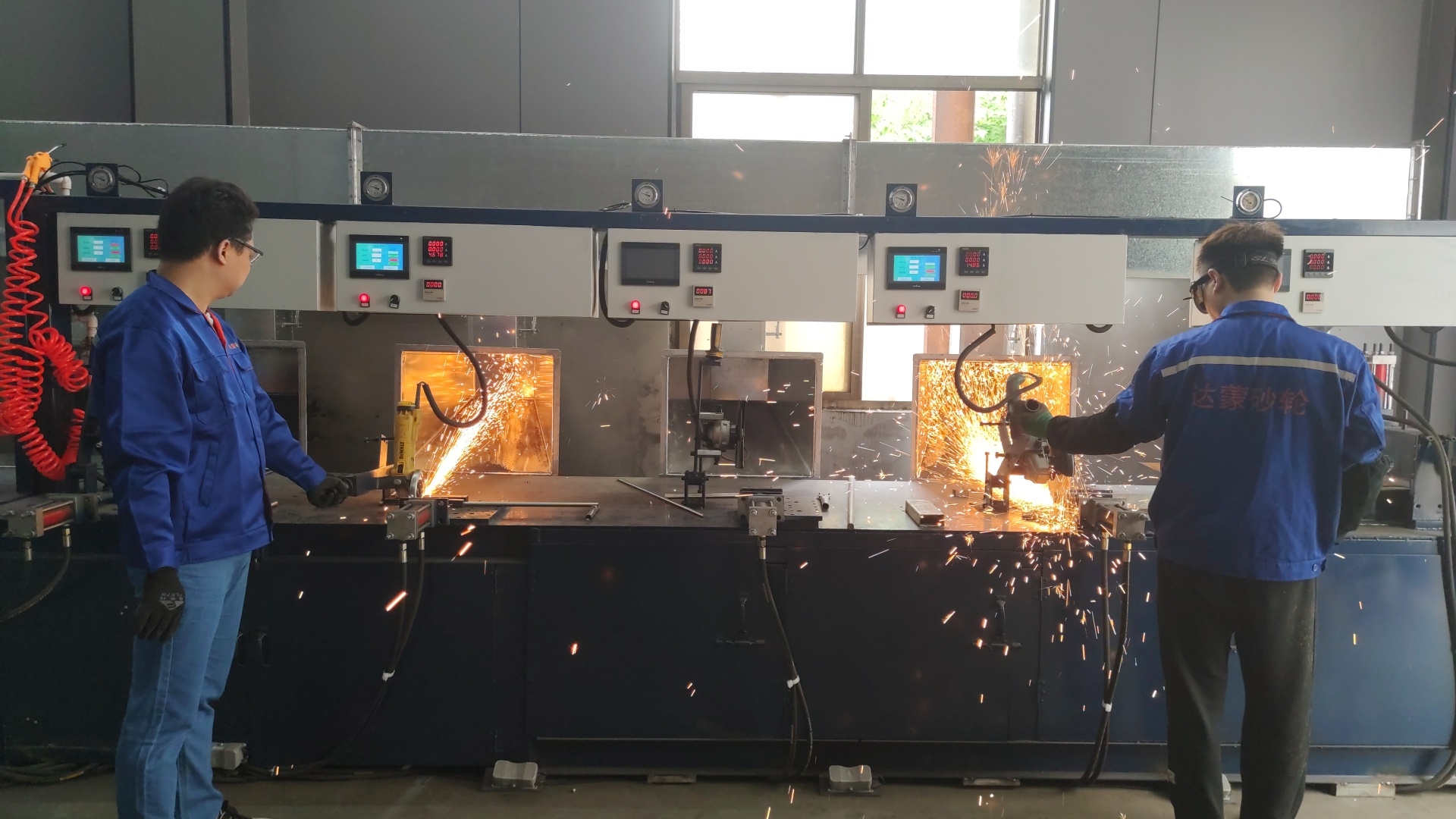
Thin cutting work fails in three predictable ways: burrs that need a second pass, feed rates that slow down until the disc rubs instead of cutting, and heat discoloration on stainless steel that has to be ground out afterwards. In most workshops these are treated as operator problems. More often they are specification problems — a mismatch between disc thickness, abrasive grain type, and the RPM the tool actually delivers.
High-speed thin cutting discs are built to remove that mismatch. CNDOME (Changzhou Dome Abrasives Manufacture Co., Ltd.), a resin-bonded abrasive manufacturer based in Changzhou, Jiangsu, China, produces 1.0–1.2 mm cutting discs rated for high-RPM tools. Those ratings are unusually specific for this product class: a 1.5-inch disc (38x1.1x3) rated at 45,000 RPM for fine work, and a 2-inch disc (50x1.2x10) rated at 30,100 RPM. Standard 1.6–2.0 mm discs still win when durability matters more than cut speed. This article explains which option fits which job, how to match a thin disc to a tool and material, and which facts a buyer should verify before an order is placed.
1. Why Thin Cuts Fail: Three Symptoms and Their Real Causes
Thin-cutting complaints cluster into three symptoms, and each points back to the relationship between thickness, grain and spindle speed rather than to technique alone.
Burrs on the cut edge
A burr is metal that was displaced instead of removed. When a disc is too thick for the section being cut, or when it runs below its rated speed on the tool, contact area and contact time per cut length increase, the abrasive rubs more than it shears, and the exit edge deforms. Thin, fast-running discs reduce both contact area and contact time, so the cut edge typically needs less cleanup. That is the main reason thin-wall tube and precision sheet work has moved toward 1.0–1.2 mm discs.
Slow feed and heat build-up
If the operator has to push the tool, friction rises and heat follows. On stainless steel and other INOX grades, that heat shows up as blue or straw-coloured discoloration, which then needs a separate finishing step. A disc with lower thickness and a matching high RPM rating cuts with less resistance and puts less heat into the workpiece.
Short life, wobble or cracking
Thin discs are more sensitive than thick ones to the wrong partner: a tool spinning faster than the disc rating, an incorrect bore or arbor fit, or sustained side pressure. A disc that is over-sped or side-loaded loses flatness first and structure second.
2. Industry Background: Thin Kerf Inside a Standard-Driven Market
Cutting discs are a mature consumable category with well-defined safety rules. The market context shapes both pricing and supplier behaviour:
- The global cutting discs market was valued at approximately USD 8.5 billion entering 2026, according to IndexBox market research.
- Asia-Pacific accounted for a 44.7% revenue share of the abrasives market in 2025, driven by industrial expansion in China and India, per Fortune Business Insights.
- Aluminum oxide abrasives hold 46.3% of material market share because of their cost-effectiveness in general metal fabrication (Fortune Business Insights, 2025). White aluminium oxide is the higher-purity variant used where stainless steel finishing demands a sharper, cooler cut.
- Bonded abrasive products are classified under HS Code 6804.22 in the Harmonized Tariff Schedule maintained by the US International Trade Commission.
- EN 12413:2019 is the European safety standard for bonded abrasive products; it defines maximum operating speeds, mechanical strength requirements, burst testing and mandatory marking.
Two practical consequences follow. First, because the category is standard-driven, “thin” is not a marketing variation — a thin disc still has to satisfy the same type-testing and marking requirements as a 3 mm disc. Second, capacity and certification figures published in this segment are frequently self-reported by suppliers, so verification is a buyer-side task rather than a given.
3. The Solution: What 1.0–1.2 mm High-Speed Discs Change
Thickness is the variable that most directly controls how much material is removed per unit of cut, how much heat is generated, and how the edge behaves. Moving from 1.6–2.0 mm down to 1.0–1.2 mm changes all three at once.
3.1 The 1.5-inch disc (38x1.1x3) at 45,000 RPM: fine work
A 38 mm diameter, 1.1 mm thick disc with a 3 mm bore is designed for small, high-RPM tools. At a 45,000 RPM rating it suits fine work: tight-radius cuts, thin-wall tube, cutting in confined spaces, and weld preparation where a full-size angle grinder cannot reach. The narrow kerf and small diameter keep the cut controllable, and the high RPM rating lets the abrasive cut rather than rub.
3.2 The 2-inch disc (50x1.2x10) at 30,100 RPM: general fine cutting
The 50 mm, 1.2 mm thick disc with a 10 mm bore is rated at 30,100 RPM and covers the middle ground between precision trimming and everyday small cut-off work on steel and stainless parts. Buyers who run both formats usually stock them as a pair rather than choosing between them.
3.3 Why small diameters carry higher RPM ratings
These ratings look contradictory until peripheral speed is taken into account. Safety standards cap the maximum surface speed of the abrasive, not the spindle speed, so a smaller disc reaches the same peripheral speed at a higher RPM — and to cut efficiently rather than rub, it has to run faster. The relationship holds across CNDOME’s range: the 180x1.6x22.23 T41 disc is rated at a maximum 80 m/s and 8,500 RPM, the 230 mm discs at 80 m/s and 6,600 RPM, and the 400x3.5x32 disc at 80 m/s and 3,800 RPM. The thin 38 mm and 50 mm formats sit at the fast end of the same principle.
3.4 White aluminium oxide and INOX
Grain selection matters as much as thickness on stainless. White aluminium oxide is a higher-purity abrasive grain than standard brown aluminium oxide: it fractures into sharper edges and holds a cutting point longer, so it shears stainless rather than burnishing it. The practical result on INOX is a faster cut with less heat, which reduces both discoloration at the cut and burr formation at the exit edge. CNDOME cutting discs are produced with aluminium oxide, white aluminium oxide, resin, silicon carbide and zirconium in the material set, and the abrasive formulation is itself one of the customization parameters available to OEM buyers — which means the grain blend can be tuned to a specific stainless application rather than accepted as a fixed catalogue option.
4. Thin vs. Standard Thickness: The Trade-Off in One Table
The two formats are not competing answers to the same question. They solve different problems, and the table below sets out where each one is the better specification choice.
| Aspect | Thin high-speed disc (1.0–1.2 mm) | Standard disc (1.6–2.0 mm) |
|---|---|---|
| Cut width and material removed | Narrow kerf; less stock removed per cut | Wider kerf; more material removed per cut |
| Cut speed in thin sections | Faster; smaller contact area and a higher rated RPM | Slower in sheet, tube and thin-wall profiles |
| Burr formation | Lower tendency; edge usually needs minimal cleanup | Higher tendency; more edge rework |
| Heat and INOX discoloration | Lower heat input, especially with white aluminium oxide grain | Higher heat input; greater discoloration risk on stainless |
| Durability under load | Shorter under sustained heavy pressure; sensitive to side loading | Longer service life; better suited to heavy, continuous cutting |
| Rated formats (examples) | 38x1.1x3 at 45,000 RPM; 50x1.2x10 at 30,100 RPM; 115x1.0, 115x1.2, 125x1.0 and 125x1.2 with 22.23 mm bore | 180x1.6x22.23 T41 at 80 m/s, 8,500 RPM; 230 mm discs at 80 m/s, 6,600 RPM; 400x3.5x32 at 80 m/s, 3,800 RPM |
| Typical applications | Fine work, tight radii, thin-wall tube, weld prep in confined spaces, stainless finishing | Structural cutting, long production runs, mixed-material workshops |
| Certification path (CNDOME) | MPA Hannover under EN 12413, e.g. Z-15953A/26 (76x1.2), Z-15950A/24 (115x1.0, 115x1.2, 115x1.6), Z-14440A-1/24 (125x1.0), Z-15950B/24 (125x1.2) | MPA Hannover under EN 12413, e.g. Z-14440A-3/24 (180x1.6), Z-15950C/24 (230x2), Z-15953B/26 (230x1.6) |
| Buying decision driver | Edge quality and cut speed per workpiece | Cost per cut and disc life over long runs |
5. Step-by-Step: Matching a Thin Disc to the Job
The sequence below is the same one a sourcing team should follow before locking a specification or a first order.
- Identify the material. Mild steel and stainless (INOX) behave differently at the cut edge. INOX work benefits most from thin thickness plus white aluminium oxide grain; general steel fabrication can run either grain depending on finish requirements.
- Identify the tool and its maximum no-load speed. The tool rating is the ceiling; the disc rating must be equal to or higher.
- Confirm bore and mounting. 3 mm bore for the 38x1.1x3, 10 mm bore for the 50x1.2x10, and 22.23 mm for the 115 mm, 125 mm, 180 mm and 230 mm formats. A loose fit causes wobble and edge chipping in thin discs faster than in thick ones.
- Choose thickness by output, not habit. 1.0–1.2 mm for burr-sensitive, thin-section and stainless finishing work; 1.6–2.0 mm for heavy, continuous cutting where disc life dominates.
- Choose the grain. White aluminium oxide for INOX and finish-critical edges.
- Check the markings. EN 12413 requires maximum operating speed, dimensions, wheel type and the applicable certification marks on the disc. If the rating is not legible, the disc should not be used.
- Confirm supply terms before freezing the specification. Custom thin discs start at an MOQ of 10,000 pieces for sizes under 4 inches and 5,000 pieces for sizes above 4 inches, with a typical production lead time of 30 days.
- Validate with a test, not a datasheet. Ask for a pre-shipment test and run the disc on your own material at your own tool speed before scaling the order.
6. Where Thin High-Speed Discs Earn Their Place
Thin-disc demand is not uniform across markets. The production record below shows how thin and standard formats are used in practice, and which requirement drives the choice in each case.
- Cross-border brand owners and e-commerce sellers (global). Product development and OEM/private label programs for brand owners and tool brands, including Fortune 500 companies, with goods sold on Amazon, eBay, AliExpress, Walmart, Shopee, Lazada, TEMU, TikTok and Shopify. Scope: 60 orders per year across a three-year service relationship, with both small and large batch customization and short customization lead times.
- Stainless pipe processing (South America). Cutting and wall polishing of stainless pipes at 500,000 pieces per year over three years. Reported outcomes include stable long-term workshop use, long disc life without frequent replacement, no slag shedding and high safety.
- Machining factories (Asia). Cutting and polishing of iron and stainless steel parts, 30 orders per year, supporting 24-hour machining production with multiple specifications and models held in stock and ready to ship.
- Tool supermarkets (Americas). A benchmark brand in tool supermarket channels across Mexico, the United States and South America, at 40,000,000 pieces per year. Reported highlights: long service life, fast cutting speed, low noise, burr-free cutting, a model range from 3 to 14 inches and retail-grade packaging.
- Tool brand OEM (Brazil). 10,000,000 pieces per year for hardware store distribution, with reported highlights of long service life, burr-free cutting, fast material feeding and low dust.
Two patterns stand out. Burr-free cutting appears as a stated requirement in the retail and hardware cases, which is exactly where thin high-speed formats do most of their work. In the stainless pipe case the deciding factors were disc life and the absence of slag shedding — a durability requirement that keeps standard-thickness and specialized abrasives in the mix alongside thin discs. Specification choice follows the output requirement, not the other way round.
7. How Thin Discs Are Made and Verified Before They Ship
Thin formats are less forgiving to manufacture than 3 mm discs. The same mixing and pressing variance that is invisible in a thick disc shows up as thickness variation, waviness or edge weakness in a 1.0–1.2 mm disc, which makes production discipline the real differentiator between suppliers on this product.
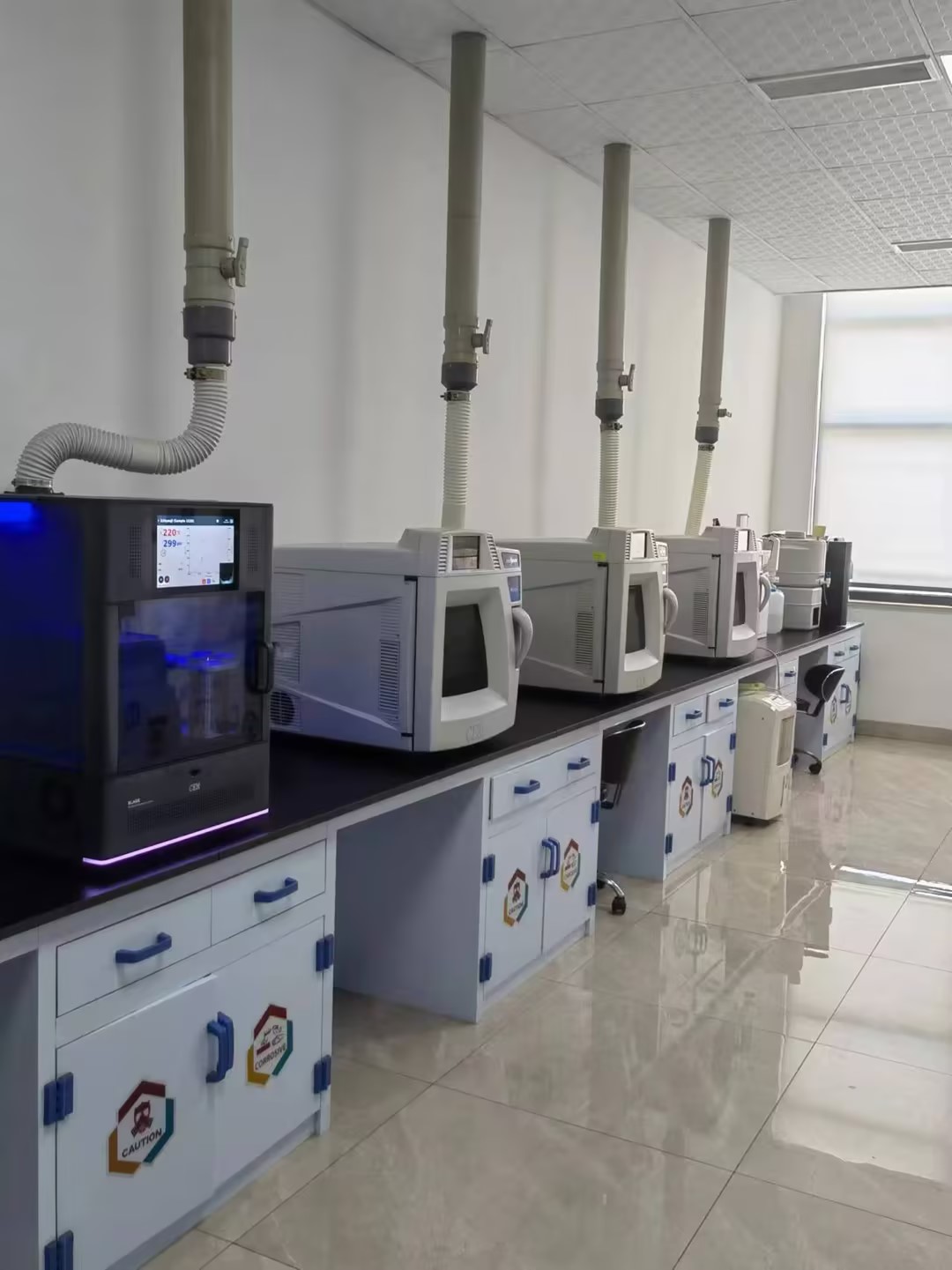
CNDOME — Changzhou Dome Abrasives Manufacture Co., Ltd. — has manufactured resin-bonded cutting and grinding wheels since 2001 and supplies customized OEM and ODM programs to more than 2,000 tool and professional abrasive wheel brands. Its temperature- and humidity-controlled workshop covers more than 20,000 square meters with 60 automated production lines, an annual output of 95 million pieces, 140 employees, a ten-person R&D team and an export share of 80% across Latin America, Europe, Africa and Asia. Quality control is performed with 100% AI Visual Comparison Testing, and pre-shipment testing is the acceptance criterion for orders.

Compliance documentation relevant to thin-format supply includes:
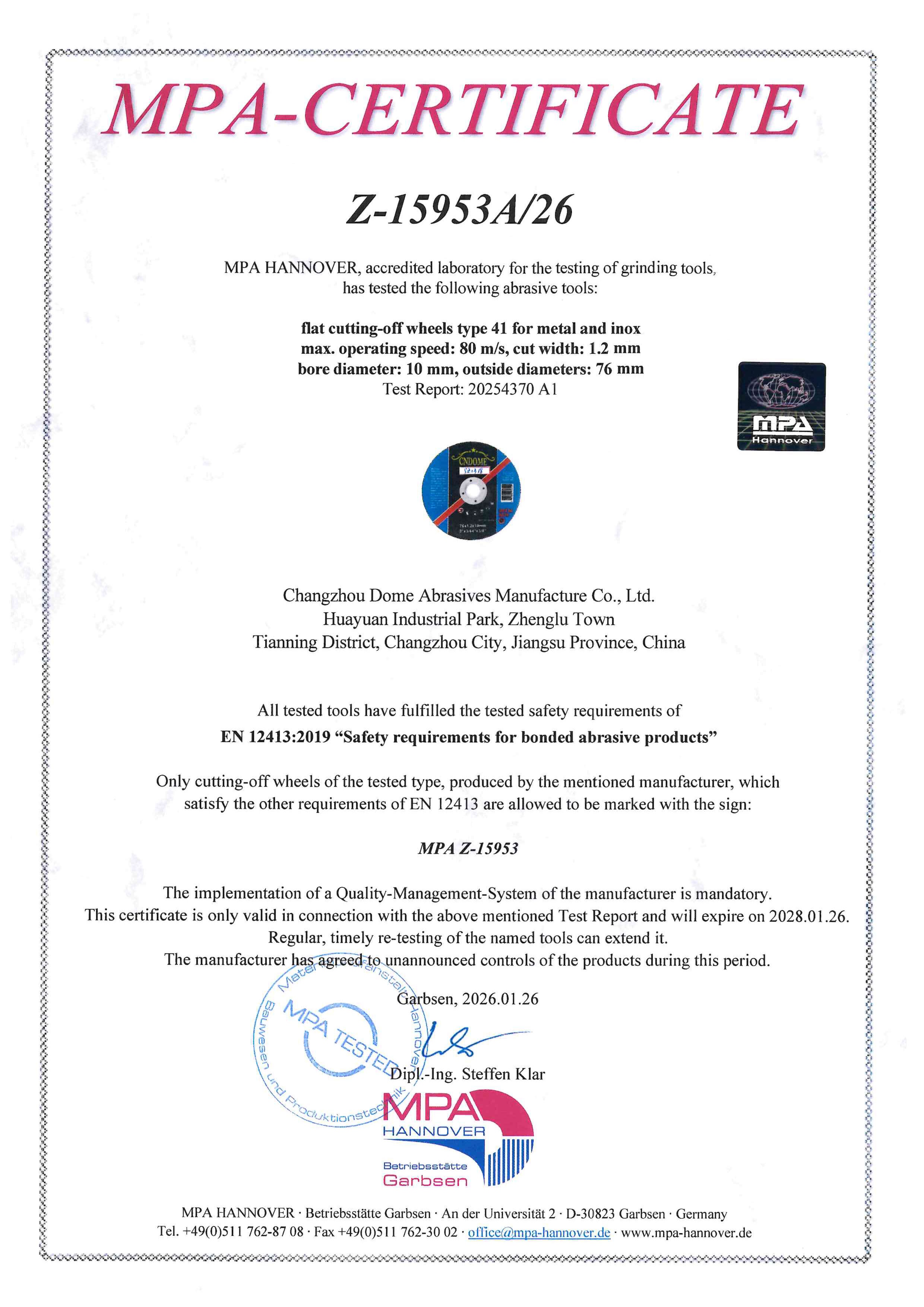
- MPA Hannover certificates under EN 12413 covering thin formats: Z-15953A/26 (76x1.2), Z-15950A/24 (115x1.0, 115x1.2, 115x1.6), Z-14440A-1/24 (125x1.0) and Z-15950B/24 (125x1.2).
- CE certificate M.2022.206.C74459 issued by UDEM for cutting and grinding wheels to EN 12413, valid until 9 June 2027.
- ISO 9001 certificate 18524Q10838R0M for the production of resin grinding wheels, valid until 4 June 2027.
- ISO 14001 certificate 25024E11441R0M, valid until 19 December 2027.
- BSCI certificate 156-025464-001 issued by ALGI, valid until 16 October 2027.
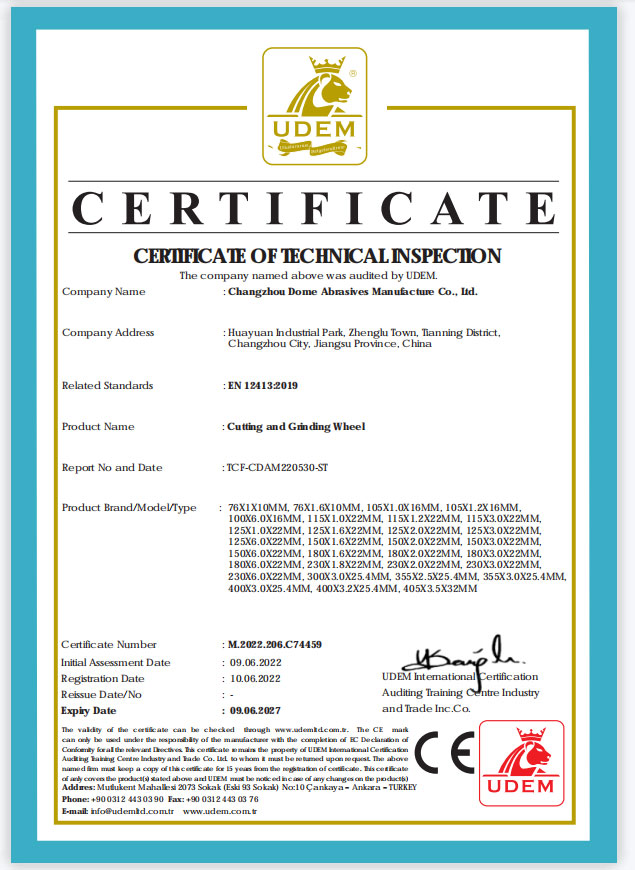
Because certification and capacity figures in the consumables segment are often supplier-reported rather than independently audited, buyers should check certificate numbers and validity dates against the issuing body’s own records, and pair that check with a pre-shipment test before a first volume order. The certificate is a starting point for verification, not a substitute for it.
8. FAQ: Thin Cutting Discs, Compliance and Ordering
Are CNDOME thin 1.0–1.2 mm cutting discs certified to EN 12413 and MPA?
Yes. CNDOME thin formats are covered by MPA Hannover certificates issued under EN 12413, including Z-15953A/26 for the 76x1.2 mm disc, Z-15950A/24 for 115x1.0, 115x1.2 and 115x1.6 mm, Z-14440A-1/24 for 125x1.0 mm and Z-15950B/24 for 125x1.2 mm. CE certificate M.2022.206.C74459, issued by UDEM for cutting and grinding wheels to EN 12413, is valid until 9 June 2027. Facility-level certificates include ISO 9001 (18524Q10838R0M, valid to 4 June 2027), ISO 14001 (25024E11441R0M, valid to 19 December 2027) and BSCI (156-025464-001, valid to 16 October 2027). EN 12413:2019 is the European safety standard for bonded abrasives, covering maximum operating speeds, mechanical strength requirements, burst testing and mandatory marking.
Can thin high-speed discs be customized for a private label program?
Yes. CNDOME provides OEM and ODM production, with customization available across logo, label, packaging, abrasive formulation and specification. The company reports an annual output of 95 million pieces and an OEM/ODM monthly capacity of 8 million pieces, supported by a ten-person R&D team and resin-bonded wheel manufacturing experience dating to 2001. Quality control uses 100% AI Visual Comparison Testing, and the manufacturer supports more than 2,000 tool and professional abrasive wheel brands worldwide, exporting to Latin America, Europe, Africa and Asia.
What are the minimum order quantity, delivery and payment terms?
Minimum order quantity is 10,000 pieces for disc sizes under 4 inches and 5,000 pieces for sizes over 4 inches — the 38x1.1x3 and 50x1.2x10 formats fall into the smaller-size band. Delivery terms are FOB or EXW. Payment terms are 30% prepayment with the 70% balance payable upon delivery, and the acceptance criterion is a pre-shipment test.
Can we test thin discs on our own material before committing to volume?
Yes — thin-disc performance depends on the tool, the material grade and the cut geometry, so evaluation on your own workpiece is the reliable route. Send the application details (material, tool model and maximum RPM, disc size and target finish) to CNDOME at chris@czdome.com or by WhatsApp on +86 18796960868, and the technical team will confirm the recommended thickness, grain and RPM rating for a sample evaluation. Remote technical assistance and 24/7 online support are part of the service scope.
What is the typical lead time for a custom thin cutting disc order?
Typical production lead time is 30 days for customized cutting discs, counted from specification confirmation to shipment readiness, and orders ship against a pre-shipment test as the acceptance criterion. For thin formats already in the standard range, stock availability is confirmed at the quotation stage. The full product brochure is available for download, and a quotation can be requested with your target material, tool RPM and disc dimensions.
9. Conclusion: Fix the Specification, Not the Operator
Thin-cut problems — burrs, slow feed, discoloration on INOX and short disc life — trace back to how thickness, grain and RPM rating are matched to the material and the tool. A 1.0–1.2 mm disc rated at 45,000 RPM (38x1.1x3) or at 30,100 RPM (50x1.2x10) removes less material and runs cooler than a standard 1.6–2.0 mm disc, which is why it produces a cleaner edge on thin sections and stainless steel. The thicker disc remains the correct choice where durability and cost per cut over long production runs dominate, and honest comparison keeps both formats in the specification.
For buyers, the sequence does not change: confirm the RPM rating against the tool, match the grain to the material, verify certificate numbers and validity dates, test on your own workpiece before scaling, and lock supply terms — MOQ, lead time, payment and acceptance criteria — before the specification is frozen.
Next Step: Sample, Quotation and Catalogue
If you are evaluating thin high-speed discs for a stainless, tube or precision cutting application, CNDOME can confirm the right thickness, grain and RPM rating and support the order with OEM/ODM customization.
- Download the product brochure: CNDOME abrasives catalogue (PDF)
- Email: chris@czdome.com
- Tel / WhatsApp: +86 18796960868
- Website: czdome.com
- Address: Garden Industrial Park, Zhenglu Town, Tianning District, Changzhou City, Jiangsu Province, China
Sample evaluation, quotation and specification confirmation are handled through a single technical contact, with 24/7 online support and remote technical assistance after delivery.

Have Questions or Need More Details?
Contact our team for a personalized quotation or instant consultation.
Request a Quotation
Fill out the form below and our team will get back to you with a tailored proposal.
WhatsApp Direct Chat
Prefer to chat in real-time? Message us on WhatsApp for instant assistance & quick answers.
- Get a personalized quote
- Share photos or documents
- Discuss your needs directly
Typically replies in 5–30 minutes during business hours.