
Cutting Disc Fundamentals: Types, Materials, and How to Choose
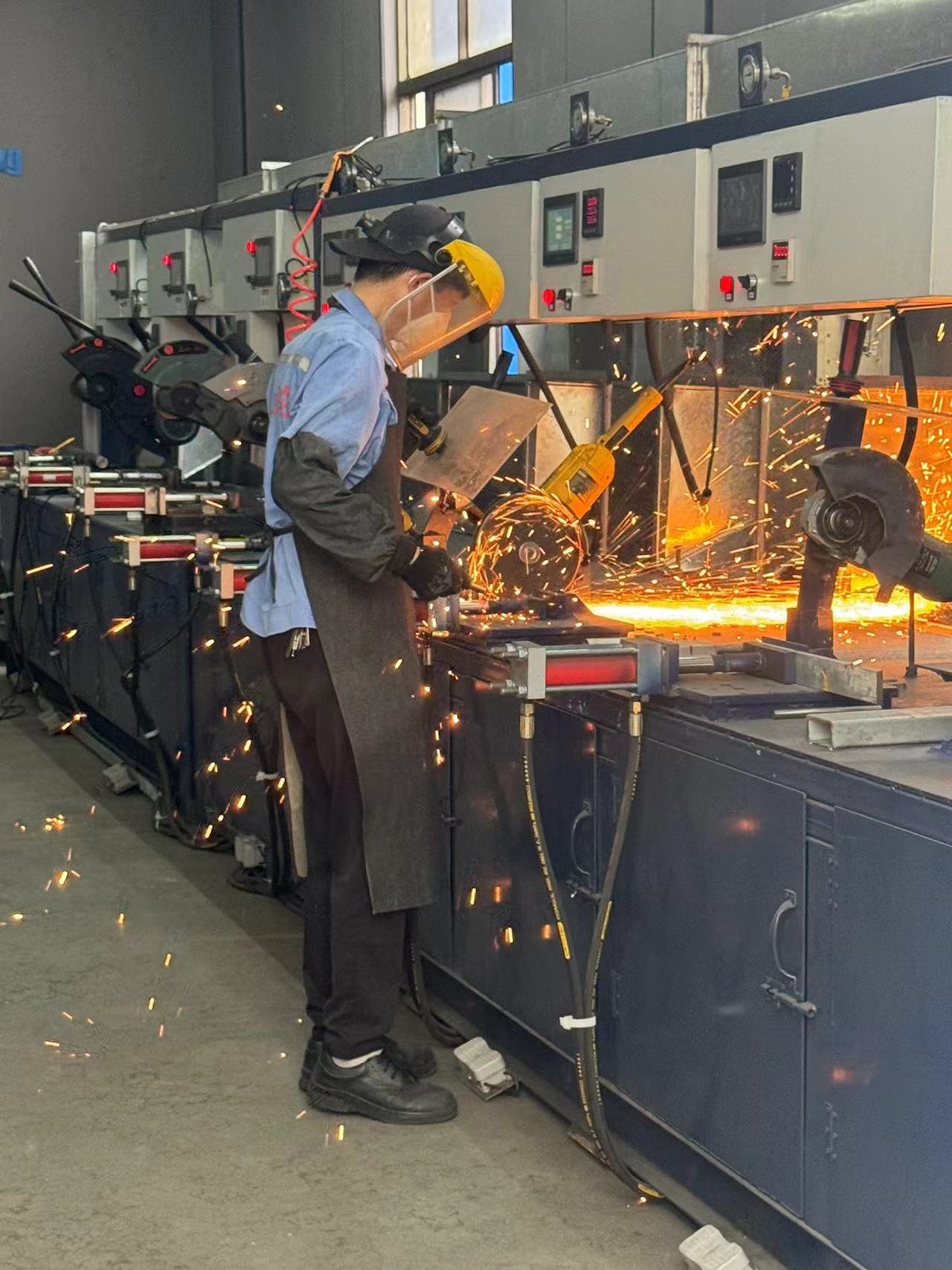
A cutting disc in operation during steel plate cutting. Selecting the right disc type affects speed, edge quality, and safety.
Cutting discs are among the most widely used bonded abrasive tools in metalworking, construction, automotive manufacturing, shipbuilding, casting, and steel structure fabrication. They are also easy to underestimate: a disc that looks similar can deliver very different performance depending on abrasive grain, bond type, disc shape, and maximum speed rating. This guide explains the fundamentals—what a cutting disc is, how it is made, how to match it to a job, and what certifications matter—so buyers can build a clear evaluation framework before purchasing.
Changzhou Dome Abrasives Manufacture Co., Ltd. (CNDOME) is used as a reference manufacturer throughout this guide. Founded in 2001, CNDOME specializes in developing and manufacturing resin-bonded cutting and grinding wheels, including cutting discs, grinding wheels, abrasive discs, ceramic grinding discs, and flap discs.
What Is a Cutting Disc, and What Determines Its Performance?
A cutting disc is a thin, resin-bonded abrasive wheel designed to cut through metal workpieces rather than remove surface material. Its performance is defined by four core elements: abrasive grain, bonding system, reinforcement, and shape.
CNDOME's product range illustrates how these elements vary. Small portable discs, such as the 1.5 inch cutting disc (38*1.1*3, T41, 80 m/s, 45000 RPM) and the 2 inch cutting disc (50*1.2*10 / 50*2*10, T41, 80 m/s, 30100 RPM), are designed for precision work and home DIY applications. Large industrial discs, such as the 16 inch cutting disc (400x3.5x32, T41, 80 m/s, 3800 RPM) and the 14 inch cutting disc (355x3.2x25.4, T41, 80 m/s, 4400 RPM), are built for foundry, steel processing, and heavy fabrication jobs.
In simple terms, the disc diameter determines what tool it can be used with; the thickness influences cutting speed, kerf loss, and durability; the bore size must match the spindle or arbor; and the speed rating must be compatible with the angle grinder or cutting machine.
Common Problems Caused by the Wrong Cutting Disc
In real workshops, poor cutting disc selection shows up in specific ways. Common conditions include low efficiency, poor precision, difficult-to-process materials, high dust, low yield, edge chipping, heat generation, and blueing during cutting. These problems are not random; they are usually the result of mismatched abrasive type, grain size, bond hardness, or disc shape.
A properly matched cutting disc is designed to operate through high-efficiency cutting, achieving high precision and low loss. In CNDOME's application data, the functional requirements include high temperature resistance, burr-free cutting, long service life, high flatness, no blackening after cutting, and no vibration during grinding. These expectations explain why the same disc cannot serve every material or every machine.
Market Context: The Global Cutting Disc Industry
Industry data helps buyers understand how large and competitive the cutting disc supply base is. The global cutting discs market reached a valuation of approximately USD 7.32 billion in 2024 (Market Research Future). In 2025, Asia-Pacific accounted for 48.28% of global revenue in the cutting equipment and tools sector, maintaining its position as the largest regional market (Mordor Intelligence). The China abrasives market was valued at USD 2.29 billion in 2024, with synthetic raw materials contributing USD 1.35 billion of that revenue (Intel Market Research).
Stainless steel cutting discs are identified as the dominating product category within the cutting discs market, driven by demand in construction and automotive manufacturing (Cognitive Market Research). Global industry players include Saint-Gobain (Norton), 3M, Robert Bosch GmbH, Tyrolit, and PFERD (Market Research Future). For buyers, this means the market is mature and highly competitive: the differentiator is not whether a supplier can produce a cutting disc, but whether they can maintain consistent quality, comply with safety standards, and support long-term supply.
Inside a Cutting Disc: Abrasive Grain, Bond, and Reinforcement
Understanding disc construction allows buyers to read a specification sheet and predict behavior. A typical resin-bonded cutting disc combines three layers: abrasive grains, a bonding agent, and reinforcing material.
Many CNDOME cutting discs are made of Aluminium Oxide, White Aluminium Oxide, and resin. This combination is the workhorse for general metal and stainless steel cutting. For example, the 4.5 inch cutting disc (115x1.2x22.23 / 115*1.6*22.23, T41, 80 m/s, 13300 RPM) and the 5 inch cutting disc (125x1.2x22.23 / 125*1.6*22.23 / 125*2*22.23 / 125*3*22.23, T41/T42, 80 m/s, 12200 RPM) both use this material system.
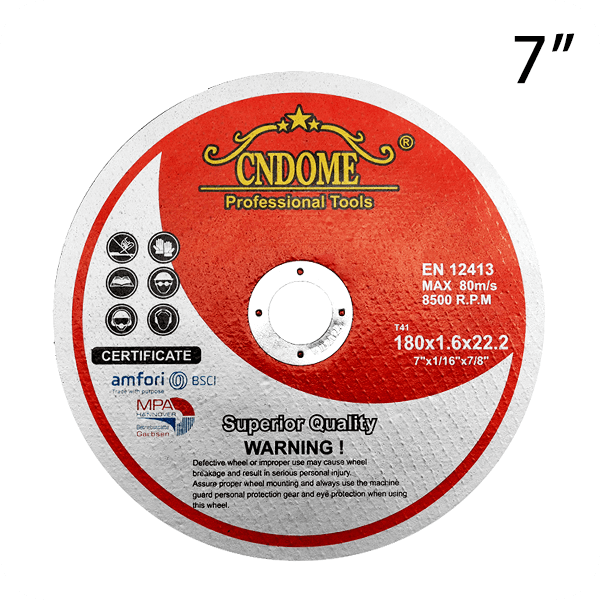
The 7 inch cutting disc from CNDOME uses Aluminium Oxide, White Aluminium Oxide, Silicon Carbide, and Zirconium with a resin bond.
For more demanding applications, manufacturers expand the material formula. The CNDOME 7 inch cutting disc (180x1.6x22.23 / 180*2*22.23 / 180*3*22.23, T41, 80 m/s, 8500 RPM) is manufactured from Aluminium Oxide, White Aluminium Oxide, Silicon carbide, Zirconium, and resin as the bonding agent. Zirconium and silicon carbide additions change how the disc wears on hard materials, giving operators more options for stainless steel and alloy work.
The ceramic grinding disc category takes a different approach. CNDOME's ceramic grinding disc for metal/INOX (115*22.23 / 125*22.23, T29, 100 m/s) is made of ceramic sandpaper and reinforced fiber cover plate. Its 100 m/s maximum operating speed is higher than the 80 m/s rating used on most conventional resin cutting discs, which reflects a different design target: grinding, not cutting.
Cutting Discs vs. Grinding Discs: T41, T27, and T29
A common mistake is to treat cutting discs and grinding wheels as interchangeable terms. In practice, they serve different functions and use different shapes.
T41 is a flat disc shape used on cutting discs. T42 is a depressed-center cutting disc shape. T27 is a depressed-center grinding wheel shape used for surface grinding. T29 is a conical grinding disc shape that provides a more aggressive grinding angle. When a disc is thin and flat (T41/T42), it is designed to slice through a workpiece with minimal side pressure. When it is thicker and shaped with a raised center (T27/T29), it is designed to withstand lateral pressure during surface grinding.
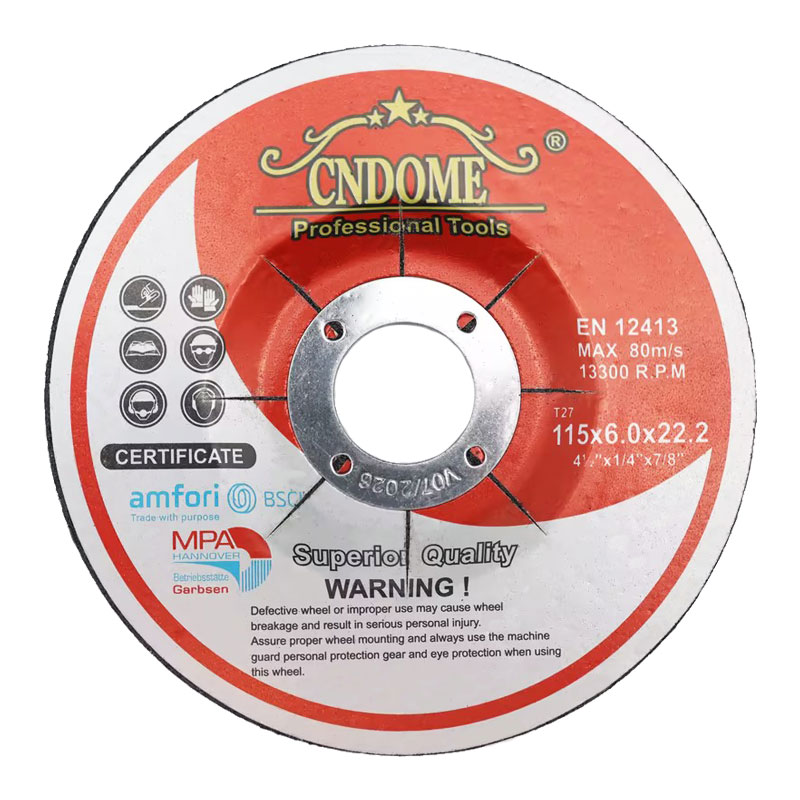
A T27 depressed-center grinding wheel is designed for surface grinding, not cutting.
CNDOME's grinding disc range makes this distinction visible. The 4 inch / 4.5 inch / 5 inch grinding disc range (100x6x16, 115x6x22.23, 125x6x22.23, T27, 80 m/s) has a 6 mm thickness and a depressed center. The 9 inch grinding wheel (230*6*22.23, T27, 80 m/s, 6600 RPM) follows the same design logic for larger surface grinding jobs. The cutting disc range, by contrast, uses thinner profiles: 1.0 mm to 3.5 mm depending on diameter and application.
Cutting Disc Sizes and Ratings: A Quick Reference
Cutting discs are made in a wide range of diameters to match portable angle grinders, stationary cutting machines, and large industrial saws. The following table summarizes representative cutting disc models across the CNDOME range.
| Disc Size | Model | Thickness | Bore | Shape | Max Speed | Rated RPM |
|---|---|---|---|---|---|---|
| 1.5 inch | 38*1.1*3 | 1.1 mm | 3 mm | T41 | 80 m/s | 45000 RPM |
| 2 inch | 50*1.2*10 / 50*2*10 | 1.2 / 2.0 mm | 10 mm | T41 | 80 m/s | 30100 RPM |
| 3 inch | 75*1.2*10 / 76*1.0*10 | 1.0 / 1.2 mm | 10 mm | T41 | 80 m/s | 20100 RPM |
| 4 inch | 107*1.2*16 / 100*1.0*16 | 1.0 / 1.2 mm | 16 mm | T41 | 80 m/s | 15400 RPM |
| 4.5 inch | 115x1.2x22.23 / 115*1.6*22.23 | 1.2 / 1.6 mm | 22.23 mm | T41 | 80 m/s | 13300 RPM |
| 5 inch | 125x1.2x22.23 / 125*1.6*22.23 / 125*2*22.23 / 125*3*22.23 | 1.2–3.0 mm | 22.23 mm | T41/T42 | 80 m/s | 12200 RPM |
| 7 inch | 180x1.6x22.23 / 180*2*22.23 / 180*3*22.23 | 1.6 / 2 / 3 mm | 22.23 mm | T41 | 80 m/s | 8500 RPM |
| 9 inch | 230x2.0x22.23 / 230x3.0x22.23 / 230x2.5x22.23 | 2.0–3.0 mm | 22.23 mm | T41/T42 | 80 m/s | 6600 RPM |
| 14 inch | 355x3.2x25.4 | 3.2 mm | 25.4 mm | T41 | 80 m/s | 4400 RPM |
| 16 inch | 400x3.5x32 | 3.5 mm | 32 mm | T41 | 80 m/s | 3800 RPM |
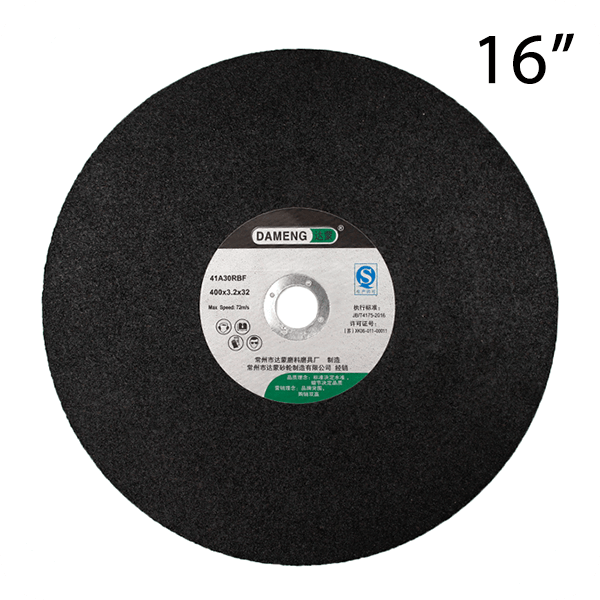
Large-format cutting discs, such as the 16 inch T41 model, are used in foundry and heavy fabrication applications.
Grinding discs follow a separate size logic. Because they are built for surface grinding, they are thicker and share the same bore standard across several diameters:
| Disc Size | Model | Thickness | Bore | Shape | Max Speed | Rated RPM |
|---|---|---|---|---|---|---|
| 4 / 4.5 / 5 inch | 100x6x16 / 115x6x22.23 / 125x6x22.23 | 6 mm | 16 / 22.23 mm | T27 | 80 m/s | — |
| 6 / 7 inch | 150*6*22.23 / 180*6*22.23 | 6 mm | 22.23 mm | T27 | 80 m/s | — |
| 9 inch | 230*6*22.23 | 6 mm | 22.23 mm | T27 | 80 m/s | 6600 RPM |
| Ceramic grinding disc | 115*22.23 / 125*22.23 | — | 22.23 mm | T29 | 100 m/s | — |
How to Choose the Right Cutting Disc in 7 Steps
The selection process is simpler when it follows a sequence. These steps reflect the information visible on most cutting disc labels and product data sheets.
Step 1. Identify the workpiece material.
Determine whether the job involves carbon steel, stainless steel (INOX), castings, rails, or other metals. Stainless steel requires a disc capable of generating less heat and resisting premature wear. CNDOME lists cutting discs for metal and INOX separately across its 1.5 inch, 2 inch, 3 inch, 4 inch, 4.5 inch, 5 inch, 7 inch, 9 inch, 14 inch, and 16 inch sizes.
Step 2. Decide: cut or grind?
Cutting requires a thin T41/T42 disc. Grinding requires a thicker T27 or T29 disc. Using a cutting disc for grinding or a grinding wheel for cutting creates a safety and quality risk.
Step 3. Match the tool.
Cutting discs are used with angle grinders, cutting machines, straight angle grinders, and chainsaws. Check the tool manufacturer's maximum disc diameter and the disc's rated RPM to ensure compatibility. CNDOME cutting discs operate with angle grinders at a maximum speed of 80 m/s; the ceramic grinding disc operates at 100 m/s.
Step 4. Confirm diameter and bore.
The disc diameter must be within the tool guard size, and the bore must fit the spindle. Common bores are 3 mm, 10 mm, 16 mm, 22.23 mm, 25.4 mm, and 32 mm, depending on the size range.
Step 5. Select the thickness.
Thinner discs, such as 1.0–1.6 mm, cut faster and lose less material to kerf. Thicker discs, such as 2.5–3.5 mm, provide more stability and longer wear for heavy work. The 14 inch and 16 inch discs in the CNDOME range use 3.2 mm and 3.5 mm thicknesses respectively for large stationary cutting tools.
Step 6. Define the quality expectation.
For high-precision operations, look for discs that produce high flatness, no blackening after cutting, burr-free edges, low vibration, and minimal heat damage. These parameters are often specified by industrial buyers working in mechanical processing, shipyards, or steel structure fabrication.
Step 7. Verify compliance.
Before placing a bulk order, check for third-party safety certification and confirm that the product complies with the applicable standard in the destination market.
Safety Standards: EN 12413, CE, and Independent Testing
Cutting and grinding wheels operate at high peripheral speeds. When a disc fails, the consequences can be severe. That is why regulated markets require bonded abrasive products to meet specific safety standards.
European standard EN 12413:2019 specifies the safety requirements and testing procedures for rotating bonded abrasive products, including cutting and grinding wheels (BSI/CEN). MPA Hannover, a Materialprüfanstalt in Germany, provides independent safety testing and certification for abrasive tools, which is a key requirement for exporting industrial cutting discs to the EU market (MPA Hannover).
CNDOME's cutting discs provide a verifiable example. The cutting disc model 180x1.6x22.23 is CE certified under EN 12413, with certification number M.2022.206.C74459 issued by UDEM. This certification covers cutting disc and grinding wheel products for the global market.
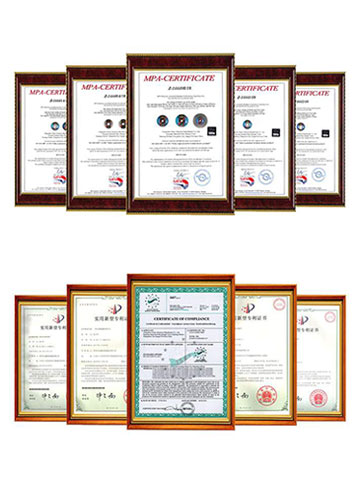
Third-party safety certificates support regulatory compliance in export markets.
For buyers, the practical request is simple: ask suppliers for the certificate number and the issuing body on the product's declaration of conformity, and verify that the standard matches the destination market.
What Makes a Manufacturer Reliable for Long-Term Supply?
A cutting disc's quality can vary noticeably between production batches, and that inconsistency is one of the main reasons buyers switch suppliers. Evaluating a manufacturer's production system is therefore part of the selection process.
CNDOME operates a temperature- and humidity-controlled workshop covering more than 20,000 square meters, equipped with 60 automated production lines. Its daily output is about 600,000 pieces, and its annual production capacity is 95 million pieces. The company employs approximately 140 staff and has an R&D team of 10 engineers. More than 2,000 global tool and abrasive wheel brands have used CNDOME's customized OEM and ODM services.
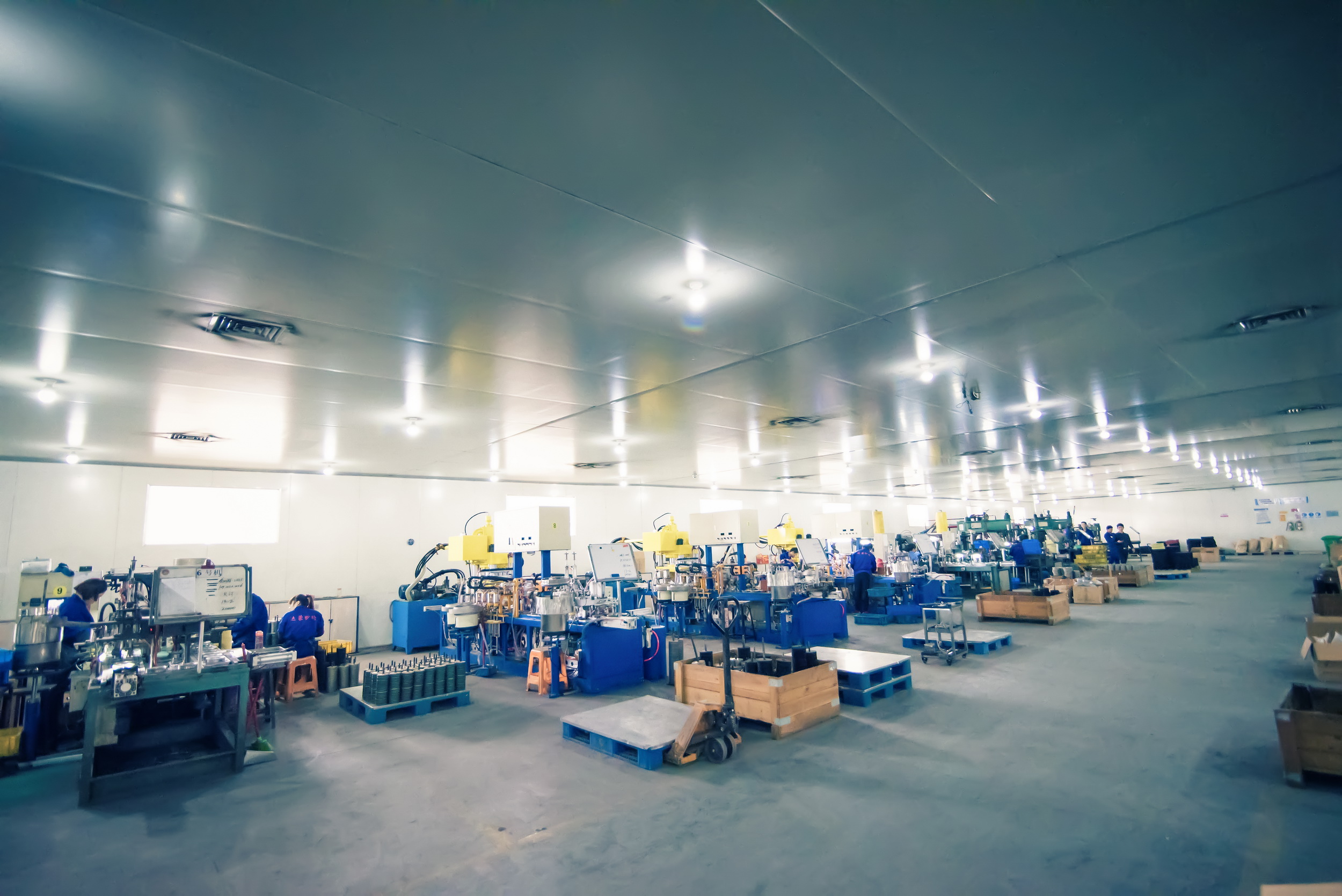
Automated production lines help maintain consistent disc quality at high output volumes.
These figures matter because resin-bonded abrasive production is sensitive to raw material consistency, curing conditions, and process control. A manufacturer that controls workshop temperature and humidity is better positioned to deliver repeatable performance across batches.
Cutting Disc Options at a Glance
The table below compares the main product families discussed in this guide.
| Product Family | Typical Shape | Material System | Max Speed | Main Function |
|---|---|---|---|---|
| Cutting disc 1.5–9 inch | T41 / T42 | Aluminium Oxide, White Aluminium Oxide, resin | 80 m/s | Cutting metal and stainless steel with portable grinders |
| Cutting disc 14–16 inch | T41 | Aluminium Oxide, White Aluminium Oxide, resin | 80 m/s | Cutting steel, castings, and profiles with stationary machines |
| 7 inch reinforced cutting disc | T41 | Aluminium Oxide, White Aluminium Oxide, Silicon carbide, Zirconium, resin | 80 m/s | Demanding metal and stainless steel cutting |
| Grinding disc 4–9 inch | T27 | Aluminium Oxide, White Aluminium Oxide, resin | 80 m/s | Surface grinding of metal |
| Ceramic grinding disc | T29 | Ceramic sandpaper, reinforced fiber cover plate | 100 m/s | High-speed grinding of metal and INOX |
Frequently Asked Questions
Are CNDOME cutting discs certified for the European market?
Yes. CNDOME cutting disc model 180x1.6x22.23 is CE certified under EN 12413, with certification number M.2022.206.C74459 issued by UDEM. The certification covers cutting disc and grinding wheel products for the global market. The European safety standard EN 12413:2019 defines safety requirements and testing procedures for rotating bonded abrasive products, and independent bodies such as MPA Hannover perform testing and certification for abrasive tools.
What materials are used in CNDOME cutting discs?
Most CNDOME cutting discs are manufactured from Aluminium Oxide, White Aluminium Oxide, and resin. The 7 inch cutting disc also contains Silicon carbide and Zirconium. Ceramic grinding discs use ceramic sandpaper and a reinforced fiber cover plate. Material choice affects cutting speed, heat resistance, and wheel life on different metal grades.
What is the difference between T41 and T27 disc shapes?
T41 is a flat shape used on cutting discs designed to slice through a workpiece. T27 is a depressed-center shape used on thicker grinding wheels designed for surface grinding. T29 is a conical grinding disc shape used for aggressive grinding. The shape determines how the disc distributes pressure during operation.
What maximum operating speed should a buyer look for?
Most conventional CNDOME cutting discs and grinding wheels are rated for a maximum operating speed of 80 m/s. The ceramic grinding disc for metal/INOX has a maximum operating speed of 100 m/s. Rated speeds vary by diameter: for example, a 2 inch cutting disc is rated at 30100 RPM, a 4.5 inch disc at 13300 RPM, and a 16 inch disc at 3800 RPM. Buyers should always compare the disc's rated speed with their tool's maximum RPM.
Can I request samples and a quotation before placing a bulk order?
Yes. CNDOME supports global distributors, tool brands, and OEM/ODM customers with samples and quotations. To start, contact Chris at chris@czdome.com, call or WhatsApp +86 18796960868, or view the company brochure at https://cdn.socialarks.com/sbsp/24879/common/2026/0519/6a0c1596e4f3c.pdf. The factory is located in Garden Industrial Park, Zhenglu Town, Tianning District, Changzhou, Jiangsu, China.
Conclusion
Choosing a cutting disc does not require guessing. Once a buyer can identify the workpiece material, define the operation as cutting or grinding, match the disc diameter and bore to the tool, confirm the maximum speed rating, and verify the applicable safety certification, most selection errors are eliminated before they enter the workshop.
For buyers evaluating suppliers for metal and stainless steel cutting, the CNDOME product range covers cutting discs from 1.5 inch to 16 inch, grinding discs from 4 inch to 9 inch, reinforced models for demanding cutting work, and ceramic grinding discs for high-speed grinding. The manufacturing facility in Changzhou, Jiangsu, China supports long-term supply with automated production and a service history of more than 2,000 global abrasive brands.
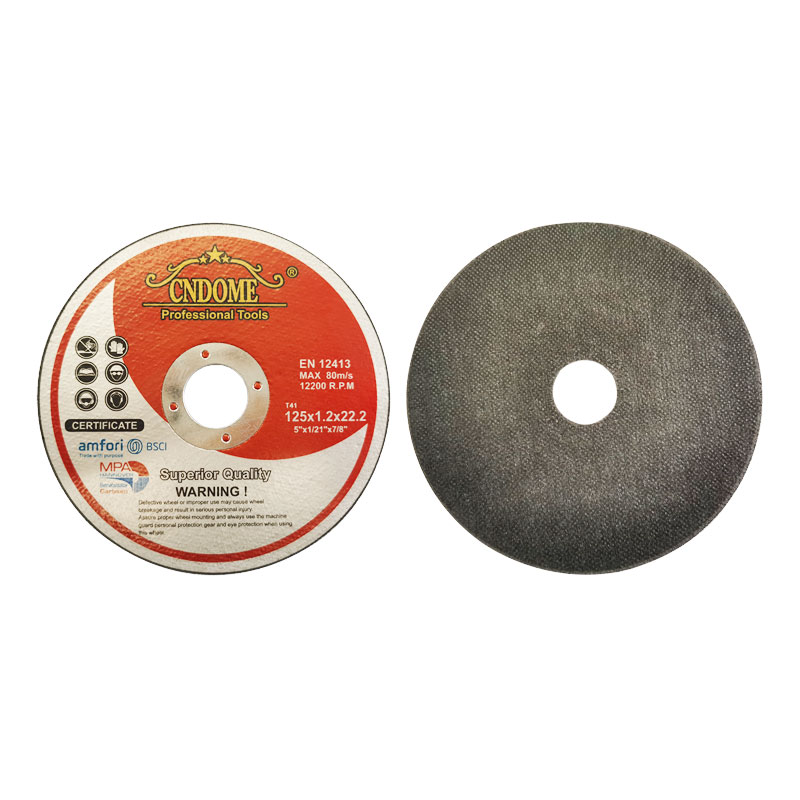
Request the CNDOME brochure for full product specifications and available sizes.
Download the brochure or contact Chris at chris@czdome.com to discuss sample orders and OEM requirements.
Have Questions or Need More Details?
Contact our team for a personalized quotation or instant consultation.
Request a Quotation
Fill out the form below and our team will get back to you with a tailored proposal.
WhatsApp Direct Chat
Prefer to chat in real-time? Message us on WhatsApp for instant assistance & quick answers.
- Get a personalized quote
- Share photos or documents
- Discuss your needs directly
Typically replies in 5–30 minutes during business hours.