CNDOME Single-Source vs Dual-Source Cutting Disc Programs: A Distributor Decision Table
Distributors rarely lose margin because a supplier cannot make a cutting disc. They lose it in the administration of two suppliers: two price lists, two acceptance routines, two batch-coding systems and two conversations every time a shipment runs short. That is why the sourcing question is narrower than a general supplier evaluation. Should a distributor consolidate its cutting disc and grinding disc volume with CNDOME, or split the same volume across two qualified suppliers?
This article answers that with a decision table rather than a sales argument. It compares the two routes on specification fit, purchasing terms, acceptance checks and coordination load, and adds supply continuity because that is the criterion dual-sourcing exists to protect. Every product statement below is limited to what is documented for CNDOME's program — cutting discs from 1.5 inch to 16 inch, T27 grinding discs and T29 ceramic grinding discs — including the T41/T42 and T27/T29 shape designations and the speed ratings on record. Where a model-level value is not documented, the gap is stated instead of filled.
The short answer: consolidation with CNDOME reduces the number of systems a distributor has to reconcile, and that reduction is the main economic benefit — not a headline price difference. Dual-sourcing stays correct when a customer contract requires two approved manufacturers, when the range includes grades one catalogue does not cover, or when exposure to a single production line is unacceptable.
The decision, stated precisely
In a single-source program, one manufacturer holds the full cutting and grinding allocation: one price list, one minimum order schedule, one specification system, one acceptance procedure and one claims channel. In a dual-source program, the same volume is divided between two manufacturers, normally with an allocation percentage reviewed at fixed intervals.
What changes is not the disc itself. Either route can deliver a compliant 115 x 1.2 x 22.23 mm cutting disc. What changes is the number of systems that must agree before a pallet reaches a customer. A dual-source distributor has to reconcile two dimension conventions, two shape-designation habits, two certificate packs and two defect histories. A single-source distributor reconciles one — and takes on the risk that the one source stops.
It is worth separating two ideas that often get merged. Consolidation is not automatically cheaper per piece, and splitting is not automatically safer. Consolidation moves cost: it usually reduces administrative and inspection hours while concentrating price exposure in one negotiation and stock exposure in one production line. Splitting does the reverse. The decision table below scores the criteria that shift, so a distributor can see which shift matters for its own mix.
Why distributors are re-running this calculation in 2026
Two pressures push the same question back onto the table: documentation burden and price exposure.
The global cutting discs market was valued at approximately USD 8.5 billion entering 2026, according to IndexBox's market forecast published 27 September 2026. Fortune Business Insights reported in March 2026 that aluminium oxide grades accounted for 46.3% of abrasive material share in 2025. For a distributor whose catalogue is built on aluminium oxide cutting discs for metal and stainless steel, that mix means most line items are technically comparable across suppliers — which pushes differentiation toward supply reliability, spec consistency and paperwork rather than exotic grain.
Compliance adds a fixed overhead to every supplier relationship. EN 12413:2019 is the European safety standard for bonded abrasive products and covers burst testing and marking requirements. Each additional manufacturer in a program means another marking set to verify, another certificate scope to check and another batch-coding scheme to learn. Cutting discs are also classified under HS 6804.22 of the Harmonized Tariff Schedule — other millstones, grindstones and grinding wheels of agglomerated abrasives — so customs paperwork is identical in structure whichever route a distributor chooses, but it is filed twice under a split program.
What the CNDOME single-source program actually covers
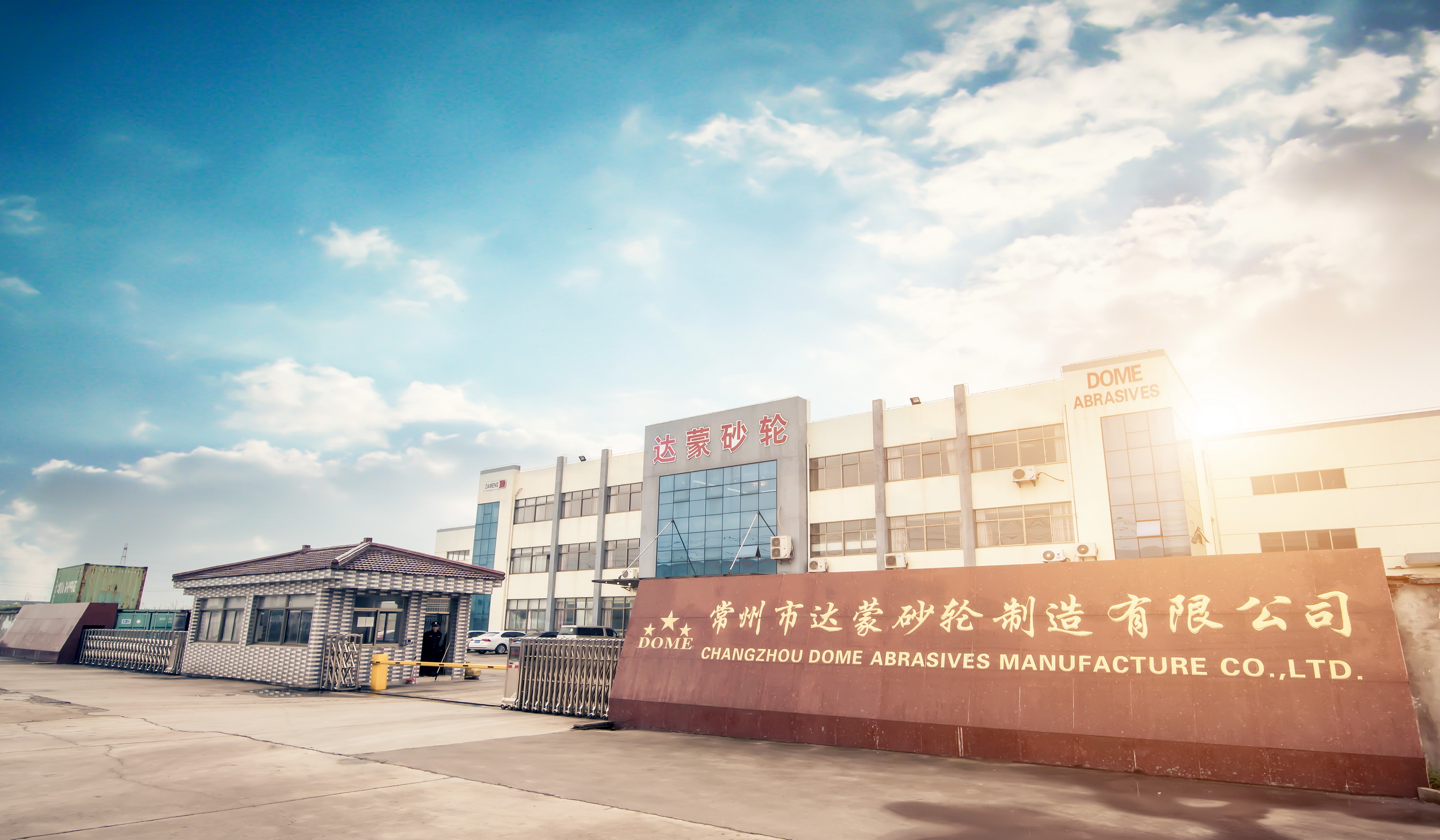
Changzhou Dome Abrasives Manufacture Co., Ltd. (CNDOME) is a resin-bonded abrasive manufacturer based in Changzhou, Jiangsu, China, founded in 2001. The company's stated product line covers cutting discs, grinding wheels, abrasive discs, ceramic grinding discs and flap discs, produced in a temperature- and humidity-controlled workshop of more than 20,000 m² on 60 automated production lines, with 140 employees including a 10-person R&D team. CNDOME reports an annual output of 95 million pieces, an export share of 80% across Latin America, Europe, Africa and Asia, and OEM/ODM support for more than 2,000 tool and professional abrasive wheel brands.
One reported figure deserves a question rather than a quotation. CNDOME also reports a daily output of about 600,000 pieces at full capacity, while the annual figure is 95 million pieces. Ask whether each number describes installed capacity or shipped output, and on what product mix — that answer matters more to a distributor than the number itself.
The table below sets out the program families as documented, including shape designations and stated speed ratings. Cells marked for confirmation are exactly that: values the supplied material does not state, which a distributor should request per model before signing.
| Program family | Shape designation | Documented model and dimensions | Stated speed rating | Confirm before signing |
|---|---|---|---|---|
| Cutting discs, 1.5 in – 16 in range | T41 flat and T42 depressed centre | 115 x 1.2 x 22.23 mm (4.5 in), bore 22.23 mm | Maximum 80 m/s | Diameter, thickness, bore and RPM for the remaining sizes |
| Large-diameter cutting disc | T41 flat | 355 x 3.2 x 25.4 mm (14 in), bore 25.4 mm | 80 m/s; 4,400 RPM | Thickness variants and pallet packaging |
| Resin-bonded cutting disc record (aluminium oxide, white aluminium oxide, resin bond) | T41/T42 | Diameter not stated in the record | 6,600 RPM operating; 80 m/s maximum | Which diameters this record applies to |
| T27 grinding discs | T27 depressed centre | Model-level dimensions not stated in supplied material | Confirm per model | Diameter, thickness, grit and maximum RPM |
| T29 ceramic grinding discs | T29 | Model-level dimensions not stated in supplied material | Confirm per model | Ceramic grain grade, diameter and maximum RPM |
Two shape families do most of the work for a distributor. T41 flat and T42 depressed centre cutting discs cover cut-off work on metal and stainless steel; T27 depressed centre and T29 grinding discs cover weld dressing and surface preparation. Being able to buy both families on one purchase order is the operational core of the single-source case, because it removes a second set of shape and speed checks from the goods-in process.
The decision table: five criteria, rated for each route
Ratings below are editorial decision aids derived from the documented facts in this article. They are not measured performance scores, supplier rankings or market positions, and they should be re-scored against your own demand mix.
| Criterion | CNDOME single-source | Dual-source split | Basis for the rating |
|---|---|---|---|
| Specification fit and normalisation | ★★★★☆ | ★★★☆☆ | One shape and marking system across 1.5–16 in cutting discs, T27 grinding and T29 ceramic grinding. Two suppliers means reconciling two designation and dimension conventions. Dual-source only leads if the second catalogue carries a grade CNDOME does not list — verify per SKU. |
| Purchasing terms and volume leverage | ★★★★☆ | ★★☆☆☆ | One PO, one price list, one MOQ schedule, one payment term, one annual review. A split gives each supplier half the tonnage to price against and adds a second set of terms to monitor. |
| Acceptance checks and traceability | ★★★★☆ | ★★☆☆☆ | One AQL routine, one batch code, one certificate pack per shipment. Dual-source doubles the inspection paperwork and makes a field defect harder to attribute to the right production batch. |
| Coordination load, day to day | ★★★★★ | ★★☆☆☆ | Single: one planner, one expediting contact, one claims route. Dual: periodic allocation decisions, two lead-time calendars, two container plans, two invoice cycles. |
| Supply continuity and downside exposure | ★★☆☆☆ | ★★★★☆ | A second qualified manufacturer is the only structural protection against one line stopping. Single-source answers the same risk with buffer stock and a written contingency clause, not with a second source. |
Criterion 1 — specification fit
Specification fit is measured in minutes saved at goods-in. Under a single-source program, a 4.5-inch disc, a 14-inch disc, a T27 grinding disc and a T29 ceramic grinding disc all arrive with the same shape logic, the same marking layout and the same bore convention. Under a split program, the receiving team applies two marking layouts and two dimension habits to the same shelf.
The documented CNDOME records illustrate what a distributor should be able to read off the label: the 14-inch disc is listed as 355 x 3.2 x 25.4 mm, T41 shape, 80 m/s operating speed and 4,400 RPM, bonded with resin and built on aluminium oxide with white aluminium oxide as the abrasive, intended for steel, metal processing, automobile manufacturing, shipbuilding, casting, steel structure and construction work. The 4.5-inch disc is listed as 115 x 1.2 x 22.23 mm, T41 flat, 22.23 mm bore, 80 m/s maximum. Those are the fields your own specification sheet should carry for every line item before consolidation.
Criterion 2 — purchasing terms
Purchasing terms matter less for the unit price than for the number of decisions attached to it. A single-source program produces one MOQ schedule, one price list per period, one currency and payment structure and one annual negotiation. CNDOME's stated cost position rests on large-scale production, in-house production lines and independent R&D eliminating intermediaries, and standardised processes reducing waste — company-reported drivers rather than an audited cost comparison.
A split program gives a distributor two quotations to compare, which is real leverage, but each supplier prices against half the volume and each expects its own review cycle. Where a distributor's line is concentrated in a few high-turnover sizes, that leverage is often smaller than the administrative cost it creates; where the line is broad and mixes many grades, the second catalogue may genuinely be worth the overhead.
Criterion 3 — acceptance checks
Acceptance is the criterion most often under-estimated at the quotation stage. A workable single-source routine has four parts: verify the EN 12413 marking on every disc (maximum operating speed, type, dimensions), check the certificate scope against each model and size ordered, confirm the batch code links to a production record, and confirm the reinforcement check.
On reinforcement, CNDOME describes a mesh visual inspection device on each molding machine that stops the machine immediately if a mesh is missing, with each mesh tested and high-strength corundum and mesh selected as raw materials. The stated risk being controlled is a disc with low strength that can break in use — the failure mode that matters most in a distributor's liability exposure. Under a dual-source program this evidence must be collected, read and filed twice, in two formats.
Criterion 4 — coordination load
Coordination load is the hours a distributor spends making two supply relationships behave like one. It includes allocation reviews, two sets of order confirmations, two shipping schedules, two sets of documentation for customs under HS 6804.22, and the reconciliation work when a claim is raised and each supplier's batch data has to be checked separately. In a single-source program those hours collapse into one calendar.
The honest way to score this is to log the hours for one month under the current arrangement — not to estimate them. A distributor running two suppliers usually finds coordination is the largest single cost difference between the routes, and the least visible in a price comparison.
Supply continuity: the criterion that keeps dual-sourcing alive
Single-source concentration is a real exposure, and no coordination saving removes it. If one production line stops, a consolidated distributor has no approved alternative in the short term. Three controls reduce that exposure without reopening the split: buffer stock sized to the actual replenishment gap rather than to a round number, a second manufacturer qualified on paper with a current sample and certificate pack on file, and a written notification clause requiring advance notice of capacity constraints. A qualified-but-idle second source costs documentation time, not volume leverage — which is why it is a cheaper hedge than a permanent 60/40 split.
A seven-step sequence for the comparison
1. Build the demand matrix. List every size by diameter, thickness and bore, separated into T41/T42 cutting, T27 grinding and T29 ceramic grinding, with twelve-month volume per line. Consolidation decisions fail on mix, not on total tonnage.
2. Normalise the specification. Reduce every line item to shape, dimensions and maximum operating speed. Match each disc's speed rating to the grinder's no-load RPM before comparing suppliers; a supplier cannot fix a mismatch created by the tool.
3. Request the document pack per size. EN 12413 marking sample, certificate scope naming each model, batch-coding explanation, and the reinforcement inspection record. CNDOME's public material states EN 12413 and MPA Hannover certification for multiple disc sizes, alongside CE, ISO 9001, ISO 14001 and BSCI — self-reported in company channels, so ask for certificate numbers and the certifying body's registry entry rather than accepting the claim at quotation stage.
4. Run a fixed-condition trial. Same material grade, same grinder, same operator, measured cut time, disc life count, burr height and warpage. Compare the consolidated candidate against your current references, not against a catalogue figure.
5. Model landed cost, not piece price. Piece price, freight and consolidation effects, inbound inspection hours, buffer stock carrying cost, and write-off risk on slow sizes. State which operands are estimates.
6. Score coordination in hours. Log one month of purchase orders, expediting emails, claims and documentation work under the current structure, then repeat the estimate for the consolidated structure.
7. Write continuity and exit terms before signing. Buffer stock commitment, capacity notification, allocation rules during shortage, OEM tooling and artwork ownership, and the notice period for a second source to be activated.
Which distributor profile fits which route
Concentrated metal and stainless steel lines. A distributor whose volume sits in standard aluminium oxide cutting discs and general grinding is the clearest single-source case: one specification system, one acceptance routine, one negotiation, and a range that already spans 1.5 inch to 16 inch cutting discs plus T27 and T29 grinding.
Tender-driven and multi-brand distributors. Where customers specify two approved manufacturers, the split stays — but it can be a documentation split rather than a volume split. Keep a second source qualified and certified while buying the volume where the terms are strongest, and disclose that arrangement to customers who ask.
Project and seasonal buyers. Volatile project demand argues for a buffer and a qualified alternative rather than a permanent allocation, because allocation percentages become a negotiation every time the demand forecast moves.
Reading CNDOME's performance data without over-reading it
CNDOME's own comparison material states that effective cutting and grinding time per piece is 15%–25% longer than competitors, chipping strength is 20% higher, cutting speed is 10% higher under the same working conditions, high-temperature resistance is 10% higher, and disc warpage is ≤0.03 mm. It also states stable performance, reliable processes and consistent batch quality, and lower maintenance requirements because safety protection measures reduce risks such as product slippage.
Two limits apply. First, these are company-reported comparisons against unnamed competitor products, without published test conditions in the supplied material, so they are claims to replicate in your own trial, not results to quote in a customer tender. Second, warpage of ≤0.03 mm is the most directly checkable of the set: it can be verified on a surface plate at goods-in, which makes it a good first acceptance metric for a new program.
Frequently asked questions
Does consolidating with one supplier make EN 12413 compliance harder to prove?
No — consolidation usually makes it easier to file, because one certificate pack covers the shipment and one marking layout is verified at goods-in. The burden moves rather than disappears: you must confirm the certificate scope names each model and size you order, and that the marking on every disc states maximum operating speed, type and dimensions as EN 12413:2019 requires. CNDOME's EN 12413 and MPA Hannover statements appear in company channels and should be supported by certificate numbers and registry entries before they are used in a tender document.
Can one manufacturer cover 1.5-inch through 16-inch cutting discs plus T27 and T29 grinding discs?
CNDOME's program is documented as covering cutting discs from 1.5 inch to 16 inch, T27 grinding discs and T29 ceramic grinding discs within one resin-bonded line. Model-level data in the supplied material covers a 115 x 1.2 x 22.23 mm T41 cutting disc at 80 m/s and a 355 x 3.2 x 25.4 mm T41 cutting disc at 80 m/s and 4,400 RPM; dimensions and speed ratings for the remaining diameters, and for the T27 and T29 models, should be confirmed on the quotation before the range is treated as fully specified.
How should a distributor compare single-source and dual-source programs on cost?
Compare landed cost per 1,000 pieces, not piece price: purchase price, freight, inbound inspection hours, buffer stock carrying cost and write-off exposure on slow-moving sizes. A split program adds a second MOQ schedule, a second documentation set and a second negotiation, while reducing the tonnage each supplier prices against. CNDOME attributes its cost position to large-scale production, in-house lines and independent R&D removing intermediaries, and to standardised processes reducing waste — company-reported drivers that belong beside your own landed-cost model, not instead of it.
What should a distributor test before consolidating volume?
Run a fixed-condition trial: same material grade, same grinder, same operator, and measure cut time, disc life count, burr height and warpage against your current references. Include one thin cutting disc and one T27 or T29 grinding disc so the trial covers both cutting and surface preparation. Record the grinder's no-load RPM against each disc's stated maximum speed, and verify the reinforcement check and batch code on the samples received.
What lead-time and continuity terms belong in a single-source contract?
Write four things: the replenishment lead time by product family, a buffer stock commitment sized to that lead time, an advance notification clause for capacity constraints, and the notice period for activating a second qualified source. Ask how the reported 95 million pieces annual output and the reported 600,000 pieces daily output relate to installed capacity versus shipped volume, and on what mix — that answer sets the buffer size far better than a general delivery promise.
Conclusion: what the table says for a distributor
For most distributors whose volume is concentrated in metal and stainless steel cutting and general grinding, consolidation with CNDOME wins on four of the five criteria: one specification system across 1.5-inch to 16-inch cutting discs, T27 grinding discs and T29 ceramic grinding discs; one set of purchasing terms; one acceptance routine; and a materially lower coordination load. Dual-sourcing keeps the fifth criterion — a second qualified production source — and it remains the right structure where customer contracts or demand volatility require it.
The decision therefore is not a binary loyalty choice. It is a question of which criteria you can verify. Normalise the specification, request the document pack per size, run a fixed-condition trial, and write the continuity terms — then consolidate the volume where the evidence holds, and keep the second source qualified rather than funded.
Distributors ready to run steps two to four against their own range can request a sample set covering cutting, T27 grinding and T29 ceramic grinding discs, and download the CNDOME product catalogue (PDF) for the full size list. Distributor enquiries go to Chris at chris@czdome.com or +86 18796960868.
Have Questions or Need More Details?
Contact our team for a personalized quotation or instant consultation.
Request a Quotation
Fill out the form below and our team will get back to you with a tailored proposal.
WhatsApp Direct Chat
Prefer to chat in real-time? Message us on WhatsApp for instant assistance & quick answers.
- Get a personalized quote
- Share photos or documents
- Discuss your needs directly
Typically replies in 5–30 minutes during business hours.