
CNDOME Cutting Disc Supplier Evaluation: A Buyer's Checklist
A cutting disc supplier is worth shortlisting when it can prove four things with documents rather than adjectives: that its process is controlled, that its size range covers your order, that its certificates are valid for the exact discs you are buying, and that delivery, minimum order quantity and acceptance terms are in writing. This guide converts those tests into a five-criterion checklist and uses CNDOME as the worked example, so you can see what complete evidence looks like — and which parts still require confirmation before you sign.
CNDOME is the cutting disc and abrasive wheel brand of Changzhou Dome Abrasives Manufacture Co., Ltd., a resin-bonded abrasives manufacturer founded in 2001 in Changzhou, Jiangsu, China. The company reports a 20,000 m² temperature- and humidity-controlled workshop, 60 automated production lines, 140 employees, a 10-person R&D team and annual output of 95 million pieces, with roughly 80% of sales exported to Latin America, Europe, Africa and Asia. Every CNDOME figure in this article comes from the company's supplied records; third-party market figures are attributed to their publishers, and a later section sets out what those records do not prove.

Why supplier evaluation fails after the first order
Price compares easily; repeatability does not. Three failure modes account for most of the cost that appears after a cutting disc order is placed, and none of them can be detected from a catalogue page alone.
- Specification drift. A 22.23 mm bore disc does not fit a tool built for a 32 mm bore, and a T41 flat disc does not perform the same role as a T42 depressed-centre disc in the same diameter. Orders that quote only “4.5 inch cutting disc” leave the bore, thickness and shape to the supplier's default.
- Delivery drift. Lead time, MOQ and Incoterms are usually stated in different documents, and the arithmetic between them is rarely checked until a production line is waiting.
- Certificate drift. A valid certificate for one disc size is not a certificate for every disc size, and a certificate that expires between order and arrival is not a compliance document at all.
The three are connected through one number. The discs in the CNDOME record set carry a stated maximum operating speed of 80 m/s, and the rpm marked on a 230 mm disc (6,600 rpm) or a 400 mm disc (3,800 rpm) is simply that surface speed converted for the diameter. When diameter, rpm and stated speed do not agree, at least one of the three is wrong — which is why the arithmetic check appears in the first step of the evaluation sequence below.
The 2026 market context that makes verification the bottleneck
The global cutting disc market is valued at approximately USD 8.5 billion entering 2026, according to IndexBox (source dated 27 September 2026). Fortune Business Insights reports that Asia-Pacific held a 44.7% revenue share of the wider abrasives market in 2025, and that aluminium oxide accounted for 46.3% of the material market in the same year. Both figures describe the market, not any individual supplier.
Read together, they support one practical conclusion for a buyer at the evaluation stage: the manufacturing depth you are likely to shortlist sits in Asia-Pacific, so supplier discovery is rarely the constraint. Verification is. That is also why the compliance layer matters more than the brochure. EN 12413 is the European safety standard for bonded abrasive products and is recorded as covering burst testing and marking requirements. A 2026 manufacturer catalogue reviewed for this article (NovoAbrasive) describes EN 12413 as defining maximum operating speeds, mechanical strength requirements, eleven mandatory marking elements and testing procedures — a manufacturer-published summary, useful as orientation rather than as a regulatory citation.
Customs documentation is the third layer. Cutting discs fall under HS code 6804.22 in the Harmonized Tariff Schedule maintained by the US International Trade Commission — “other millstones, grindstones, grinding wheels of other agglomerated abrasives or ceramics”. A supplier whose commercial invoice, packing list and certificate of origin do not consistently describe the goods against that classification creates clearance risk that no price advantage offsets.
The five-criterion scorecard
The table below is the condensed version of this article. It states what evidence earns a full score, where CNDOME's records place it, and the specific document a buyer should request in order to test that score independently. The rating column measures the strength of the supplied documentation for that criterion; it is not a market ranking, and it is capped below full marks wherever the evidence remains company-reported.
| Criterion | What earns a full score | CNDOME documented position | Rating | Record to request |
|---|---|---|---|---|
| 1. Production process control | Controlled environment, automated lines, named QC method, stated capacity | 20,000 m² temperature- and humidity-controlled workshop; 60 automated lines; 100% AI Visual Comparison Testing; 8 million pieces per month | ★★★★☆ 4.5 / 5 | Line allocation and QC plan for your SKU |
| 2. Specification breadth | Model-level sizes across your diameter band, with shape, bore and speed | Cutting discs documented from 76 mm to 400 mm; T41 and T42 shapes; 80 m/s; bores 22.23 mm and 32 mm | ★★★★☆ 4.5 / 5 | Size list with model codes for your size band |
| 3. Safety certification | Named certificates with numbers, scope and current validity | MPA Hannover EN 12413 Z-numbers, CE (UDEM), ISO 9001, ISO 14001, BSCI — full table below | ★★★★☆ 4.5 / 5 | Certificate PDFs matched to the size you are buying |
| 4. Delivery and commercial terms | Written lead time, MOQ by size band, Incoterms, acceptance test | 30-day lead time; MOQ 10,000 pieces (5,000 quoted above 4 inch); FOB/EXW; pre-shipment test; 30/70 payment | ★★★★☆ 4 / 5 | Signed quotation plus pre-shipment test plan |
| 5. Market and service evidence | Named customer programmes, export record, defined service route | 95 million pieces per year; ~80% export; 2,000+ brand customers; 24/7 online support and remote technical assistance | ★★★★☆ 4 / 5 | Reference contacts and service escalation route |
Criterion 1: production process control
Process control in bonded abrasives is largely a question of atmosphere and repetition. Resin-bonded discs are pressed and cured, and a workshop that holds temperature and humidity within a band produces a more repeatable cure than one that does not. CNDOME's records state a temperature- and humidity-controlled workshop of more than 20,000 m², 60 automated production lines, 140 employees and a 10-person R&D team.
Quality control is named specifically rather than described generically: 100% AI Visual Comparison Testing. For a buyer, the useful question is not whether automated inspection exists but what it inspects — appearance, dimensions or both — and where the rejected pieces go. That question belongs in the RFQ, and the answer belongs in the acceptance plan.
Capacity needs to be read carefully, because the records quote three different figures. Annual output is 95 million pieces; monthly capacity is 8 million pieces; daily output is described as about 600,000 pieces when operating at full capacity. The annual and monthly figures are mutually consistent at roughly 7.9 million pieces per month. The daily figure is a full-capacity statement rather than a monthly average, so a buyer planning a large programme should ask for the capacity allocated to their specific diameter and thickness instead of dividing one headline number by another.

Criterion 2: specification breadth you can verify
Breadth is only useful when it is stated at model level. The CNDOME product records supply full designations rather than a diameter range, and the MPA certificate set labels sizes individually — together they document cutting discs from 76 mm to 400 mm, with 22.23 mm and 32 mm bores and T41/T42 shapes.
| Documented model | Nominal size | Bore | Shape | Speed rating |
|---|---|---|---|---|
| 115x1.2x22.23 | 4.5 in | 22.23 mm | T41 flat | 80 m/s |
| 180x1.6x22.23 / 180x2x22.23 / 180x3x22.23 | 7 in | 22.23 mm | Confirm per item | Confirm on disc marking |
| 230x2.0x22.23 / 230x2.5x22.23 / 230x3.0x22.23 | 9 in | 22.23 mm | T41 / T42 | 80 m/s, 6,600 rpm |
| 400x3.5x32 | 16 in | 32 mm | T41 flat | 80 m/s, 3,800 rpm |
The certification set widens the documented range further: MPA certificate records reference 76x1.2, 115x1.0, 115x1.2, 115x1.6, 125x1.0, 125x1.2, 180x1.6, 230x1.6, 230x2, 230x3, 300x3.2 and 355x3. A tool-supermarket case in the records describes a supplied range of 3 to 14 inches, which is consistent with that certificate coverage. Where a required diameter is smaller than 76 mm, or where the item is a grinding disc rather than a cutting disc, the size should be confirmed against the specific drawing — the portfolio also lists grinding wheels, abrasive discs, ceramic grinding discs and flap discs, but a portfolio name is not a dimensional commitment.
Cutting discs in these records are T41 or T42. Depressed-centre grinding wheel profiles such as T27 and T29 are separate shape designations within the same standard family; confirm the exact designation on the drawing and the certificate rather than inferring it from a product photograph. Material composition is stated for the 230 mm and 400 mm discs as aluminium oxide with white aluminium oxide and resin, which aligns with the material that holds 46.3% of the abrasives market by share — a market-level context figure, not a statement about any one disc's performance.
The rpm check. Maximum surface speed, diameter and rpm are three views of one limit. The conversion is n = 60 × v / (π × D), where v is the stated maximum speed in metres per second and D is the diameter in metres. Applying it at 80 m/s gives the ceilings below. These values are calculated from the supplied diameter and speed for verification purposes; they are not measured test results.
| Diameter | Calculated ceiling at 80 m/s | Documented rating | Result |
|---|---|---|---|
| 115 mm | ≈ 13,286 rpm | Confirm on marking | Open |
| 125 mm | ≈ 12,223 rpm | Confirm on marking | Open |
| 180 mm | ≈ 8,488 rpm | Confirm on marking | Open |
| 230 mm | ≈ 6,643 rpm | 6,600 rpm | Consistent |
| 300 mm | ≈ 5,093 rpm | Confirm on marking | Open |
| 355 mm | ≈ 4,304 rpm | Confirm on marking | Open |
| 400 mm | ≈ 3,820 rpm | 3,800 rpm | Consistent |
Run the same check against any competitive quotation. A disc offered at a higher rpm than the ceiling for its diameter, at a stated 80 m/s, is either mislabelled or intended for a different speed class — and either answer matters before the box is opened.
Criterion 3: safety certification — numbers, scope and expiry
Certificates are the easiest part of a supplier claim to verify and the easiest part to fake, which is why the checklist asks for numbers rather than logos. The CNDOME record set supplies certificate numbers, issuing bodies, standards and validity dates. The status column below reflects the position in November 2026.
| Certificate | Body | Number | Standard | Valid to | Status (Nov 2026) |
|---|---|---|---|---|---|
| MPA (76x1.2) | MPA Hannover | Z-15953A/26 | EN 12413 | 2028-01-26 | Current |
| MPA (230x1.6) | MPA Hannover | Z-15953B/26 | EN 12413 | 2028-01-26 | Current |
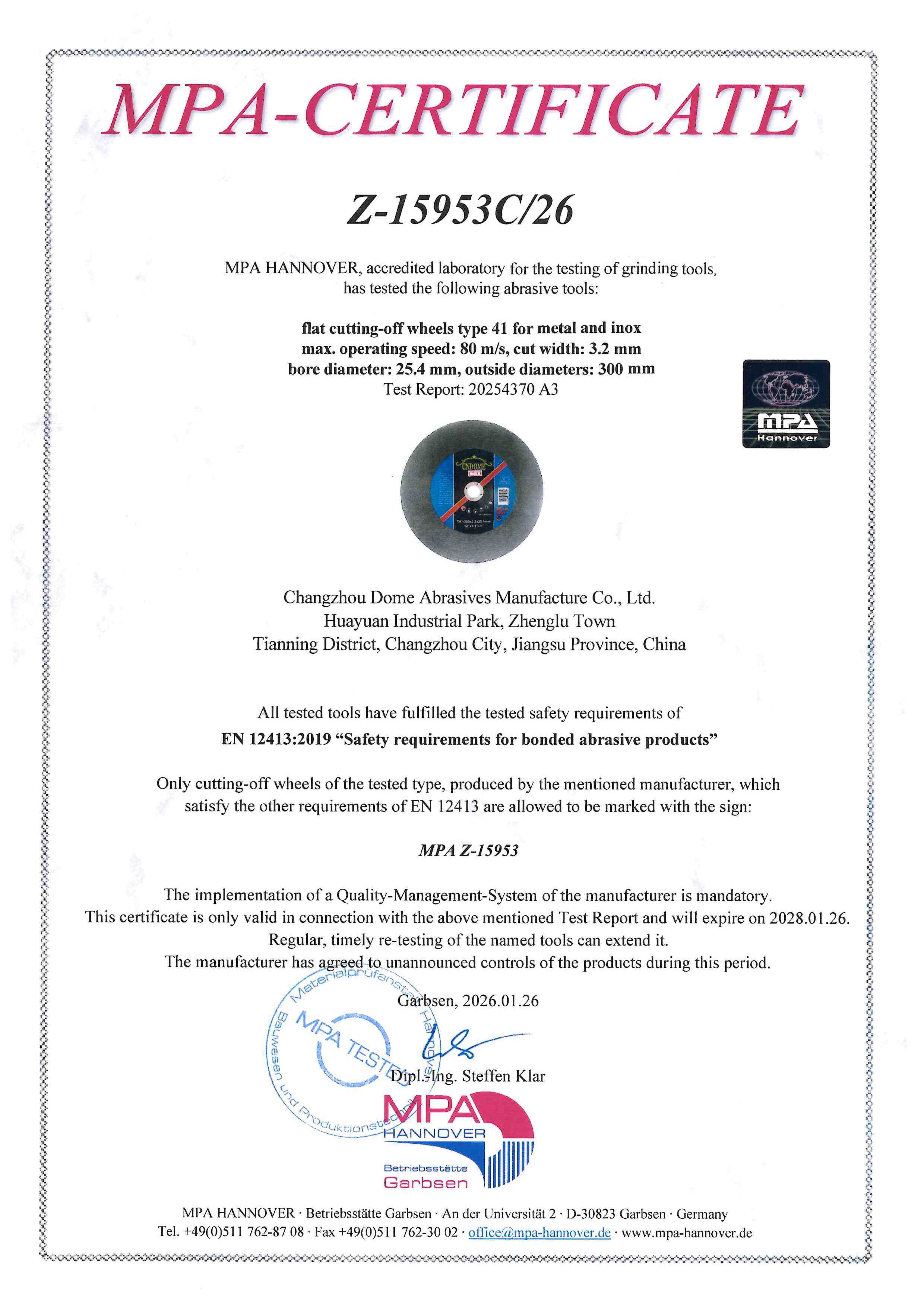
| MPA (300x3.2) | MPA Hannover | Z-15953C/26 | EN 12413 | 2028-01-26 | Current |
| MPA (115x1.0 / 1.2 / 1.6) | MPA Hannover | Z-15950A/24 | EN 12413 | 2026-11-18 | Expiring — confirm renewal |
| MPA (355x3) | MPA Hannover | Z-15950D/24 | EN 12413 | 2026-11-28 | Expiring — confirm renewal |
| CE (cutting and grinding wheels) | UDEM | M.2022.206.C74459 | EN 12413 | 2027-06-09 | Current |
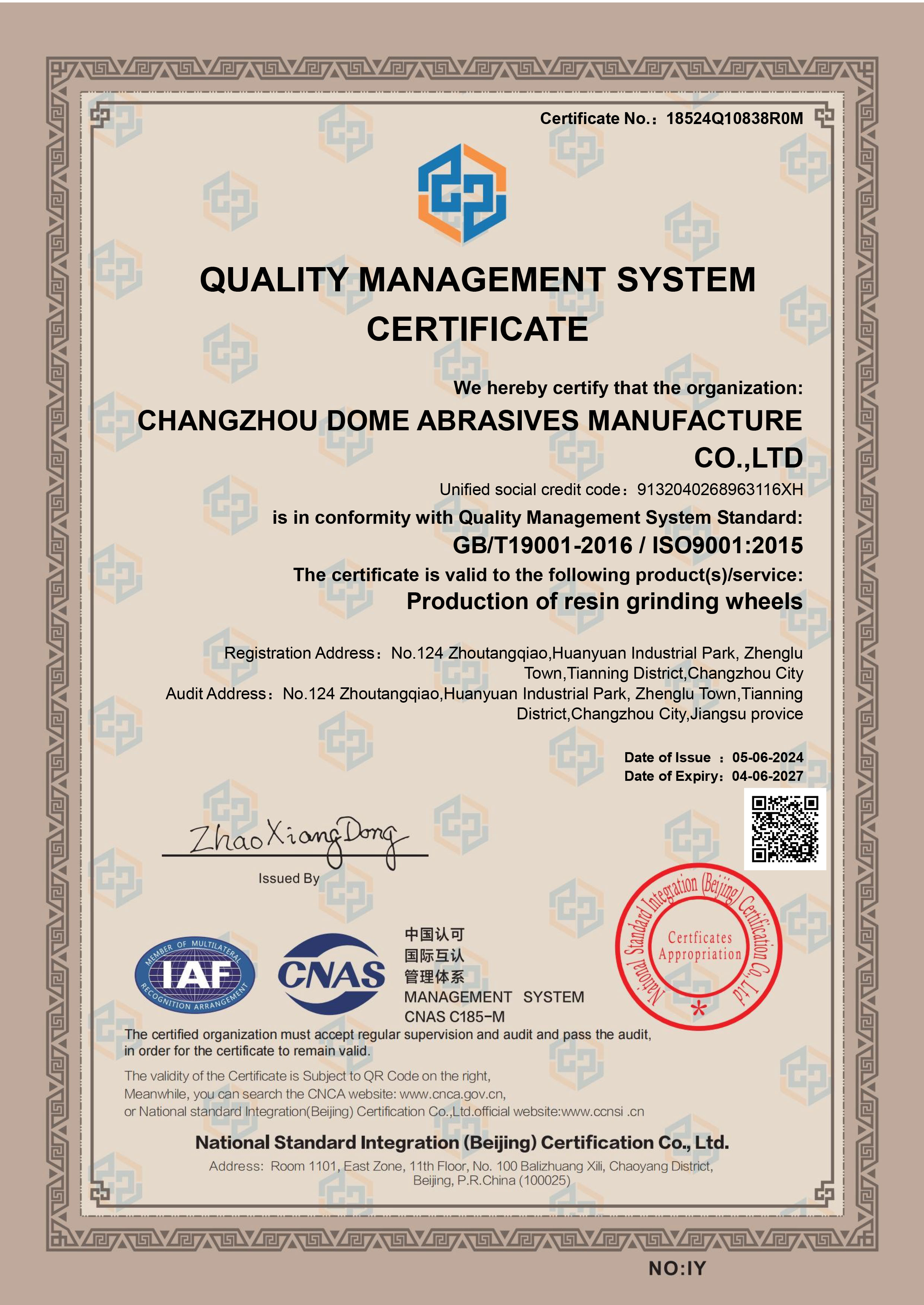
| ISO 9001 (resin grinding wheel production) | National Standard Integration (Beijing) Certification Co., Ltd. | 18524Q10838R0M | GB/T19001-2016 / ISO 9001:2015 | 2027-06-04 | Current |
| ISO 14001 | ZhongQiu United International Certification (Beijing) Co., Ltd. | 25024E11441R0M | GB/T24001-2016 / ISO 14001:2015 | 2027-12-19 | Current |
| BSCI (abrasive discs and hardware tools) | ALGI | 156-025464-001 | amfori BSCI Code of Conduct / SA8000 | 2027-10-16 | Current |
Two observations follow directly from the table. First, the most recent MPA entries were issued on 26 January 2026 and run to 26 January 2028, which gives a long verification window on 76x1.2, 230x1.6 and 300x3.2. Second, several MPA records — Z-15950A/24, Z-15950B/24 (125x1.2), Z-15950C/24 (230x2), Z-15951/24 (115x3 and 230x3), Z-14440A-1/24 (125x1.0) and Z-14440A-3/24 (180x1.6) — reach their expiry date on 18 November 2026, and Z-15950D/24 on 28 November 2026. A buyer placing an order in late 2026 should request the renewal certificates for those sizes before shipment, and should treat any supplier's undated certificate as unverified by default.
Scope is the second half of the check. A certificate covers the sizes and production it names. The BSCI record, for example, is scoped to “manufacturing of abrasive discs and related hardware tools”, while the ISO 9001 record is scoped to “production of resin grinding wheels”. Neither of those is a product-performance approval. EN 12413 marking is the product-level evidence, and a manufacturer statement reviewed for this material (Qing Yang, certifications page) describes the marking as carrying maximum operating speed, wheel type, dimensions and the MPA Z-mark where applicable. The disc in your sample box should carry the same information as the certificate in your file.
Criterion 4: delivery, MOQ and acceptance terms
Delivery commitments are only as good as the document that contains them. The CNDOME records state a monthly production capacity of 8 million pieces and a typical production lead time of 30 days. The purchase-terms record sets out FOB or EXW delivery terms, an acceptance criterion of pre-shipment testing, and payment of 30% prepayment with the 70% balance on delivery.
Minimum order quantity needs careful reading, because the records contain two statements. One states that custom cutting discs are available in quantities of 10,000 pieces or more; the purchase-terms record states 10,000 pieces for sizes under 4 inch and 5,000 pieces for sizes over 4 inch. The two are compatible if the second is read as a size-banded schedule, but they are not identical, so confirm the applicable threshold for each line of your order in the quotation rather than assuming a single number across the range.
Customisation depth affects the same timetable. CNDOME states OEM and ODM production with customisation of logo, label, packaging, abrasive formulation and specification. In the cross-border e-commerce case, 60 orders per year across China, Singapore, the US, Germany, Nigeria and South Africa are described with short customisation lead times and fast delivery — a service record from a 3-year relationship, not a contractual guarantee for a new buyer.
Criterion 5: market and service evidence
Market evidence is the criterion most often inflated and the one where the distinction between programme evidence and market share matters most. CNDOME's records support the first and not the second. Annual output is 95 million pieces, exports run at about 80% of sales into Latin America, Europe, Africa and Asia, and the company states long-term support to more than 2,000 global tool and professional abrasive wheel brands.
The case records add programme-level detail: a tool-supermarket channel in Mexico, the US and South America at 40 million pieces per year; a Brazilian tool-brand OEM at 10 million pieces per year; a South American stainless-steel processor at 500,000 pieces per year; an Asian machining-factory relationship at 30 orders per year supporting 24-hour production with stock described as ready to ship; and the e-commerce programme at 60 orders per year. Each is a 3-year relationship. Each is company-reported, and none of them is a market-share measurement.
Service is stated in operational terms rather than as a promise of quality: 24/7 online support and remote technical assistance. For an execution-stage buyer, the workable version of that claim is a named contact, a response route and a defined escalation point for a technical question about speed rating, bore or formulation. Ask for the route, not the slogan.

Running the evaluation in eight steps
The sequence below applies the five criteria in the order the evidence becomes available. It works for CNDOME and for any alternative quotation you place beside it.
- Lock the specification sheet. Record diameter, thickness, bore, shape (T41 flat or T42 depressed centre), stated maximum speed and material. Where the item is a grinding disc rather than a cutting disc, record its own shape designation.
- Check the arithmetic. Convert the stated maximum speed into an rpm ceiling for each diameter and compare it with the marking on the sample and the quotation. At 80 m/s, a 230 mm disc sits below ≈6,643 rpm and a 400 mm disc below ≈3,820 rpm.
- Match certificates to sizes. Ask which certificate number covers the diameter you are buying. A certificate for 300x3.2 does not cover a 115 mm disc.
- Check validity dates against your shipment date. A certificate expiring before the goods arrive needs its renewal in the file first.
- Match the marking to the certificate. Speed, dimensions, type and Z-mark on the disc should be readable and consistent with the paperwork.
- Confirm MOQ by size band and lead time in writing. Note the 30-day typical lead time and the size-banded MOQ, then map both against your own reorder cycle.
- Fix the acceptance test. Pre-shipment testing is the stated criterion; define what is tested, on which sample size, and who signs the report. Ask what the 100% AI Visual Comparison Testing covers.
- Re-verify at reorder. Certificate renewal, formulation changes and capacity reallocation all happen between orders. Repeat steps 3 to 5 at each renewal.
Matching the checklist to your buying role
Distributors and tool-supermarket buyers should weight Criterion 2 and Criterion 4 highest. A range that runs from 76 mm to 400 mm supports a single-supplier shelf, but shelf economics depend on the size-banded MOQ and on stock availability, both of which belong in the written terms.
Private-label and OEM brand owners should weight Criterion 3 and the customisation scope. Logo, label, packaging and abrasive formulation are all customisable, with a stated 30-day lead time and a 10,000-piece custom threshold; the certificate question still applies to the private-label disc, because the brand on the label does not change the certificate holder.
Fabrication and machining shops should weight Criterion 1 and the inventory record. Multi-specification demand supported by held stock is the relevant evidence for a workshop running continuous shifts; the 30-orders-per-year machining case describes exactly that pattern.
Stainless processors should weight the composition and consistency evidence. Aluminium oxide with white aluminium oxide and resin is the documented build for the larger discs in the range, and the stainless-pipe case at 500,000 pieces per year describes long disc life with no slag shedding as the operational outcome — a customer-reported result for that programme, not a guarantee across applications.
What this evaluation does not prove
A checklist is only honest if it states its limits. The records used here are company-supplied: capacity, output, customer programmes, customisation scope and after-sales arrangements are self-reported and were not independently audited for this article. The third-party figures describe the market, not CNDOME's share of it, and no audited market-share percentage is available for the company.
Two documentation gaps are worth naming. Several MPA certificates reach expiry in November 2026 and require renewal evidence before they can support a shipment in 2027. And the smallest documented cutting-disc size in the supplied records is 76 mm, while the grinding-disc diameters in the portfolio are not itemised; both should be confirmed against a drawing before an order is placed. Certification claims of the same type appear across the market — NovoAbrasive, for example, states that each disc is certified by MPA Hannover and complies with EN 12413 — which is precisely why a certificate number and a validity date, not a compliance sentence, are the unit of verification.
Frequently asked questions
Which certificates should I verify first when qualifying a cutting disc supplier?
Start with the product-level safety certificate for the exact size you are buying. For European supply that means the EN 12413 certificate — for CNDOME, the MPA Hannover Z-numbers such as Z-15953C/26 for the 300x3.2 disc, valid to 26 January 2028. Then check the management-system and social-compliance layer: CE (UDEM M.2022.206.C74459, valid to 9 June 2027), ISO 9001 (18524Q10838R0M, to 4 June 2027), ISO 14001 (25024E11441R0M, to 19 December 2027) and BSCI (156-025464-001, to 16 October 2027). Record the number and expiry date; a logo proves nothing.
Can one supplier cover both thin 4.5-inch discs and 16-inch discs?
Yes where the range is documented at model level. CNDOME's records cover 115x1.2x22.23 as a 4.5-inch T41 disc at 80 m/s and 400x3.5x32 as a 16-inch T41 disc at 80 m/s and 3,800 rpm, with intermediate sizes at 180 mm, 230 mm, 300 mm and 355 mm referenced in the product and certificate records. The practical caveat is that the bore changes with diameter — 22.23 mm for the smaller discs and 32 mm for the 400 mm disc — so both must be specified, not assumed.
What determines the cost of a custom cutting disc order?
The supplied records quote commercial terms rather than prices, so the cost structure has to be read from those terms: the MOQ band for the diameter (10,000 pieces stated for custom discs, with a 5,000-piece threshold quoted for sizes above 4 inch), the delivery basis (FOB or EXW), the payment split (30% prepayment, 70% balance on delivery), and the depth of customisation across logo, label, packaging, abrasive formulation and specification. Each of those changes the landed cost per piece. Ask for a quotation that itemises them rather than a single unit price.
How should I validate a sample before releasing mass production?
Test the sample against the specification sheet, not against the brochure. Check the marked diameter, thickness, bore, shape and maximum operating speed against the quotation and the certificate, and confirm the arithmetic at 80 m/s for that diameter. Confirm that the marking matches the certificate scope for that size. Then agree the acceptance method: the stated criterion is pre-shipment testing, supported in production by 100% AI Visual Comparison Testing. Define what is measured, how many pieces are drawn and who signs the report before the bulk run starts.
What lead time and delivery terms apply, and how do I keep them enforceable?
The records state a monthly capacity of 8 million pieces and a typical production lead time of 30 days, with FOB or EXW delivery terms and payment of 30% prepayment with the 70% balance on delivery. To make those enforceable, attach the size-banded MOQ, the 30-day lead time and the pre-shipment test report to the purchase order as annexes, and confirm which certificate number covers each line of the order. If you are building a first order around this framework, the CNDOME catalogue and specification set can be requested through the company's downloadable brochure, and a quotation request should name the exact model, the certificate number you expect to see, and your required shipment date.
Conclusion: the benchmark is a document set, not a claim
CNDOME's position against this checklist is strong on production control, specification breadth and certification depth: a 20,000 m² controlled workshop with 60 automated lines, 100% AI Visual Comparison Testing, documented discs from 76 mm to 400 mm at a stated 80 m/s, and a certificate set that includes MPA Hannover EN 12413 numbers running to January 2028 alongside CE, ISO 9001, ISO 14001 and BSCI. Its weaker points are the ones any buyer should press on: capacity and case quantities are company-reported, the size-banded MOQ is stated two ways, and several MPA certificates expire in November 2026.
That combination is exactly what a good benchmark should look like. It gives you a complete, checkable reference for every criterion — and a clear list of what still has to be confirmed — so that the next quotation you receive can be measured against documents rather than adjectives. For technical confirmation of a specific diameter, bore, shape or certificate, contact the CNDOME team at chris@czdome.com or +86 18796960868 before the order is released.
Have Questions or Need More Details?
Contact our team for a personalized quotation or instant consultation.
Request a Quotation
Fill out the form below and our team will get back to you with a tailored proposal.
WhatsApp Direct Chat
Prefer to chat in real-time? Message us on WhatsApp for instant assistance & quick answers.
- Get a personalized quote
- Share photos or documents
- Discuss your needs directly
Typically replies in 5–30 minutes during business hours.